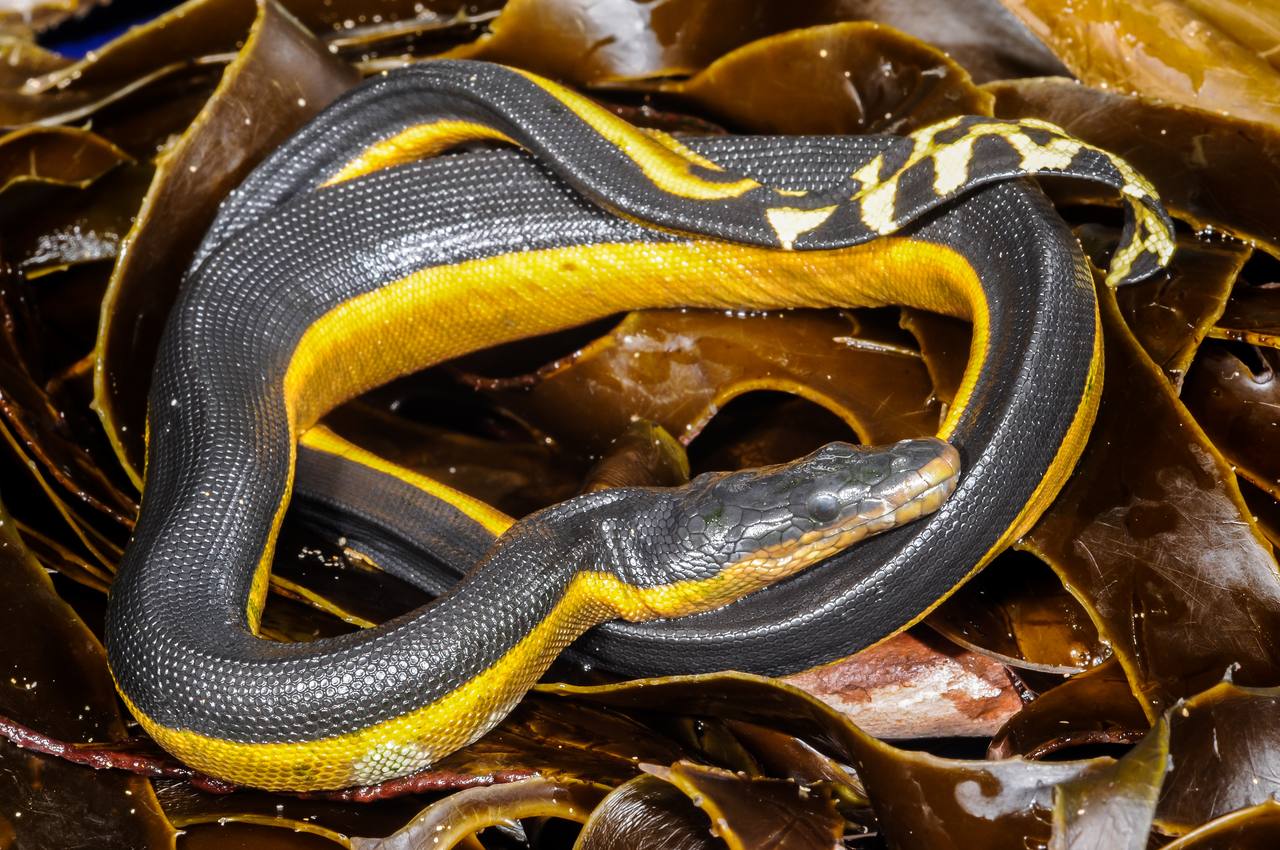
A rare and venomous yellow-bellied sea snake washed ashore at Bolsa Chica State Beach in Orange County on Sunday, November 22 — only the eighth of its kind ever recorded on the California coast, California State Parks said. The striking black-and-yellow reptile was found alive by park staff, and officials are warning beachgoers to keep their distance from any sea snake they find, even one that appears dead.
Source: California State Parks, Orange Coast District
The snake was discovered on the sand at Bolsa Chica, near Huntington Beach, and was later identified as a yellow-bellied sea snake (Hydrophis platurus), a highly venomous marine species with a glossy black back, a bright yellow belly and a flattened, paddle-like tail. It was alive when staff found it, but it appeared lethargic and was not expected to survive. It was collected by researchers from the San Diego Natural History Museum's Department of Herpetology, who are studying how such rare coastal encounters happen.
Only the eighth ever recorded
The find is exceptionally rare. Just eight yellow-bellied sea snakes have ever been documented along the California coast, according to the California State Parks Orange Coast District — and seven of those eight discoveries coincided with El Niño conditions, when warming ocean waters push warm-water species far beyond their usual range.
The Bolsa Chica discovery is the second yellow-bellied sea snake reported on an Orange County beach in recent months, the Natural History Museum of Los Angeles County said. As ocean waters warm during the current El Niño event, officials say other unusual species could also appear along the California shore.
Venomous — keep your distance
Yellow-bellied sea snakes are venomous and should never be handled. State Parks officials advise beachgoers not to touch one even if it appears dead. The reptiles are generally in deteriorating health by the time they reach land and typically die within a day of being spotted on a beach — but a snake that looks lifeless can still bite.
Do not touch it, even if it looks dead. Photograph it from a distance, note the number of the nearest lifeguard tower, and alert a lifeguard or park staff.
Warming waters are bringing rare visitors
Warmer ocean waters associated with El Niño can draw yellow-bellied sea snakes into currents that become too cold for them during winter, according to the Natural History Museum of Los Angeles County. The museum's curator of herpetology, Greg Pauly, and colleagues from the U.S. Fish and Wildlife Service have also identified what the museum said was the northernmost and earliest olive ridley sea turtle nesting site yet recorded in California, on a Santa Barbara County beach — a discovery that suggests olive ridley eggs may incubate successfully in California under certain conditions.
Source: Natural History Museum of Los Angeles County
The museum has launched a community-science effort, called the Fangsgiving and Hissmas Sea Snake and Sea Turtle Search, asking beachgoers to look along the high-tide line for stranded sea snakes and sea turtle eggshell fragments or exposed eggs. High tides through Sunday are more likely to bring sea snakes ashore or expose previously unknown turtle nests, with additional windows expected from December 4 to 11 and December 20 to 27. Anyone who finds a nesting sea turtle or possible sea turtle eggs should notify lifeguards, or report it to the NOAA California Sea Turtle Stranding Line at 562-506-4315.
What happens next
Researchers at the San Diego Natural History Museum are investigating the circumstances behind the rare coastal encounters, and officials are asking the public to keep reporting unusual wildlife through the iNaturalist app, which feeds a statewide coastal wildlife tracking project. With warm El Niño waters still in place, more rare marine visitors could wash ashore in the coming weeks — and the advice from park staff stays the same: look, photograph from a distance, and leave the animal alone.