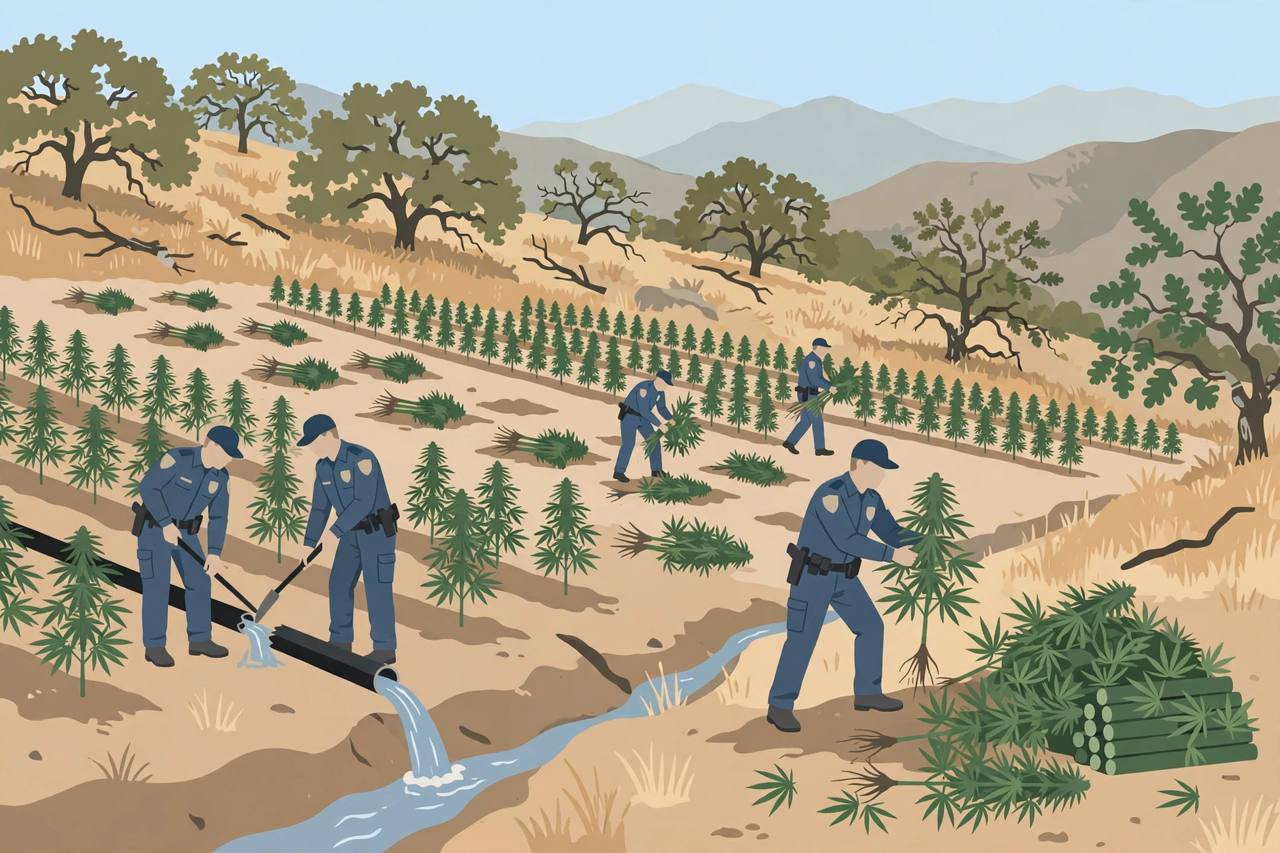
OAKLAND, California — California Attorney General Rob Bonta announced on Monday, November 16 that the state's Eradication and Prevention of Illicit Cannabis (EPIC) program eradicated nearly one million illegally cultivated cannabis plants and made 221 arrests across 22 counties in 2026, in a year-long, multi-agency campaign against unlicensed grow operations that the Department of Justice links to organised crime, labour trafficking and environmental destruction.
Source: California Department of Justice
EPIC teams operating across Northern, Central and Southern California conducted 655 operations during the year, recovered 158 weapons, and dismantled the infrastructure of illegal grows — including dams, water lines and containers of toxic chemicals — according to the Attorney General's office. The 221 arrests are arrests, not convictions: the Department of Justice says EPIC builds investigations that can lead to civil and criminal prosecution, and cases arising from the operations will be decided in court.
What the Attorney General said
“Illegal cannabis cultivation is not a victimless crime. It is a driving force behind human exploitation, a plethora of illegal activity, and ecological devastation,” Bonta said. “There are rules and regulations for growing legal cannabis to keep Californians and California's environment healthy. Our strong EPIC team consists of local, state and federal law enforcement and is designed to operate all throughout California to ensure these regulations are met. Every illicit grow operation that goes unchecked directly undermines the hardworking, licensed farmers who play by the rules. Let this announcement serve as a stern reminder to anyone out there growing cannabis illegally that we will find you and hold you accountable.” California legalised recreational cannabis for adults in 2016, and licensed growers operate under state rules on water, pesticides, labour and taxes that illegal operations ignore — the competitive and environmental gap the program says it exists to close.
Banned chemicals and stolen water
At the grow sites, teams removed containers of toxic chemicals including carbofuran, methyl parathion, aluminum phosphate, zinc phosphide and illegal fertilisers, the department said. Carbofuran drew particular warning: a lethal insecticide that is effectively banned in the United States, it remains on plants after application and seeps into soil and nearby water sources. “An illegal grow can divert a stream and leave toxic chemicals behind long after the plants are gone,” said Thomas French, the Bureau of Land Management's Special Agent in Charge for Region 1–California, adding that EPIC is the only task force in California bringing local, state and federal partners together against illegal cultivation on public lands. California Department of Fish and Wildlife Director Meghan Hertel said illegal water diversions, toxic pesticides and habitat destruction “threaten our fish, wildlife, and the ecosystems they depend on,” and that the partnerships are “addressing these threats at the source.”
Where the operations ran — including the Central Valley
The 22 counties were Alameda, Butte, Fresno, Humboldt, Kern, Lake, Lassen, Los Angeles, Mariposa, Mendocino, Nevada, Riverside, Sacramento, San Benito, San Bernardino, San Joaquin, Shasta, Stanislaus, Tehama, Trinity, Tulare and Yuba. Six of them — Fresno, Kern, Sacramento, San Joaquin, Stanislaus and Tulare — are in the Central Valley, the agricultural heartland where many Punjabi farming families own and work land, and where illegal grows compete directly with licensed farms for water in dry years. John Martin, Executive Director of the Central Valley California High Intensity Drug Trafficking Area (CVC HIDTA) Program, called EPIC “CVC HIDTA's largest collaborative effort” and said coordinated intelligence sharing and joint operations “maximize the effectiveness of enforcement efforts.”
Forced labour at remote grow sites
The Attorney General's office said dismantling the grows is also aimed at “rescuing vulnerable individuals from forced labor, and dismantling the human trafficking operations that exploit workers at remote grow sites.” Reporting on the announcement noted that officials did not specify how many people were rescued this year. California State Parks Director Armando Quintero said the partnership eradicates illicit cultivation from public lands, “providing safer places to recreate, while protecting the diverse natural and cultural resources within,” and Col. Brandon Hill of the California Military Department said its Counterdrug Task Force serves as “an enabler” for law-enforcement partners against illicit narcotics in the state.
EPIC is led by the California Department of Justice. It is a different effort from the Governor's Unified Cannabis Enforcement Task Force (UCETF), which announced its own 2026 figures on October 29 — more than $230 million of illicit cannabis seized or destroyed and 236,846 plants eradicated through September. Monday's nearly-one-million-plants figure is EPIC's alone, for the full 2026 season.
Who runs EPIC and who pays for it
EPIC is led by the California Department of Justice in partnership with the Bureau of Land Management, the California National Guard's Counter Drug Task Force, the Department of Fish and Wildlife, California State Parks, the Central Valley HIDTA program, the California Environmental Protection Agency, the U.S. Forest Service and numerous local law-enforcement agencies. Each season it is funded primarily through the U.S. Drug Enforcement Administration's Domestic Cannabis Eradication/Suppression Program. “These continual impressive results by the EPIC program demonstrate the critical importance of DEA's Domestic Cannabis Eradication/Suppression Program funding in supporting our state and local law enforcement partners,” said Bob P. Beris, the DEA's Special Agent in Charge for the San Francisco Field Division. Inside the Justice Department, EPIC works with the Cannabis Control Section, the Special Prosecutions Section and the Tax Recovery in the Underground Economy (TRUE) Task Force.
What happens next
The department describes EPIC as an evolution of its cannabis enforcement work, reshaped each summer by what operations find. The investigations behind the 221 arrests now move toward civil and criminal cases, which will name defendants and charges as they are filed; Awaaz Punjab will follow the Central Valley cases in particular. For licensed growers — including Punjabi-owned farms in Fresno, Tulare and Sacramento counties — the practical question the program raises every year is whether enforcement keeps pace with the illegal market that undercuts them on price while skipping the water, pesticide and labour rules they pay to follow.