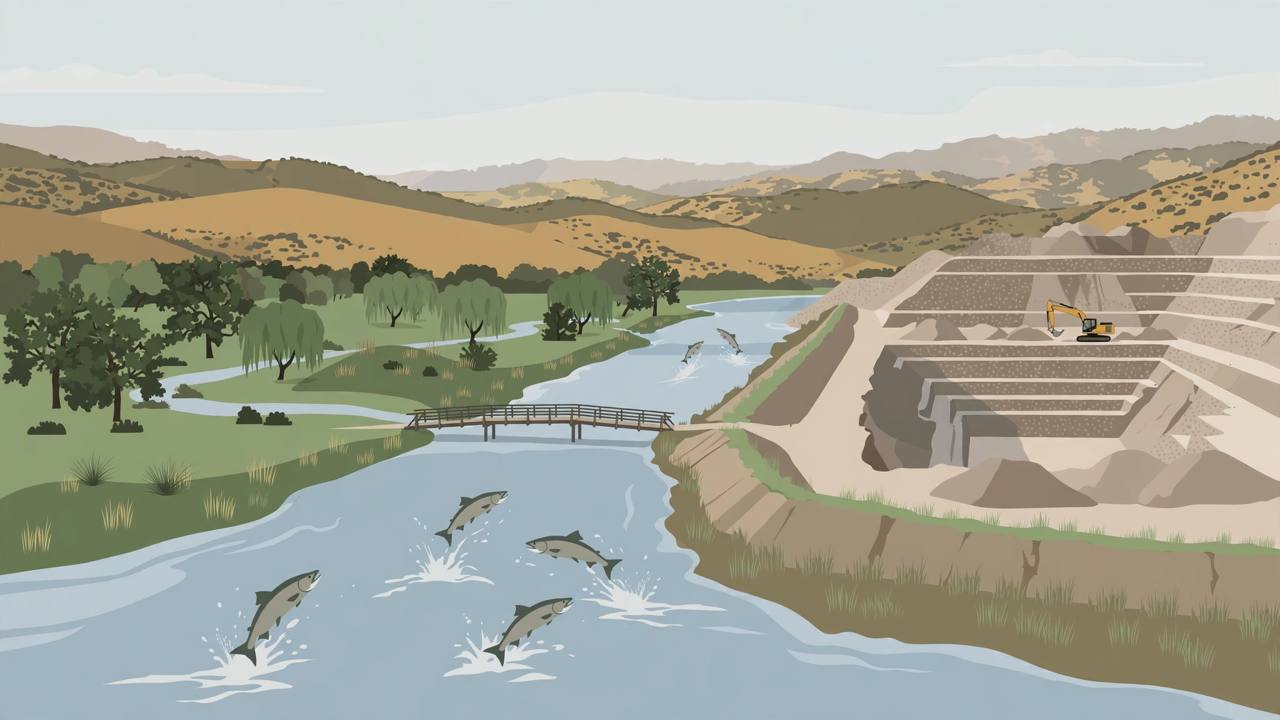
Fresno County's Board of Supervisors will take a final vote on Thursday morning on one of the most contested land-use decisions in the Central Valley in years: whether CEMEX, the $15 billion building-materials company headquartered in Mexico, may blast a 300-foot-deep gravel pit into the bank of the San Joaquin River just north of Fresno, beside the river parkway where families fish, walk and picnic. The hearing is set for 9:30 a.m. on Thursday, November 12, at the Hall of Records in downtown Fresno, and county officials expect a large turnout.
Source: Fresnoland
What is actually being decided
CEMEX operates the Rockfield quarry along Friant Road near Friant, on the river's edge by Lost Lake Park and the growing San Joaquin River Parkway. Gravel that can be reached by conventional digging is running low, so the company asked to modify its permit and blast into hard rock. The original application was far bigger — a pit roughly 600 feet deep, deep enough to fit the Golden Gate Bridge, with a project life of up to 100 years. County planning staff recommended a scaled-back alternative: blasting to 300 feet for up to 63 years.
The proposal has already failed once. On October 8, the Fresno County Planning Commission split 3-3 on the staff-recommended alternative, and a tie means the motion failed — a technical denial of the conditional use permit. CEMEX appealed, which is why the decision now sits with the five elected supervisors. Of 77 speakers at the October hearing, 62 opposed the project, according to KVPR, and reporting based on the county's comment file put total public comments at roughly 675, about 90 per cent of them opposed.
UC Berkeley professor Mathias Kondolf, a fluvial geomorphologist who studies flood-prone land, told Fresnoland it is "practically guaranteed that a flood will cause the gravel mine to spill into the river" and that "it's not a matter of if, but when those levees separating this massive pit from the river are breached." He warned chemicals would end up in the water and the salmon run the restoration is meant to revive would be harmed.
A flood map the company drew itself, and warnings the county set aside
The outer edge of the proposed pit sits inside the federally designated floodplain of the San Joaquin River. CEMEX, however, produced its own flood map claiming the site is not in the floodplain. Kondolf called the rewriting of the flood maps "a real red flag" that "should have been a disqualifying approach." On the company's own analysis from this year, he noted, a major flood would bring the river's waterline within inches of the top of the pit's protective berms — about 7 inches of freeboard. "That's not much. It's as good as over top," he said.
The federal Bureau of Reclamation and the California Department of Fish and Wildlife both wrote to Fresno County warning of exactly this risk. The Bureau of Reclamation warned that breaching of the site by high flows "could cause long-term impact to fisheries, the ability for Reclamation to provide water to Holding Contracts below the proposed project site … and potentially the ability for Reclamation to deliver water to Mendota Pool for the Exchange Contract." County planners answered in the environmental documents that the scenario was unlikely — "in the unlikely and unforeseeable event that the Quarry Site is 'captured' by the SJR … the operator would work with several local, state and potentially federal agencies for any necessary remediation activities."
What is solid
- The Board of Supervisors votes Thursday, November 12 at 9:30 a.m. at the Hall of Records in Fresno.
- The Planning Commission's 3-3 tie on October 8 was a technical denial; CEMEX appealed to the board.
- 168 of 204 written comments on the draft environmental report opposed the project (KVPR).
- About $1 billion in public funds has been pledged to restore the San Joaquin River and build the parkway system.
What is only claimed
- Whether the pit site lies in the river's floodplain: the federal map says the outer edge is inside it; CEMEX's own map says the site is not.
- Whether a flood breach is coming: Professor Kondolf calls it practically guaranteed; county planners call the scenario unlikely and unforeseeable.
It has happened on this river before — and taxpayers paid
The San Joaquin near Fresno has already swallowed two gravel pits. The big lake on Milburn Avenue, on the river bluffs, is an old gravel pit that was breached in the 1990s; state and federal governments have spent millions just trying to seal it off from the river system. A second breach, at Sycamore Island in 2005, cost $4.5 million, paid entirely by the taxpayer-funded San Joaquin River Conservancy, its chief executive Kari Daniska said. A Bay Area gravel site was also breached in the very wet year of 2023, and in Germany in 2021 floodwaters overwhelmed a 200-foot-deep gravel mine, cutting a canyon hundreds of metres long and swallowing homes. Kondolf's point is that those were surface mines; a blast mine, he said, "is a whole different animal."
A board that is mostly on its way out
Three of the five supervisors voting Thursday will not be on the board in 2027. Nathan Magsig and Brian Pacheco were elected to state office in the midterms and will be sworn in on December 7; Buddy Mendes is retiring. Only Garry Bredefeld and Luis Chavez will remain. That has sharpened the argument in the valley: opponents ask why a departing majority should lock in a pit that could outlive everyone in the room, while Chavez has argued the current board "started it, minus me and Garry, and should finish it." Magsig told KMPH he has not made up his mind and that the decision will be based on the evidence.
CEMEX's lawyer, Patrick Mitchell, did not respond to multiple requests for comment from Fresnoland. Fresno County also declined to answer what damages, if any, CEMEX would have to pay if a spill happened; communications director Sonja Dosti wrote on Tuesday that the public works team was receiving many comments and questions daily and did not have time to respond. Fresnoland also reported that the county's planning team said it did not consider an alternative location for the mine, saying it was not their responsibility to search for one.
Why this matters beyond Fresno, and what happens next
The San Joaquin is not an abstract environmental issue in the Central Valley. About $1 billion in taxpayer money has been pledged to restore the river so salmon can spawn beside the mine site again, and to build what the state hopes will be Fresno's biggest park system. Downstream farmers — including the valley's large Punjabi farming community, whose families depend on San Joaquin water deliveries — rely on the same river the Bureau of Reclamation warns could be disrupted if the pit is captured by a flood. The vote is Thursday at 9:30 a.m. If the board approves the modified project, CEMEX gets its blasting permit under whatever conditions the board attaches; if the board upholds the Planning Commission's denial, the company must decide whether to accept the result or challenge it. Either way, Thursday's vote — not the October hearing — is the decision that counts.