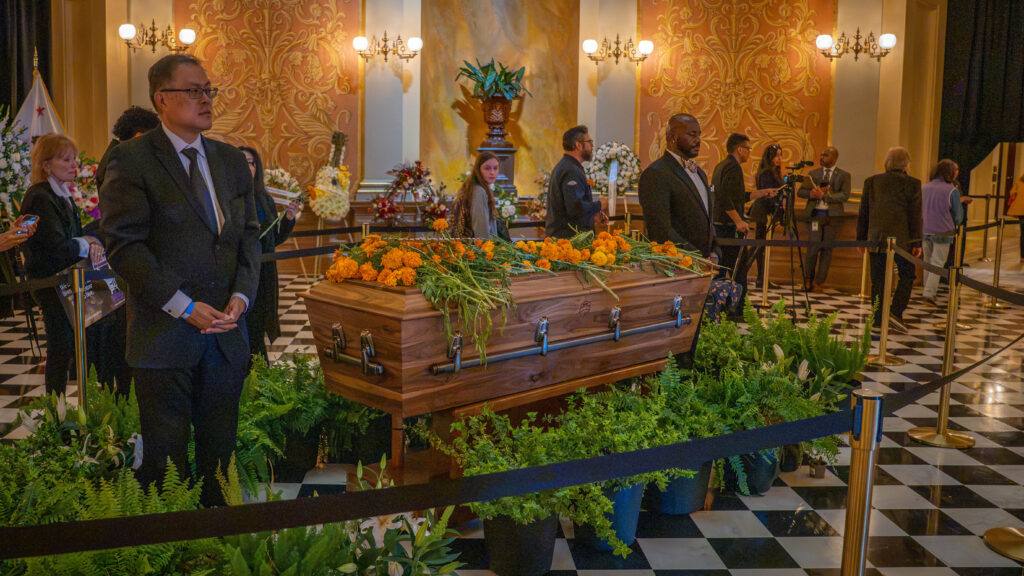
Dolores Huerta made history one last time on Monday, November 16, 2026. The labour leader who co-founded the farm workers' movement became the first woman and the first non-elected person ever to lie in honor at the California State Capitol in Sacramento, an honour the building has previously reserved for elected officials who lie in state.
Source: Abridged by PBS KVIE
Huerta died of cancer at her home in Bakersfield on October 28, 2026, at the age of 96, Awaaz Punjab reported at the time. Monday's ceremony was the state's formal farewell — and, by every account from the Capitol, it looked and sounded like the movement she built, not like a stiff state occasion.
A procession that sounded like a rally
About 600 people gathered at Crocker Park in Sacramento on Monday morning, according to Abridged by PBS KVIE, and marched alongside a white hearse carrying Huerta's casket to the Capitol. Marigold-decorated lowrider cars led the procession, indigenous dancers took part, and mourners held marigolds — the flower long associated with Mexican remembrance — as they walked.
On the Capitol's western steps, hundreds sang “De Colores,” the folk song that has been sung at United Farm Workers rallies for six decades, and the crowd took up the chant Huerta herself coined and made famous around the world: “Sí, se puede” — yes, it can be done.
Huerta is the first woman and the first civilian who never held elected office to lie in honor in the California State Capitol rotunda. Officials and reporters drew the distinction carefully: elected officials lie in state; Huerta's honour, created for a private citizen, is called lying in honor.
Six hours in the rotunda
Her casket, covered in marigolds and surrounded by ferns and floral tributes, lay in the Capitol rotunda for public viewing from 12:30 p.m. to 6:00 p.m. on Monday, and members of the public queued through the afternoon to file past and pay their respects, photographs from the ceremony show.
Governor Gavin Newsom ordered flags at the Capitol flown at half-staff on Sunday ahead of the ceremony, and Governor Newsom and Acting Governor Monique Limón ordered flags at the Capitol and all state buildings flown at half-staff in her honour, according to summaries of the official orders. Governor-elect Xavier Becerra, who won California's governorship in the November 3 election, was among the leaders who took part in the Sacramento events.
“Someone we can stand on the shoulders of”
For many in the crowd, the day was personal. Elia Garcia Rotch told Abridged by PBS KVIE she had been reflecting on Huerta's work just days before the leader's death, while helping wildfire victims in Pasadena, where a banner depicting Huerta hung in the aid centre. “I was already feeling really impacted and emotional about her, the long arc of her life and work,” she said.
Adriana Estrada, who first learned about Huerta in a Chicano Studies class in college, said learning her story “opened a role to me.” “I just learned about what a bright leader she was in organizing. How she stood tall amongst men,” Estrada said. “I'm raising two girls of my own, too. She's someone we can stand on the shoulders of.”
The life the Capitol was honouring
Huerta co-founded the National Farm Workers Association in 1962 with César Chávez — the organisation that became the United Farm Workers — and helped lead the Delano grape strike and the national grape boycott that forced growers to recognise farm workers' unions and changed California labour law. She negotiated contracts, lobbied in Sacramento and Washington, and coined “Sí, se puede” in 1972. President Barack Obama awarded her the Presidential Medal of Freedom in 2012, and in 2018 California made April 10 — her birthday — Dolores Huerta Day in the state.
Her final year also carried a difficult chapter that mourners at the Capitol did not hide from. A New York Times investigation published in June detailed allegations by multiple women against the late César Chávez, and Huerta confirmed before her death that she was among the women, PBS reported. Attendees interviewed Monday praised her strength in speaking, and organisers have said her legacy — and the movement's — is now being weighed with that fuller record in view.
What happens next
Sacramento's ceremony is not the last farewell. Public memorial events continue this week in Bakersfield, the Central Valley city Huerta called home: a public rosary and evening vigil are scheduled for Thursday, November 19, and an interfaith memorial and celebration of her life for Friday, November 20, according to event organisers and family announcements summarised by Particle News. The Dolores Huerta Foundation, which she founded in 2002 and which is based in Bakersfield, continues its community-organising and training work in farm worker communities across the San Joaquin Valley — the same valley where thousands of Punjabi and Latino farm families, including many Awaaz Punjab readers, have worked the fields for generations.