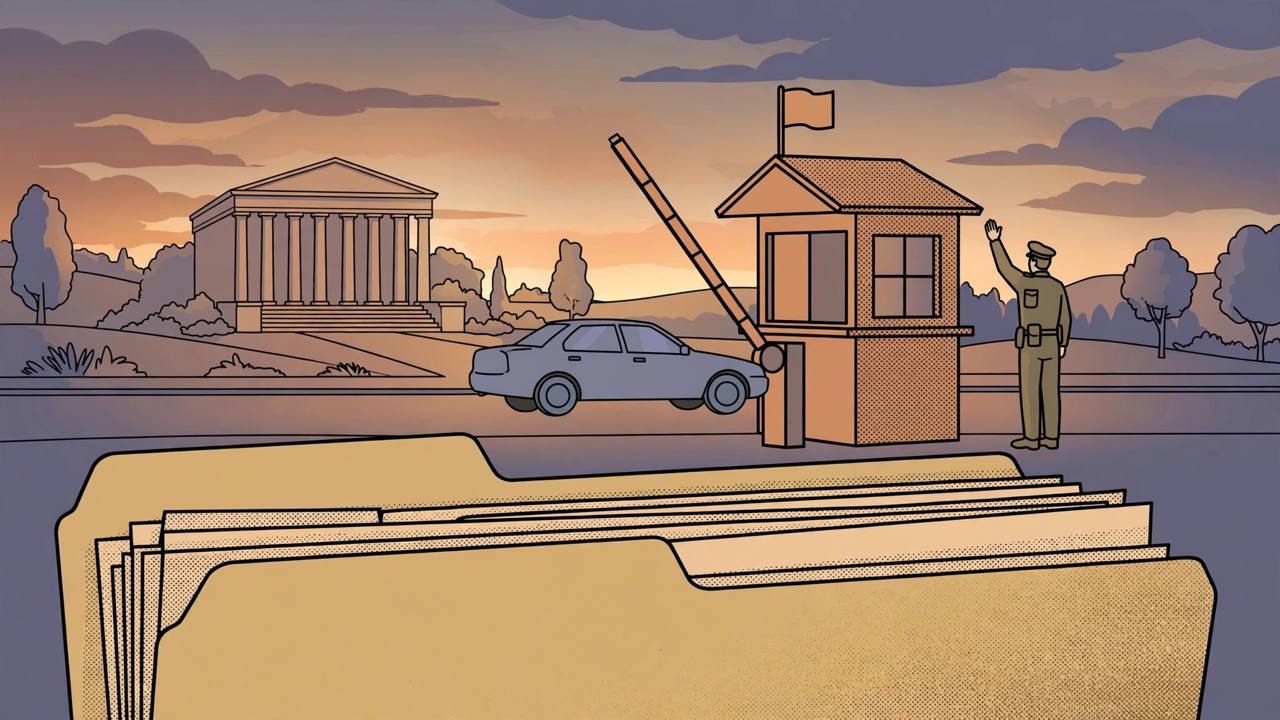
A border crossing that a 13-year-old says he slept through in 1994 has decided a removal case in 2026. In a published opinion filed on November 17, 2026, a divided panel of the U.S. Court of Appeals for the Ninth Circuit denied Alvaro Elizondo Urzua's petition for review and held that he — not the federal government — bore the burden of proving that his claimed 1994 entry into the United States was procedurally regular.
Source: U.S. Court of Appeals for the Ninth Circuit, Elizondo Urzua v. Blanche, No. 25-604 (Nov. 17, 2026)
Everything in the case turned on one date. Federal law makes a lawful permanent resident removable if he is convicted of a crime involving moral turpitude committed within five years after the date of admission, where a sentence of one year or longer may be imposed — 8 U.S.C. § 1227(a)(2)(A)(i). It was undisputed that Elizondo Urzua is a noncitizen, that he was convicted of a qualifying crime, that the crime was committed in 2017, and that it carried a qualifying sentence. The only question was the date of admission: if it was 1994, the 2017 crime came far more than five years later; if it was 2015, when he received his green card, the crime came within two years and he was removable. On the court's own summary, the dispositive line was whether the admission came before or after 2012.
A ride to a festival, and a crossing he slept through
According to his declaration and testimony, Elizondo Urzua was living in Chapala, Mexico, with his grandparents in 1994 while his mother, father and siblings lived in the United States. Three friends — whose last names he could not remember — invited him to travel with them to Tijuana for a festival. He planned to attend the festival and fly home; his friends planned to drive into the United States afterwards. After the festival they invited him to ride along. Believing the worst that could happen was being turned back at the border, he made what the opinion calls a last-minute decision to go with them.
He had no legal papers to enter the United States — only a Mexican birth certificate, an ATM card and a backpack with a change of clothes. As the car moved through heavy traffic toward the border, he fell asleep. The next thing he remembered was waking up, still in the car, parked next to a taco truck in Los Angeles, California. His friends told him that at the border an officer asked the driver a few questions and then let the car pass through. His friends dropped him at his uncle's house in Victorville. He later lived with an aunt in Santa Maria, then moved in with his mother in Oakland and enrolled in school. He did not leave the United States at any point between his arrival in 1994 and obtaining lawful permanent resident status in 2015, and he married a U.S. citizen in 2011, a marriage that later ended in divorce.
A green card in 2015 — and the papers that cut against the claim
In December 2015 the Department of Homeland Security approved his adjustment of status under 8 U.S.C. § 1255(i), as the beneficiary of a visa application his father had filed many years earlier, before May 2001. But the paperwork from that process later became the centre of the case. In his Form I-485 application he stated at least three times that he had entered the United States without inspection, and he said the same in an application for employment authorization. He also certified, under penalty of perjury, that he could read and understand English and that he had read and understood every question and instruction on the form.
Elizondo Urzua explained the contradiction this way: his ex-wife hired the law firm that helped with the application; he had approximately three appointments at the law office and met the same woman each time; he said he told her he had been waved through the border around 1995; he could not remember her name and could not remember whether she was an attorney; because he did not speak English fluently at the time, his ex-wife reviewed the paperwork and he signed it. Two immigration attorneys also filed declarations explaining that so-called Quilantan admissions are easy for lawyers to miss, because neither the immigration statute nor the regulations use the term wave-through admission — so, they argued, a statement of entry without inspection on the form is not necessarily inconsistent with a legally valid wave-through entry. He also pointed to two government reports noting that people entering the United States are not always asked for identification and that wave-through admissions were not uncommon in the 2000s, and to the fact that the current Form I-485 — changed after he filed — now asks specifically whether the applicant was waved through the border.
The criminal charge arrived years later. In 2023, Elizondo Urzua pleaded no contest to rape of an unconscious person, an offence under California Penal Code § 261(a)(4) that he committed in 2017, and he was sentenced to three years in prison. In 2024 the Department of Homeland Security served him with a Notice to Appear charging removability under the five-years-after-admission rule. An immigration judge held a hearing in August 2024 on the single question of when he had been admitted, and the Board of Immigration Appeals later dismissed his appeal from the immigration judge's decision ordering his removal to Mexico.
In Matter of Quilantan, 25 I. & N. Dec. 285 (B.I.A. 2010), the Board held that an admission requires only procedural regularity — a person need not have been admitted in any particular status. In that case the noncitizen rode to the border with a U.S.-citizen friend, the inspector asked him nothing, and the car was waved through the port of entry; the Board treated that as an admission. The Ninth Circuit's new opinion does not abolish that principle. The fight in Elizondo Urzua was not whether a wave-through can count — it was who had to prove that this wave-through happened, and whether the evidence proved it.
Why the burden of proof decided the case
The majority, in an opinion by Judge Lawrence VanDyke, applied 8 U.S.C. § 1361, which provides that in removal proceedings the burden of proof is on the person to show the time, place and manner of his entry into the United States. Elizondo Urzua relied on Iran v. INS, 656 F.2d 469 (9th Cir. 1981), which had said that § 1361 applies only in deportation proceedings that involve illegal entry. The panel answered that Iran's broad statement was unreasoned dicta: it surveyed the enactment history of § 1361 and the court's own precedent, and concluded that because the time, place and manner of his entry were directly relevant to whether he was deportable, § 1361 placed the burden on him to prove his 1994 entry was procedurally regular.
Source: Ninth Circuit opinion, No. 25-604, summary and majority opinion
On the evidence, the panel concluded that substantial evidence supported the Board's determination that he had failed to meet that burden. His own account of the crossing depended on what his friends told him after he woke up in Los Angeles; the supporting accounts were also secondhand; general reports about border practices did not establish his particular crossing; and his own earlier signed applications describing an entry without inspection undermined the later claim. The record, the court held, did not compel the conclusion that the 1994 entry was procedurally regular — and so did not compel a 1994 date of admission. The petition for review was denied.
What is solid
- A divided, published Ninth Circuit panel denied the petition on November 17, 2026, in Elizondo Urzua v. Blanche, No. 25-604.
- The majority held that under 8 U.S.C. § 1361 the petitioner bore the burden of proving his claimed 1994 entry was procedurally regular.
- Matter of Quilantan still recognises that a wave-through entry can be an admission; the ruling did not abolish that principle.
- Judge Gould dissented on the burden question and would have remanded the case to the Board.
What is only claimed
- Whether Iran v. INS binds panels to limit § 1361 to illegal-entry cases — the majority called its statement dicta; the dissent called it a reasoned, binding decision.
- Whether the 1994 crossing happened as described — the court held only that the record did not compel that conclusion, applying the substantial-evidence standard.
The dissent: the government should have had to prove it
Judge Ronald M. Gould dissented on the burden question. In his view, Iran's interpretation of § 1361 was a reasoned decision that bound the panel, and Elizondo Urzua's removal proceedings — which did not involve an allegation of illegal entry — were not subject to the § 1361 burden at all. He would have granted the petition and remanded the case to the Board of Immigration Appeals to assess whether the government had met its burden of proving removability. Judge Jacqueline H. Nguyen was the third member of the panel. The case was argued and submitted on June 8, 2026, in San Francisco. Raha Jorjani, a deputy public defender with the Alameda County Public Defender's office in Oakland, argued for Elizondo Urzua; Jennifer A. Bowen of the Justice Department's Office of Immigration Litigation argued for the government.
What this means for immigrant families in the West — including Punjabi green-card holders
The opinion is published precedent inside the Ninth Circuit, which covers California, Washington, Oregon, Nevada, Arizona, Idaho, Montana, Alaska and Hawaii — states that include the Central Valley, Seattle, Phoenix and other cities where large Punjabi and immigrant communities live and work, including many long-settled green-card holders who entered the United States as children in the 1990s. Its practical lesson is narrow but sharp: where an old entry date decides deportability, the person facing removal may have to prove that entry with evidence, and what he signed on earlier immigration forms can outweigh later testimony and family accounts. The ruling does not say that every conviction makes a green-card holder removable, and it does not hold that a person waved through a port of entry was never admitted — it holds that the claimed crossing must be proved, by the person claiming it, in this procedural setting.
What happens next: the removal order stands unless a further court step changes it. The avenues that ordinarily remain after a published panel ruling are a request for rehearing by the full court or a petition to the U.S. Supreme Court, and any such filing would be the next development to watch; lawyers who analysed the opinion on the day it issued cautioned that later rehearing, amendment or Supreme Court proceedings must be checked before relying on it. For readers, this report is general information about a court decision, not legal advice: anyone whose own case involves an old wave-through entry, an earlier form that says entry without inspection, or a criminal conviction after a green card should keep old passports, I-94 records, prior applications and approval notices, identify witnesses who personally saw the crossing, and take the complete file to an immigration lawyer before any hearing — because, after November 17, the file may have to carry the case.
Source: Law Firm of Farhan Aryan P.C., analysis of Elizondo Urzua v. Blanche (Nov. 17, 2026)