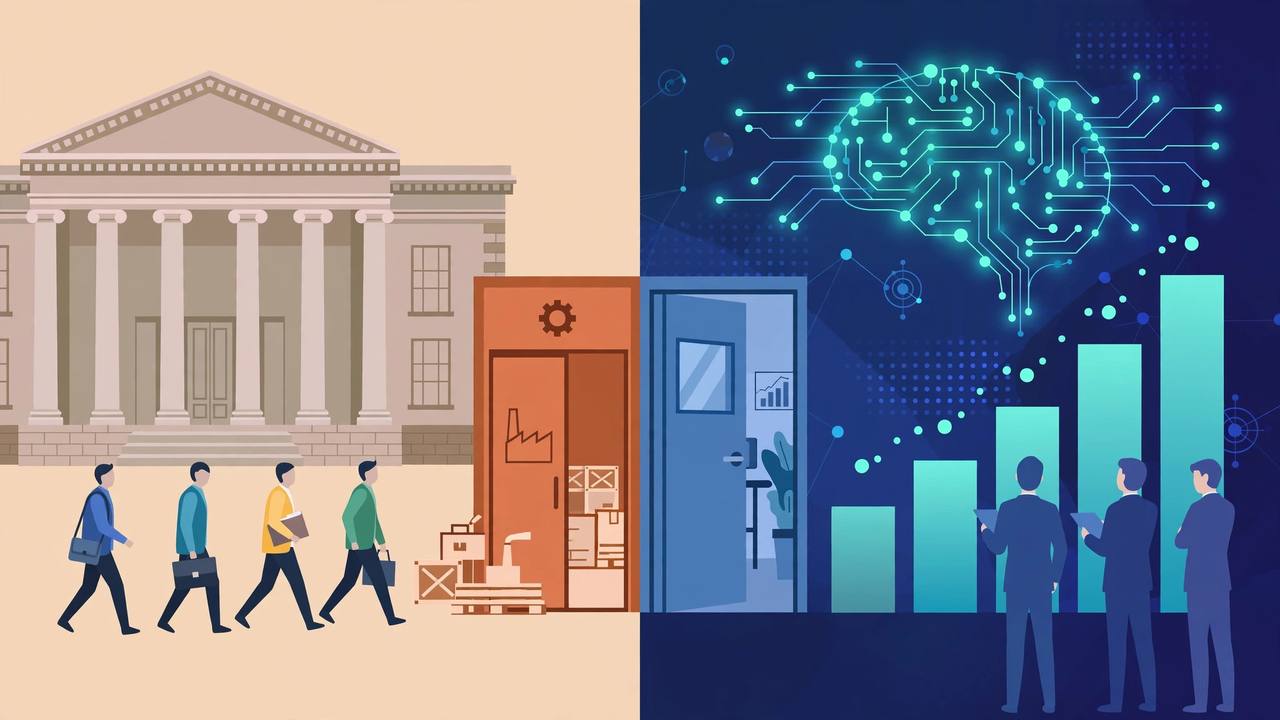
The United States should be prepared for “serious short-term disruptions” to the job market because of artificial intelligence, Federal Reserve Governor Michael Barr said on Thursday, November 12, warning that a fast rollout of AI could begin displacing workers at scale and widening inequality in favour of investors.
Source: Reuters
Barr delivered the remarks at Yale University in a speech on American inequality and the future of AI. He was not making a prediction, Reuters reported, but urging preparation for social strains if the changes arrive quickly — comments that follow midterm elections that swung partly on a backlash to the rapid AI buildout.
Two very different futures for AI
Much depends on whether competition among AI companies turns the technology into what Barr called “a cheap and ubiquitous commodity, with gains widely shared,” much as the internet became over time. In that case, he said, “AI could democratize access to skills and information needed for small businesses to thrive.”
The alternative is growing market concentration among those who own or have invested in a handful of winning companies, with gains flowing increasingly to the owners of labour-displacing capital — and labour's share of national income continuing its downward slide.
“Some researchers believe that AI has characteristics that have, in past examples of high-tech advances, reinforced concentration of market power,” Barr said. The labour share — a rough proxy for how much of the country's output becomes wages for workers rather than profits or equity income for owners and investors — hit a record low of 52.8% in the second quarter of 2026.
Inequality was already wide before AI
Barr set the AI question against an already unequal economy. Citing the Federal Reserve's Survey of Consumer Finances, he noted that the wealthiest 10 percent of households hold nearly three-quarters of the nation's wealth, while the bottom half holds about 2 percent. In 2024, the highest-earning fifth of households earned 52 percent of all income, and the bottom fifth earned only 3 percent.
On jobs so far, Barr said there has been “relatively little displacement” of workers by AI, and even evidence of AI boosting demand and creating jobs. But the issue remains unsettled, he said, hinging in part on whether small businesses can keep access to the technology to expand.
“No one knows the degree to which the benefits will be shared,” Barr said. “We are already seeing signs that AI may be a labor substitute in some sectors, especially for younger, less-experienced workers … If labor market changes happen quickly it will be hard for workers to adjust, and dislocations might be large … The concentration of market power may help drive a widening of inequality that would strain the American Dream.”
The AI boom is also pushing prices up
Barr said the main effect of AI deployment so far has been on prices: AI firms are pumping trillions of dollars into data centres and computing capacity, and that investment, while raising US gross domestic product, is creating input pressure that spills into other areas — driving up prices for consumer goods like cellphones and gaming consoles, and pushing up wages in the construction industry.
The role of AI investment in sustaining inflation above the Fed's target has been accepted by a number of Barr's colleagues and has firmed support for further interest-rate increases, Reuters reported. Fed Chairman Kevin Warsh, by contrast, has often raised the possibility that AI could usher in an era of rising productivity that lowers inflation — though the timing of those gains is uncertain.
Barr's warning is aimed squarely at workers at the start of their careers and at small businesses: the first signs of AI replacing labour are showing up among younger, less-experienced workers, while the income gains so far flow mainly to owners and investors. For diaspora families built on wages — in trucking, warehouses, stores and services — whether AI becomes a cheap shared tool or a concentrated asset is the difference between the two futures he described.
What happens next
A public Federal Reserve forum in San Francisco on Monday, convened by a task force appointed by Chairman Warsh, will explore what the new technology may mean for the economy. Barr's remarks add a senior Fed voice to that debate, but they announce no policy decision: the central bank has taken no new action on AI, and the argument inside it — productivity gains that lower inflation versus investment pressure that raises prices — remains open.
What is solid
- Fed Governor Michael Barr delivered the remarks at Yale University on Thursday, November 12, 2026
- Labor's share of national income hit a record low 52.8% in the second quarter of 2026, per Barr's speech
- Barr said AI has caused relatively little worker displacement so far, with early signs concentrated among younger workers
What is only claimed
- How fast AI will displace workers at scale — Barr presented this as a risk to prepare for, not a forecast
- Whether AI's gains will be widely shared or concentrated among a few companies and their investors