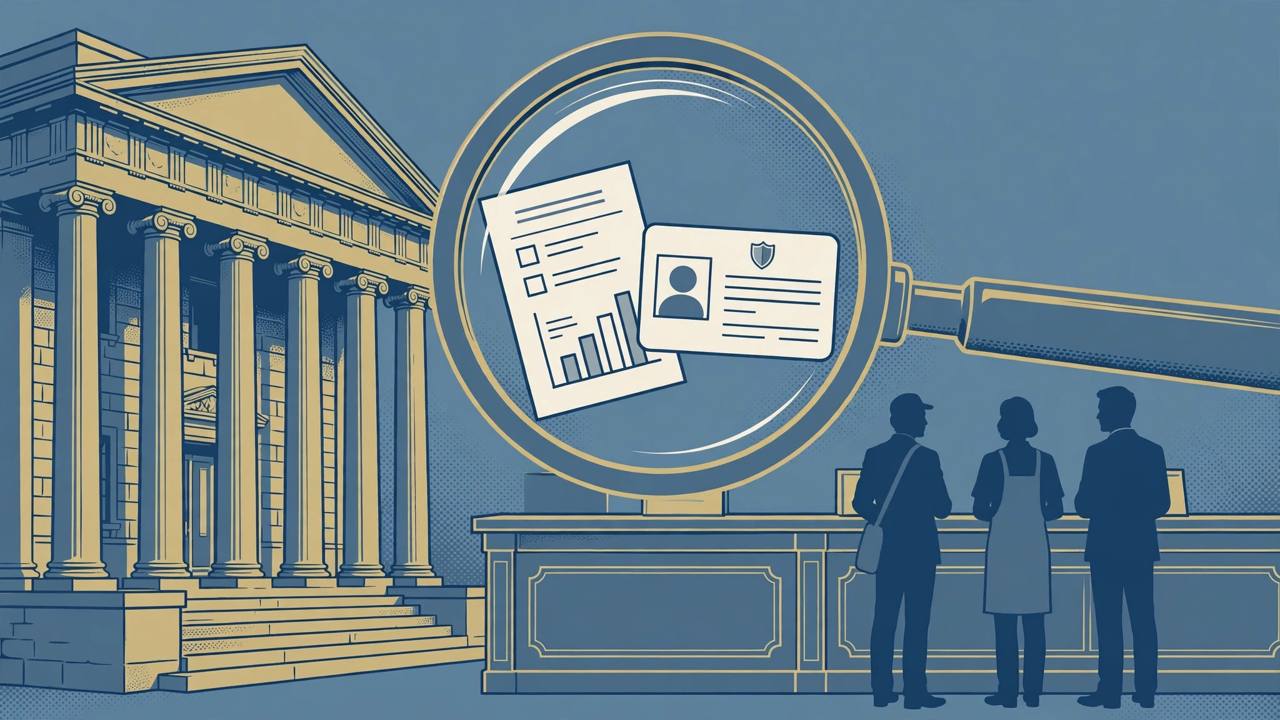
WASHINGTON — The U.S. Department of the Treasury's Financial Crimes Enforcement Network (FinCEN) on Tuesday, November 17, 2026, issued a notice of proposed rulemaking to strengthen and modernise the customer due diligence (CDD) requirements that banks and other covered financial institutions must follow under the Bank Secrecy Act, the Treasury's financial-crime framework.
Source: National Credit Union Administration (NCUA), Nov. 17, 2026
The proposal rewrites parts of the CDD Rule — the rule that forces banks, mutual funds, securities brokers and similar institutions to identify and verify the real people behind their business customers. In FinCEN's definition, a 'beneficial owner' is a person who owns at least 25 percent of a company or who has significant responsibility for managing and controlling it. The proposal is not law yet: it is a draft open for public comment, with comments due 60 days after it is published in the Federal Register.
The ITIN change immigrant business owners will feel first
The sharpest single change for immigrant-owned businesses is about identification numbers. Under the proposal, an Individual Taxpayer Identification Number (ITIN) could no longer be accepted in place of a Social Security number in the information a bank must collect about a company's beneficial owners — in plain terms, banks could no longer accept an ITIN as the identifying number for the people who own or control a business account customer.
Source: CryptoNews, FinCEN proposes tighter ID checks for business owners using ITINs, Nov. 18, 2026
The proposal does not bar ITIN holders from opening bank accounts, and it does not change a business's Employer Identification Number. A non-U.S. owner who does not have a Social Security number could still be identified with a passport or another specified government document. FinCEN said in a June advisory that certain ITIN-related practices are potential warning signs of misuse — not proof of wrongdoing — and the November proposal now turns that concern into a formal identification rule, according to reporting on the proposal's text.
Less paperwork for existing customers: the February relief becomes permanent
The other half of the package cuts paperwork. FinCEN's proposal would write into the CDD Rule itself the relief the agency already granted in an order on February 13, 2026 (FIN-2026-R001): banks would no longer have to re-collect and re-verify a company's beneficial-ownership information every time that existing customer opens another account. Verification would still be required at the first account opening, whenever facts reasonably undermine the reliability of the information already held, and whenever an institution's own risk-based procedures call for it.
Source: ABA Banking Journal, FinCEN proposes revised customer due diligence rule, Nov. 17, 2026
What the regulators said
The proposal implements a directive in Executive Order 14406, 'Restoring Integrity to America's Financial System,' signed in May 2026, and the banking regulators lined up behind it the same day. Comptroller of the Currency Jonathan V. Gould said: 'Effective Bank Secrecy Act compliance depends on understanding customers and the risks their activities present. This proposal would help banks focus their resources on those risks by reducing duplicative beneficial ownership identification and verification when an existing legal entity customer opens another account.' He added that the proposal 'would also clarify the information institutions must obtain about beneficial owners and expressly recognize their ability to collect additional information to address risk or supervisory concerns.'
Source: Office of the Comptroller of the Currency, News Release 2026-101, Nov. 17, 2026
The Federal Deposit Insurance Corporation said it welcomes the proposal and encouraged interested parties to comment, and National Credit Union Administration Chairman John Crews thanked Treasury Secretary Bessent, saying efforts 'to promote a more risk-focused approach to anti-money laundering and countering terrorist financing — while reducing unnecessary regulatory burdens — enable credit unions and other financial institutions to direct resources where they are most needed.' Because the Bank Secrecy Act applies to all federally insured credit unions, the NCUA likewise urged credit unions to file comments.
Thousands of Punjabi diaspora families in the United States run exactly the kind of legal-entity businesses this rule covers — trucking companies, dispatch firms, gas stations, restaurants and shops that hold business bank accounts. Two practical points follow from the proposal as written: (1) an owner or controlling person who today is identified at the bank with an ITIN would, if the rule is finalised, need a Social Security number or an accepted alternative such as a passport when the bank collects beneficial-owner information; and (2) established businesses would face fewer repeated ownership checks when opening additional accounts. This is general information about a proposal, not legal or banking advice for any one business — owners should ask their own bank how it plans to apply the change.
Background: a decade-old rule, rewritten in stages
FinCEN first adopted CDD requirements in 2016, requiring covered institutions to build risk-based procedures for ongoing customer due diligence into their anti-money-laundering programs. Congress later directed revisions to the rule in the Anti-Money Laundering Act of 2020. The November proposal is one stage of that rewrite: FinCEN has said the broader CDD revisions tied to the Corporate Transparency Act will be considered separately, and an August 11 final rule that exempted U.S. companies and U.S. persons from Corporate Transparency Act reporting is a distinct track from the bank-side checks proposed here.
What happens next
Nothing changes for bank customers today. The text must first be published in the Federal Register, which starts the 60-day comment clock; FinCEN must then consider the comments before issuing any final rule. Business groups, banks and credit unions are expected to comment heavily on the ITIN provision and on how much extra information banks may demand where they see risk. Awaaz Punjab will update this story when the proposal is published in the Federal Register and when a final rule is announced.