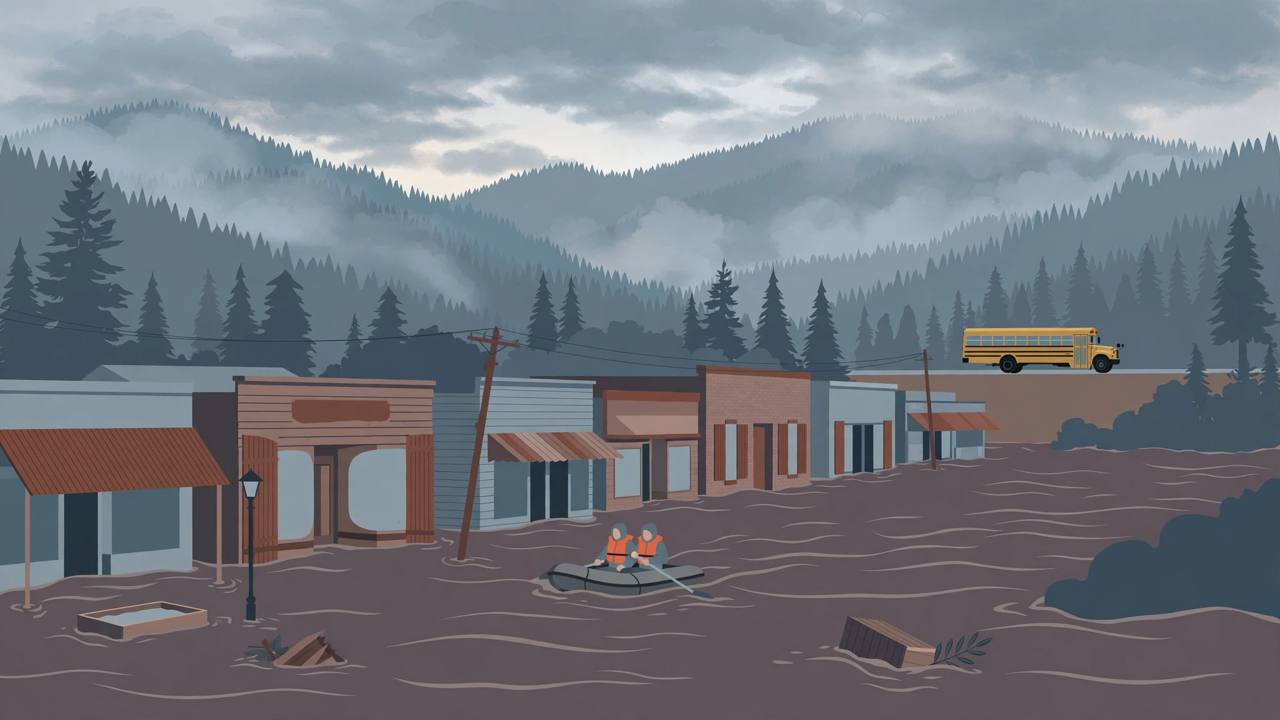
McCAYSVILLE, Georgia — Governor Brian Kemp has declared a state of emergency in four north Georgia mountain counties after the Toccoa River's record overnight flood tore through the twin border towns of McCaysville, Georgia, and Copperhill, Tennessee — the disaster Awaaz Punjab reported this morning as a flash flood emergency, now moving into a state-led rescue, shelter and damage-assessment phase. The declaration covers Fannin, Gilmer, Murray and Union counties and lets state agencies deploy equipment, emergency personnel and financial assistance as the communities begin counting the damage, according to reporting on the governor's order on Thursday.
The numbers explain why the state stepped in. A river gauge near Copperhill read 18.05 feet on Thursday morning, above the previous record of about 17.8 feet set in February 1990, after 5 to 8 inches of rain fell across the region in roughly 12 hours. The National Weather Service office in Morristown, Tennessee, said at 7:01 a.m. that the Toccoa/Ocoee River at Copperhill had crested at just over 18 feet; two hours earlier its forecasters had warned of “widespread catastrophic flash flooding” with “numerous businesses and homes under several feet of water” in Copperhill. The Toccoa is the same river on both sides of the line — it takes the name Ocoee once it crosses into Tennessee.
From a city emergency at dawn to a state emergency by afternoon
The escalation ran all day. Just before 3 a.m., McCaysville police were asking residents of some neighbourhoods to evacuate immediately; at about 5:20 a.m. the city declared its own state of emergency and closed every access point to the public — River Road, Mobile Road, Blue Ridge Drive and Georgia Highway 68 coming in from Tennessee. Police Chief Michael Earley said the closures were mandatory and that McCaysville was closed to all unauthorised personnel. The National Weather Service in Peachtree City kept a flash flood emergency — its rarest, most urgent flood warning — in force for north-central Fannin County into the morning. Governor Kemp said during the day that a multi-agency and multi-state response was under way, and by the time his four-county declaration was reported, the operation had widened well beyond the two flooded towns.
The rescue count climbed with every update, which is normal in the first hours of a flood and worth reading carefully: police put the figure at at least 30 rescues by about 6 a.m., FOX Weather later reported police saying at least 45 people had been rescued in McCaysville, and officials said at least 57 people were rescued by swift-water teams before the water began to recede. Boats were used to reach stranded residents, and a school bus transported evacuees to shelter. First responders and swift-water crews were joined by U.S. Army Rangers from nearby Camp Merrill, who used boats and a military helicopter to reach people trapped by the rising water. McCaysville officials said no major injuries had been reported — a remarkable outcome given that water ran 6 to 7 feet deep in parts of downtown and covered the roofs of some homes.
Shelters, closed schools and water you cannot drink yet
The main shelter opened at the Fannin County Recreation Center in Blue Ridge, and emergency shelters were also opened at the town halls in McCaysville and Copperhill, with authorities ordering people living along the river and in parts of downtown Copperhill to evacuate immediately. Schools in Fannin and Gilmer counties were closed on Thursday. The McCaysville water system was placed under a boil-water advisory until further notice, according to the county emergency management agency — meaning residents who are back in their homes still cannot safely drink tap water without boiling it first. Fannin County Emergency Management Agency spokesman Robert Poole told 11Alive earlier in the day that crews were also searching for a driver, a reminder that the final accounting of the night is not yet complete.
A state of emergency does not put money in anyone's hands on the day it is signed. It unlocks the machinery: state agencies can move equipment and personnel into Fannin, Gilmer, Murray and Union counties without the usual procurement and paperwork delays, coordinate the multi-state response under one command, and position the counties for state — and potentially federal — financial assistance once damage assessments are filed. Thursday's declaration is the step that turns a local rescue story into a funded recovery.
Thursday afternoon: the water falls, the damage shows
By Thursday afternoon the water had begun to fall, exposing mud-covered streets, thick silt and damaged shops across the shared border-town business district that McCaysville and Copperhill run together across the state line. That is the phase residents are now entering: washed-out roads and bridges, debris, flooded ground floors and the slow work of proving losses for insurance and assistance claims. Officials have yet to publish a final estimate of displaced residents, damaged properties or the cost of repairing roads and bridges — those numbers will decide how large the recovery ask becomes, and whether the state seeks a federal disaster declaration on top of its own.
For drivers, the practical picture is closures and caution across the southern Appalachians: McCaysville itself remains shut to unauthorised entry, Georgia Highway 68 from Tennessee and the town's local access roads were closed, and the same cross-country storm system that dropped a foot of snow on western ranges and flooded the Southwest earlier in the week is now pushing rain up the East Coast, with more than an inch expected along much of the I-95 corridor into Friday. Truckers running the US-76 and GA-68 corridors through the Blue Ridge foothills — and anyone routed through Fannin or Gilmer counties — should expect detours, washouts and debris until county crews clear and inspect the roads. North Georgia's Punjabi and South Asian families are concentrated further south around metro Atlanta, but the flooded district sits on routes many Georgia drivers use for mountain deliveries and weekend travel, and the boil-water and shelter operations will run for days.
Context matters for understanding how rare Thursday was. The Toccoa's previous record crest stood for more than 36 years, from February 1990, and the river beat it after a single night of rain measured in inches, not days. McCaysville and Copperhill are small towns — McCaysville has roughly 1,000 residents — built directly on a river that does not respect the state line running through the middle of their shared main street, which is why a Georgia flood automatically became a Tennessee rescue operation, with North Carolina crews also responding.
What is solid
- Governor Brian Kemp declared a state of emergency covering Fannin, Gilmer, Murray and Union counties, allowing state agencies to deploy equipment, personnel and financial assistance (Dispatch Times, Nov 5).
- The Toccoa/Ocoee River crested at just over 18 feet near Copperhill — a gauge read 18.05 feet against a previous record of about 17.8 feet from February 1990 — after 5 to 8 inches of rain fell in about 12 hours (National Weather Service via Weatherboy and FOX Weather; gauge figures via Dispatch Times).
- Officials said at least 57 people were rescued by swift-water teams; U.S. Army Rangers from Camp Merrill took part using boats and a military helicopter; McCaysville officials reported no major injuries (Dispatch Times, Nov 5).
- McCaysville's water system is under a boil-water advisory until further notice, and Fannin and Gilmer county schools were closed Thursday (county emergency management via Dispatch Times; AP via North Atlanta Star).
What is only claimed
- The rescue total is a running figure, not a final count: police reported at least 30 rescues by about 6 a.m., at least 45 later in the morning, and officials later put the swift-water total at at least 57 — the number may move again as the search phase ends.
- No final official estimate of displaced residents, damaged properties or repair costs has been published yet; early damage descriptions come from officials and reporters on scene, not from a completed assessment.
What happens next: the state emergency runs while counties complete damage assessments; the boil-water advisory stays in force until the McCaysville system is tested clear; schools in Fannin and Gilmer counties will announce reopening decisions as roads are inspected; and the rescue phase formally closes once the search for anyone unaccounted for — including the driver crews were reported to be looking for — is resolved. Awaaz Punjab will update this story as the governor's office and county emergency agencies publish damage figures and any federal assistance decision.