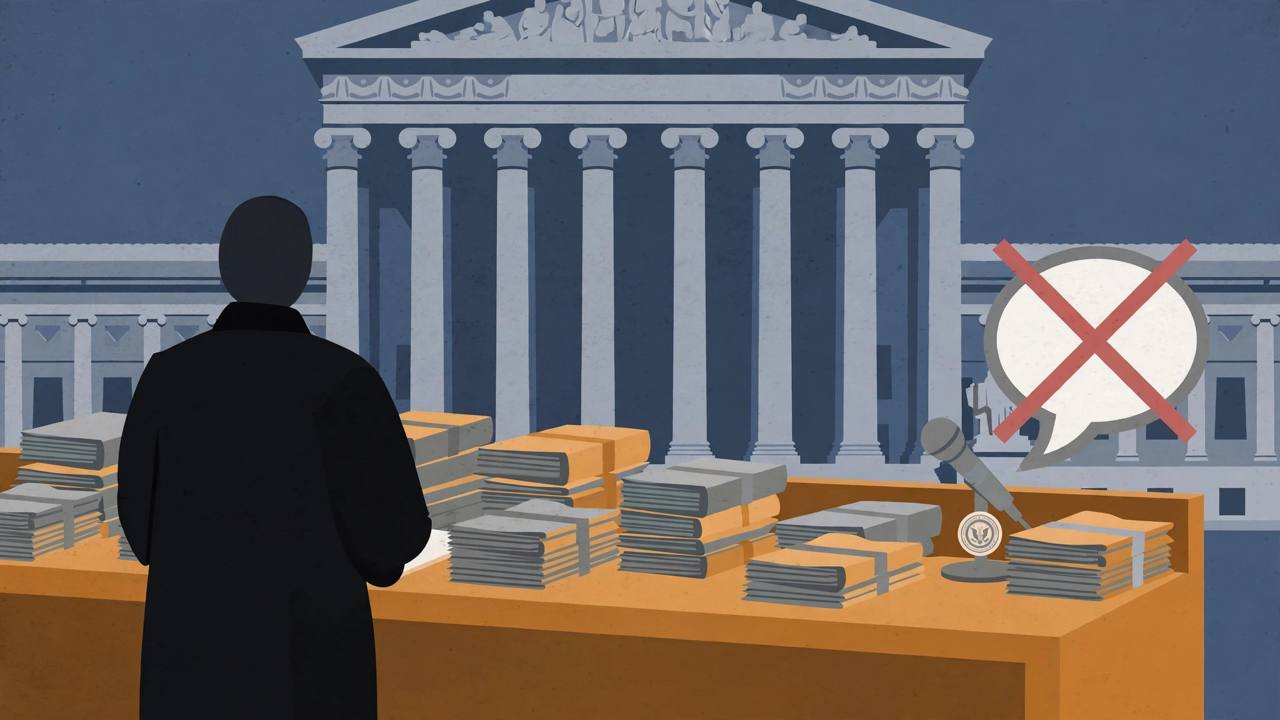
WASHINGTON — The judges who decide deportation and asylum cases across the United States have taken their six-year fight over their own right to speak back to the Supreme Court. On Monday, November 17, the National Association of Immigration Judges (NAIJ) filed a new petition for a writ of certiorari in National Association of Immigration Judges v. Owen, asking the justices to decide whether immigration judges can go straight to a federal district court to challenge a Justice Department policy that bars them from speaking publicly, in their own names, about immigration law or their own agency. The petition names Sirce E. Owen, the acting director of the Executive Office for Immigration Review (EOIR), the Justice Department agency that runs the nation's immigration courts. The association is represented by the Knight First Amendment Institute at Columbia University.
Source: Newsweek
The petition does not yet ask the Court to strike the speaking policy down. It asks a question that comes first, and that has consumed this case since 2020: which forum is allowed to hear the challenge at all. The lower courts have said the judges cannot sue in district court and must instead use the federal civil service complaint system — a system the association says almost never produces a ruling. Law360, reporting the filing on Tuesday under the headline 'Immigration Judges Warn Justices Of 1st Amend. Black Hole,' summarised the association's position as a plea for a guaranteed route to judicial review to protect federal employees' First Amendment rights.
Source: Law360
A speaking ban in place since 2017
According to the petition, a series of EOIR policies adopted since 2017 'categorically prohibits immigration judges from speaking about immigration or EOIR in their personal capacities.' Anything a judge says about agency policy, or about subjects tied to the judge's duties, is treated as official speech that may carry only the agency's own positions. Before 2017, judges could speak in a personal capacity with approval, which the petition says was usually granted alongside a disclaimer making clear the views were their own. The association says its members have not violated the policy, which makes this a pre-enforcement challenge: the judges are asking to challenge the rule before anyone is disciplined under it, not after.
Immigration judges occupy an unusual place in the American legal system. Despite the title, they are employees of the Department of Justice, not Article III judges with life tenure, and they hear cases inside an agency whose director is a political appointee. That employment status is why their claims run into the Civil Service Reform Act of 1978 (CSRA), the federal law that routes most workplace disputes of federal employees through the Office of Special Counsel and the Merit Systems Protection Board (MSPB) instead of the ordinary courts.
Six years of litigation over one question: which forum?
The association first sued in the U.S. District Court for the Eastern District of Virginia in July 2020. The district court dismissed the case in September 2023, holding that the CSRA channelled the claim away from the courts. In June 2025, the U.S. Court of Appeals for the Fourth Circuit revived the case and sent it back for fact-finding on whether the CSRA review system still works the way Congress intended. On May 26, 2026, the Supreme Court summarily reversed that ruling on party-presentation grounds — deciding the case on the basis that the appeals court had relied on a theory the parties had not raised — and denied the association's own cross-petition. On remand, the Fourth Circuit affirmed the dismissal in an unpublished opinion on August 19, 2026, amended on November 4 to correct a clerical error. The November 17 petition is the association's return to the Supreme Court after that remand.
The government's position, accepted by both the district court and the Fourth Circuit, is that Congress designed the CSRA as the exclusive path for federal employees' claims about the conditions of their jobs, constitutional claims included. That reading rests on Thunder Basin Coal Co. v. Reich (1994), in which the Supreme Court held that a detailed administrative scheme can implicitly displace district court jurisdiction. Under that view, the immigration judges' complaint is a workplace dispute like any other, and the courthouse door is closed to it.
A review system that, the judges say, rarely reviews
The new petition argues that the CSRA route is, in practice, no route at all. It asks whether the CSRA bars district courts from hearing a pre-enforcement First Amendment challenge when the claim cannot be raised under the CSRA itself, when review would turn on unreviewable agency discretion, and when any review would arrive too late to remedy what the Court in Axon Enterprise v. FTC (2023) called a 'here-and-now' injury. Its most concrete evidence is a number drawn from the Special Counsel's own annual reports: during the six fiscal years from 2020 to 2025, the petition says, the Special Counsel petitioned the MSPB for corrective action only once. If the gatekeeper almost never opens the gate, the judges argue, channelling their claim there creates a 'First Amendment black hole.' The petition also points to a conflict with the D.C. Circuit, which held in Weaver v. U.S. Information Agency (1996) that a simple pre-enforcement challenge to a rule restricting employee speech can proceed in district court.
'Judges do not turn in their right to free speech when they put on the robe,' NAIJ president Holly A. D'Andrea said in a statement reported by Newsweek. The Justice Department had not responded to Newsweek's request for comment on the new petition, Newsweek reported. No statement from EOIR or the Justice Department on the November 17 filing had been published by the sources consulted for this report.
EOIR says it hired more than 300 permanent immigration judges in fiscal 2026 and completed nearly 974,000 cases — both records, announced on October 29, 2026. The bench deciding a record volume of deportation and asylum cases is expanding at speed, while the judges on it remain barred from discussing that work publicly in their own names. The association itself was decertified as the judges' bargaining representative in April 2022 and now operates as a voluntary group.
Why this matters for families in immigration court
For the Punjabi diaspora and other immigrant communities, immigration judges are not abstractions: they are the officials who decide asylum claims, deportation cases and appeals that determine whether family members can stay in the United States. When those judges cannot explain, in public and in their own names, how the system they run is working — its backlogs, its deadlines and its pressures — the public debate about immigration courts is left almost entirely to the department that employs them and to the lawyers who appear before them. The association's case is therefore about more than workplace rules; it is about who gets to describe America's immigration courts to the public while record numbers of cases move through them.
What happens next is procedural. Under the Supreme Court's rules, the government's response to the petition is due 30 days after the case is docketed, although the government may waive a response or ask for more time. That timetable points to a likely conference in early 2027, when the justices will decide whether to take the case at all. If they decline, the Fourth Circuit's dismissal stands and the judges' only route remains the civil service system they say does not work. If they grant the petition, the case would be argued on the forum question — and a ruling for the judges would open district courts not only to immigration judges but, potentially, to federal employees across the government challenging speech restrictions. The case would join an already crowded immigration docket this term, which includes the administration's asylum ban.
What is solid
- NAIJ filed a new Supreme Court petition on November 17, 2026, in NAIJ v. Owen, represented by the Knight First Amendment Institute
- EOIR policies since 2017 bar immigration judges from speaking about immigration or EOIR in their personal capacities, according to the petition
- The Supreme Court summarily reversed a Fourth Circuit ruling in this case on May 26, 2026; the Fourth Circuit then affirmed dismissal on August 19, 2026
What is only claimed
- Whether the Civil Service Reform Act bars district courts from hearing this First Amendment challenge — the question the petition asks the Court to decide
- Whether the civil service review system works as Congress intended, as the government maintains, or is a 'First Amendment black hole,' as the judges argue