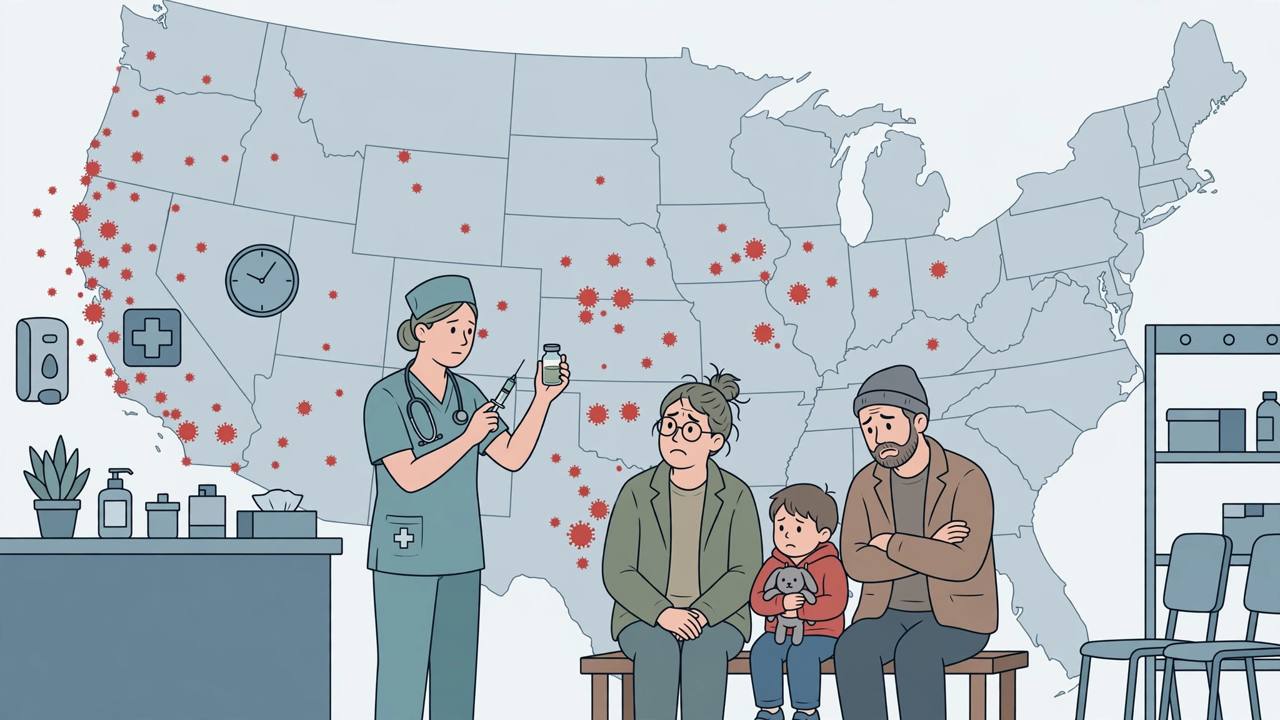
The United States is no longer officially measles-free. The Pan American Health Organization (PAHO), the World Health Organization's regional office for the Americas, announced on Tuesday, November 17, that the United States has lost the measles elimination status it had held for 26 years, after failing to curb the continuous spread of the highly contagious virus for more than a year, Reuters reported.
Source: Reuters
Elimination status never meant zero cases. It is a formal designation a country holds when endemic transmission — the virus spreading continuously from person to person inside the country — has been interrupted. Under PAHO's rules, a country loses the status when transmission of the same virus lineage is re-established and continues uninterrupted for at least 12 months, according to PAHO's Measles and Rubella Elimination Regional Monitoring and Re-Verification Commission. For the United States, the clock started with the West Texas outbreak that began on January 20, 2025, and the 12-month threshold was crossed in January 2026.
How the decision was made
A panel of eight independent experts reviewed epidemiological and laboratory evidence submitted by the Centers for Disease Control and Prevention (CDC) at the commission's meeting in Washington from November 10 to 13. PAHO had asked all 35 member states in the Americas to submit measles status reports. PAHO Director Jarbas Barbosa made the final call and announced it on Tuesday. Bolivia and Mexico lost their elimination status in the same announcement. Canada lost its status at the commission's November 2025 meeting, although Barbosa noted Canada has now gone 60 days without measles transmission, the first step toward regaining the designation.
Source: PAHO via ASTIG
"While this is a significant setback, countries are already taking action to bring their outbreaks under control. Bolivia, Mexico, and the United States are implementing measures to strengthen vaccination, surveillance, and outbreak response," Barbosa said in a media briefing, according to Reuters. Losing the status, he said, signifies that the virus has circulated for a prolonged period, putting people at risk of preventable illness, hospitalization and death.
The numbers behind the decision are the worst in a generation. The CDC count puts 2026 at 5,412 confirmed cases across 45 states and the District of Columbia as of November 12, with more than 590 hospitalizations — the highest annual total since 1991. The CDC's November 13 weekly update showed the total up 230 in a single week, the 14th straight week of a triple-digit increase, CIDRAP reported. In 2000, the year the country was certified measles-free, the CDC reported 85 cases.
The deaths, and why two counts differ
The CDC has confirmed six measles deaths in 2026 as of November 12, while state health departments have reported 10 measles-associated deaths this year — seven in Pennsylvania, two in Wisconsin and one in New York, according to reporting by NBC News and Al Jazeera cited in coverage of the announcement. Reuters, counting from the start of 2025, put the two-year picture at about 7,700 people infected and 13 deaths, the overwhelming majority among people who were not vaccinated. The figures differ because they cover different periods and because the CDC and state tallies are compiled differently; the agency says its death total is subject to change.
Genetic evidence weighed heavily in the ruling. Scientists at Utah's public health laboratory published a preprint in August showing that one measles strain had circulated in that state for more than a year, accounting for more than 95 percent of its cases and more than 600 cases between June 2025 and June 2026 as it moved from the southwest of the state to central Utah. South Carolina, Pennsylvania, Wisconsin and New York have also had sustained outbreaks. "PAHO's ruling formalizes what was already plainly visible. The US has lost the ability to control measles," said Dr. Amesh Adalja, an infectious disease expert and senior scholar at the Johns Hopkins University Center for Health Security, according to Reuters.
Washington's response
CDC Director Erica Schwartz answered by separating the label from the tool. "The measles elimination designation is not what protects Americans, vaccination does," she said in a statement, adding that the agency is committed to stopping outbreaks and planned to work to regain the status, and that it has invested $100 million in state and local health departments. Schwartz told Reuters last week that if the US lost the status, the agency would not change its response. Health Secretary Robert F. Kennedy Jr. said in a social media post that the US would work to regain elimination status and that he recommended vaccination, Reuters reported. The Department of Health and Human Services said national vaccination rates had declined before Kennedy took office; public health experts say his moves to reduce childhood immunizations have increased vaccine hesitancy, Reuters reported.
"For most people, losing measles elimination status may seem like something that doesn't affect them. But if you're a parent of a baby under a year old, your life is going to change," said Daniel Jernigan, former director of the CDC's National Center for Emerging and Zoonotic Infectious Diseases, according to Reuters. "You'll need to be more cautious of being in crowds or traveling on a plane to grandparents since the risk of your baby coming in contact with someone with measles will be getting increasingly higher." Jennifer Nuzzo, director of the Pandemic Center at Brown University, said outbreaks continue in places like Pennsylvania, New York and Wisconsin with no clear evidence transmission has ended nationally.
What this means for families, including Punjabi households in the US
Measles kills one to three people per 1,000 infections and hospitalizes about one in five unvaccinated people who catch it. Two doses of the measles-mumps-rubella (MMR) vaccine are 97 percent effective, and the WHO recommends 95 percent two-dose coverage to achieve herd immunity and protect those who cannot be vaccinated, such as infants. For families in the Punjabi diaspora — including parents travelling with babies to visit grandparents, in either direction across the Pacific — the practical step doctors are urging is simple: find proof of your measles vaccination now, before an exposure forces the question. Cleveland public health director Dr. David Margolius told the Guardian that without that proof, a person exposed to measles faces either a blood test or a 21-day quarantine.
What happens next
To regain elimination status, the United States must submit a corrective action plan and then prove it is free of continuous transmission for 12 months, PAHO officials said. The US is expected to submit its plan in the coming weeks, said Dr. Daniel Salas, executive manager of PAHO's Special Program for Comprehensive Immunization. The designation can be restored: Brazil lost its status in 2019 and regained it in November 2024, and Venezuela lost it in 2018 and regained it in 2023, according to PAHO. Regionally, PAHO's November 17 release reported 58,213 confirmed measles cases and 82 deaths across the Americas as of November 13, compared with 12,806 cases in the same period of 2025. The American Medical Association called the US outcome a "deeply troubling and entirely preventable setback for our nation."
Awaaz Punjab reported on November 13 that US cases had reached 5,412 and that PAHO's decision was due November 17. This story is that decision: the status is formally revoked. The earlier case-count story is at awaazpunjab.com under USA.