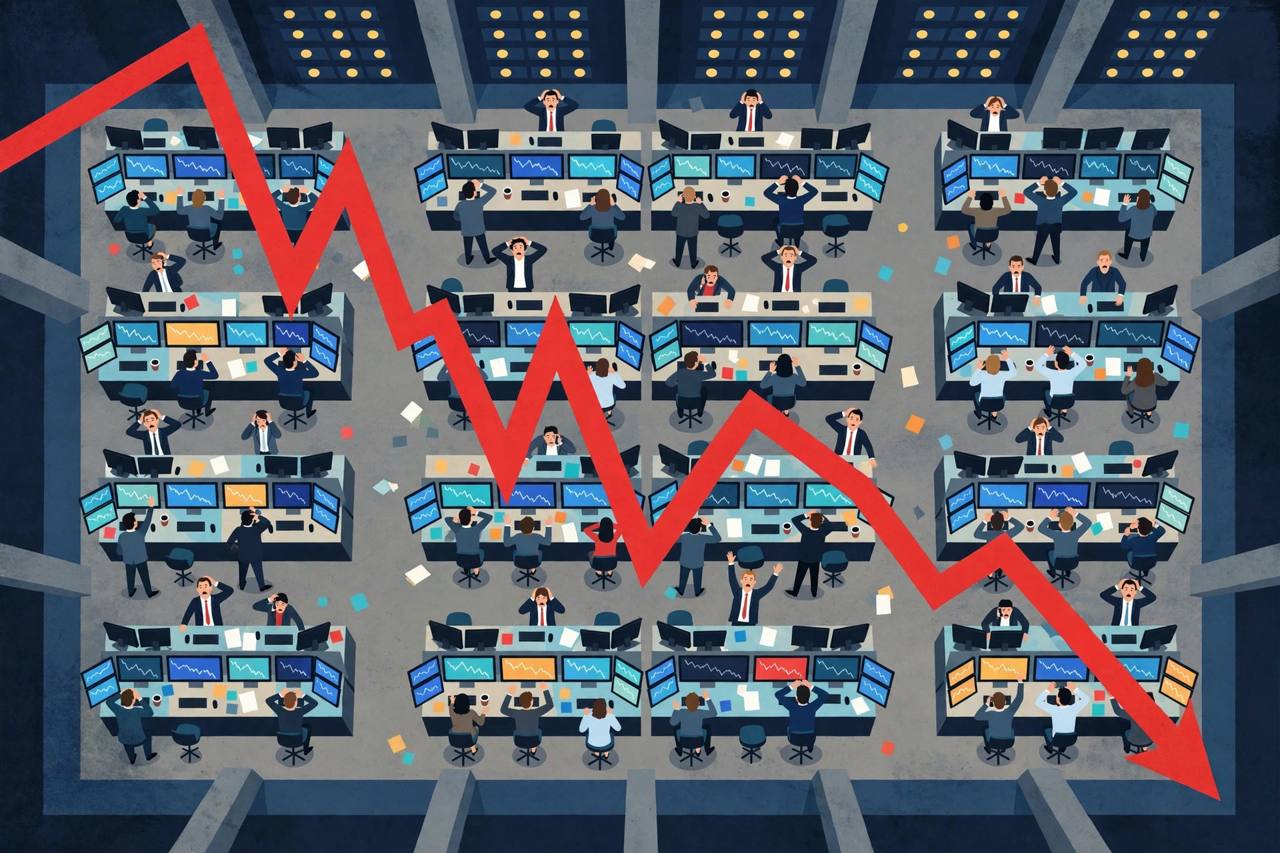
NEW YORK — Wall Street reversed violently on Thursday, November 5, one day after the midterm elections produced the Dow Jones Industrial Average's best session since April 2025. The Nasdaq Composite fell 1,421.52 points, or 5.52%, to close at 24,315.00 — its worst day since April 2025 — leaving the tech-heavy index in correction territory, more than 10% below its October 6 record high, CNN reported. The broader S&P 500 fell 4.4%, its sharpest drop since President Donald Trump announced sweeping global tariffs in April 2025, The Associated Press reported. The Dow lost 1,833.06 points, or 3.44%, to 51,523.06, more than erasing its 1,569-point jump on Wednesday, when Democrats' capture of Congress had been read on the Street as a recipe for predictable, divided government.
Source: SourceFirst News, citing CNN and AP, November 5, 2026
The narrower Nasdaq 100, home to the biggest technology companies, lost 6.36% — its worst day since March 2020. Wall Street's fear gauge, the VIX, posted its biggest one-day jump in almost two years, and the yield on the 10-year Treasury note dropped to 4.83%, a two-month low, as money ran toward bonds, CNN said. The US Times Mirror's account of the close agreed on the headline numbers: the Dow down 1,833 points, or about 3.4%, the S&P 500 down about 4.3% and the Nasdaq down 5.5% into a correction, defined as a fall of more than 10% from a previous peak.
Source: US Times Mirror, November 5, 2026
Chipmakers led the rout
The PHLX Semiconductor Index fell 12.25% to 9,011.14, its worst day in roughly six and a half years, and Nvidia's slide wiped out its gains for the year, CNN reported. At Thursday's 4 p.m. ET close, Micron closed at $656.39, down 17.46%; AMD at $404.40, down 17.26%; Applied Materials at $319.25, down 13.58%; Qualcomm at $156.75, down 9.49%; and Nvidia at $181.60, down 9.26%. SanDisk, another AI hardware firm, plummeted more than 22%, the US Times Mirror reported, while Microsoft closed down more than 3% and Amazon more than 2%. Companies that rent out AI computing power fell with the chipmakers: CoreWeave dropped roughly 10% and Nebius about 15%, CNN said. Qualcomm's slide came a day after its fiscal fourth-quarter results and forecast, which CNBC called disappointing for the current quarter, with smartphone chip sales short of Wall Street estimates, Reuters said.
Why it fell: data-center politics, Texas, and the Fed
Chipmakers sank on fears that Democratic victories — including in states where data-center expansion is disputed — could bring tighter rules that slow the AI infrastructure buildout, Reuters reported; slower construction would cut demand for AI chips and for the electricity and services the boom consumes, the AP noted. Texas was central to those worries, according to CNN: Governor-elect Gina Hinojosa campaigned on a temporary moratorium on data centers and on ending some tax incentives for companies that build them. Wells Fargo puts 27% of planned U.S. data-center capacity, measured in gigawatts, in Texas, Quartz reported, though Republicans still control the state Legislature, which limits how far Hinojosa can change policy.
Local voters also turned against data centers. Of 41 local ballot measures in 10 states that would restrict their construction, the anti-data-center side won in every case but one, in Harwood, North Dakota, CNBC reported, citing Ballotpedia. Meta executive Dina Powell McCormick told a Wall Street Journal conference on Wednesday night that data-center construction is going to be harder after the elections, CNBC said. Yorkville analyst Dan Ives put the fear bluntly: "The Democratic blue tidal wave across the Senate and House was a seismic shift that will have a negative impact on the pace of the AI Revolution buildout in the US over the next few years," he said in a statement reported by the US Times Mirror. OpenAI responded on Thursday by unveiling what it called "responsible AI infrastructure" commitments — vowing to pay for all electricity and infrastructure used at its facilities, to create a water plan for each location, and to create opportunities for local workers and businesses.
Borrowing costs added a second pressure. AI stocks have swung for months on worries that costlier borrowing could slow data-center construction, the AP noted. On Thursday, two regional Federal Reserve presidents — Beth Hammack of Cleveland and Thomas Barkin of Richmond — hinted at the possibility of further rate increases, and traders expected the Fed to raise rates next month after a September hike, Reuters reported. The sell-off spread overseas: South Korea's Kospi index fell 5.3%, the AP said, while Samsung Electronics lost 7.5% and SK Hynix 9.5%, according to Quartz.
A correction is a fall of 10% or more from a recent high — serious, but a recognised market event, not a crash on its own. For diaspora families with retirement accounts and pensions heavy in big tech funds, Thursday's move means paper losses concentrated in AI and chip names, after Wednesday's rally had briefly done the opposite. This report describes what happened; it is not investment advice, and no analyst quoted here is recommending buying or selling.
Analysts split — and what happens next
Analysts disagreed on whether the fall meant anything lasting. In a Reuters report, Melissa Brown, SimCorp's global head of investment decision research, said newly elected officials seem unlikely to halt AI infrastructure development entirely, but any slowdown would worry investors because the AI growth story has largely rested on fast construction. Jed Ellerbroek, a portfolio manager at Argent Capital Management, said the moves looked like capitulation for chip stocks and other beneficiaries of data-center spending, but added that the declines were outsized. CNN reported that Truist's investment chief, Keith Lerner, saw the week's swings as largely a knee-jerk reaction rather than a sign of how tech stocks might fare with Democrats in charge of Congress, while Ed Yardeni, president of Yardeni Research, welcomed a slower buildout, telling CNN: "It's better to let air come out of the AI bubble than let it burst."
Investors now turn to the government's October jobs report, due Friday, November 6 — the first hard economic number of the new political era, and a release that will feed directly into the Federal Reserve's December decision that traders spent Thursday pricing in. A weak jobs number could revive hopes of easier policy and steady the chip trade; a hot one would strengthen the case for the hike Hammack and Barkin hinted at, and keep pressure on the most expensive AI names. Either way, Thursday has redrawn the week's story: the post-midterm rally lasted exactly one session.