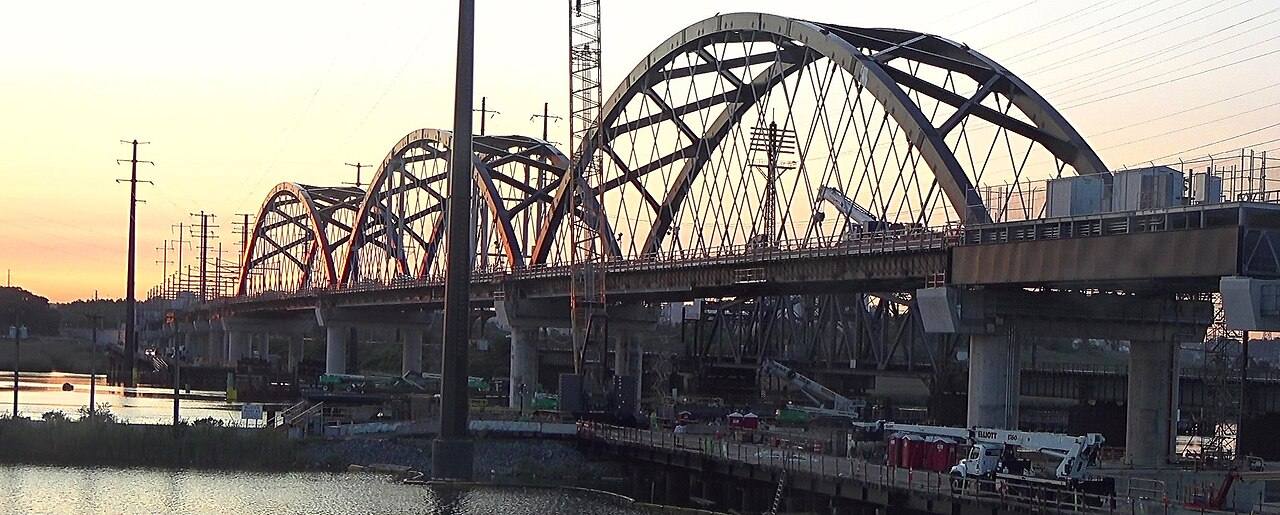
New Jersey's Portal North Bridge is complete. NJ TRANSIT and Amtrak marked the milestone in Kearny on Monday, November 16, after both tracks of the new bridge over the Hackensack River entered full service, officially retiring the 116-year-old swing bridge that had carried trains between Kearny and Secaucus since 1910.
The finish came at the end of a five-week cutover that moved the bridge's second track onto the new span. Work on that second and final track began on October 9 and concluded on November 16, Amtrak said. The first track had been transferred earlier in the year, in a process that began on February 13 and finished on March 15, while the old swing bridge remained in operation alongside it.
Regular NJ TRANSIT weekend service resumed on Sunday, November 15, and regular weekday service resumed on Monday, November 16. The weekday diversions of Midtown Direct trains to Hoboken have ended, cross-honouring arrangements have ended, and full service has resumed between Newark and Secaucus, the agencies said. Riders were advised to consult the timetables for the latest schedules.
A fixed bridge, 50 feet above the river
The new Portal North Bridge is a two-track, high-level, fixed-span bridge. It rises 50 feet over the Hackensack River — double the height clearance of the old bridge — so marine traffic can pass underneath without interrupting rail traffic. The old Portal Bridge was a swing bridge that had to open for boats, and Amtrak and NJ TRANSIT describe it as the enduring source of major service disruptions on the Northeast Corridor, the busiest rail corridor in the United States.
Trains magazine put the total project cost at approximately $2.3 billion and the length of the bridge structure at 2.44 miles. The construction contract itself — $1,559,993,000, awarded in October 2021 to the Skanska/Traylor Bros. PNB Joint Venture — was the single largest construction award in NJ TRANSIT's history, according to Amtrak's project background.
The quantities behind the structure are large even by corridor standards: an estimated 45 million pounds (about 23,000 tons) of steel, 219,000 cubic yards of concrete, 185,000 linear feet — more than 35 miles — of pipe piles, 20,000 linear feet of drilled shafts and 4,850 linear feet of retaining walls, according to Amtrak.
What officials said
"The cutover is complete, and Portal North Bridge is ready to deliver," said Amtrak Interim President Byl Herrmann. "Thanks to the hard work of our crews, and our strong partnership with NJ TRANSIT, both of our customers can now experience the full benefits of the bridge with more reliable, faster service."
Governor Mikie Sherrill said New Jersey commuters "deserve to get to work on time and get home to their families without a century-old bridge holding up the entire Northeast Corridor," adding that with both tracks now in service the state is "eliminating a major source of delays." NJ TRANSIT President and CEO Kris Kolluri said the new bridge "permanently removes a chronic source of delays, allowing marine traffic to pass beneath the bridge without interrupting the trains carrying our customers to work, home and everywhere in between."
Federal officials put their contributions on the record at the ceremony. Federal Railroad Administration Administrator David Fink cited what he called the Trump Administration's $771 million investment in the project, and Federal Transit Administration Region 2 Administrator Michael Culotta said the FTA had supported construction with an investment of $926 million. Amtrak's background notes that a Full Funding Grant Agreement signed in January 2021 secured $766.5 million in FTA funding, and that the project was funded by the U.S. Department of Transportation, New Jersey, New York and Amtrak.
Why this bridge held up a whole corridor
The Portal Bridge's failures were a byword for Northeast Corridor delay: a low swing span, opened in 1910, that had to rotate for river traffic and then line its rails back up precisely before trains could cross. Senator Cory Booker noted at the ceremony that the aging bridge "served the region from 1910 through this October," and Senator Andy Kim said commuters can now expect "easier travels without the delays and cancellations caused by crumbling and outdated infrastructure." During the two cutovers, riders paid for the fix in advance — the five-week second-track cutover required significant reductions and reroutes of NJ TRANSIT commuter trains and reduced Amtrak service, Trains reported.
For New Jersey's large Punjabi and wider South Asian communities — concentrated in Middlesex County around Edison and along the Northeast Corridor line — the bridge is part of the daily commute into New York Penn Station, and its reliability is a work-and-family issue as much as an engineering one. Gateway Development Commission CEO Tom Prendergast called the completion "a milestone for the history books" and said that, together with the Hudson Tunnel Project, it shows progress toward "a stronger transportation network."
What happens next
The old Portal Bridge is scheduled to be dismantled in 2027, Amtrak said. Portal North is the first of the Gateway Program's 11 projects to be completed, Senator Booker noted; the wider Gateway Program is intended eventually to double rail capacity between Newark and New York. NJ TRANSIT and Amtrak say the new bridge brings improved reliability, fewer bridge-related delays and a structure designed to support future capacity growth — claims riders on the corridor will now test in daily service, starting with the full weekday schedule that resumed on November 16.