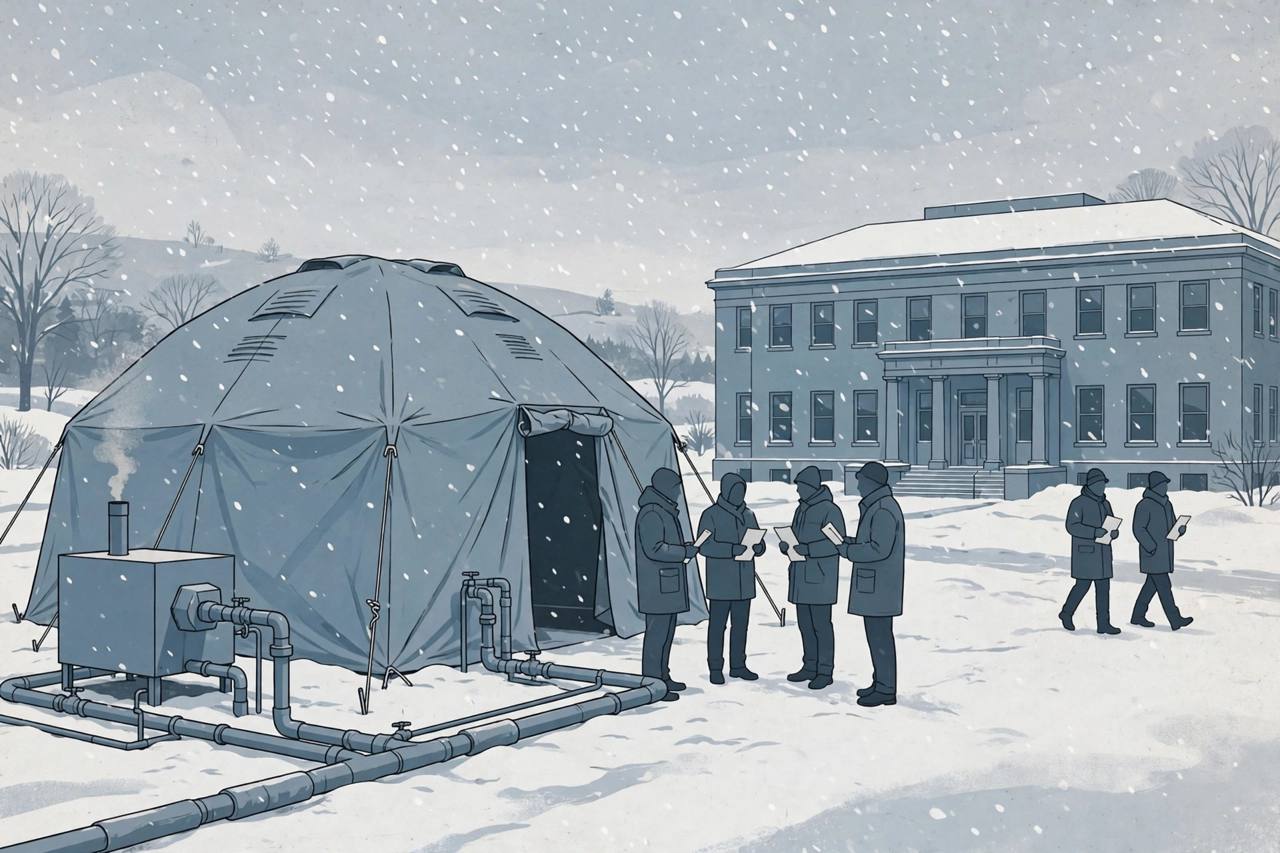
BATAVIA, New York — Governor Kathy Hochul on Wednesday, November 18 released letters from two New York State agencies demanding answers from U.S. Immigration and Customs Enforcement (ICE) and its contractor about a tent detention facility under construction at the Buffalo Service Processing Center in Batavia — and gave them a written deadline of Wednesday, November 25, 2026 to respond.
Source: Office of Governor Kathy Hochul, Nov 18, 2026
The letters, dated November 17 and signed jointly by the State Department of Environmental Conservation (DEC) and the State Department of Health (DOH), were sent to ICE Deputy Director Charles Wall and to Laura Mitchell, president of the contractor, Akima Infrastructure Protection LLC. They say the facility may be used to detain up to 100 women of all security levels, that construction is already underway — and that the State has received no information or outreach about the project from the federal government or from Akima, according to ABC News and the governor's release.
This is a follow-up development in a story this site reported in October, when documents forced out of the Department of Homeland Security by U.S. Representative Tim Kennedy detailed a nearly $17 million, two-year expansion at Batavia — the largest ICE detention centre in New York State — designed to hold women at a facility that until now has held only men. Wednesday's letters are the State government's first formal, public step into that fight, and they move it from Washington oversight to Albany's environmental and public-health regulators.
What the State is asking ICE
In the letter to ICE, DEC and DOH ask whether any federal agency has authorised Akima to tie into the existing water, sewage, electrical or other infrastructure at the Batavia centre. Federal contract documents, the agencies note, describe the new structure's utilities as “self-sustaining” and say they “shall not tie into existing water, sewage, electrical, or other facility infrastructure unless expressly authorized by the Government.” If a connection was authorised, the State wants the specifications.
Source: DEC/DOH letter to ICE, Nov 17, 2026
ICE is also asked to list every permit, registration or approval obtained for the facility; to produce any environmental review or categorical-exclusion determination made under the National Environmental Policy Act (NEPA); and to hand over any correspondence with local governments under NEPA and the Intergovernmental Cooperation Act. The agencies say permits or registrations under State law — including water-discharge and air-pollution permits — may be required depending on the project's details.
Twelve questions for the contractor
The companion letter to Akima puts 12 questions to the company, covering the practical systems a residential facility needs before anyone sleeps in it: how drinking-water and wastewater systems will work and keep working in freezing temperatures; how heating, cooling and electricity will be provided; whether generators or boilers will create air or noise pollution requiring permits; how food will be stored and meals distributed; how living spaces, bathrooms and showers will be kept clean; and what happens if the water supply is disrupted, including by freezing weather.
The medical questions are just as specific. The State asks how the facility would respond to staffing shortages during a communicable-disease outbreak, and where people would be taken for emergency treatment. It also asks whether construction involves excavation or other ground disturbance, and which construction approvals have been requested. The letters do not say an outbreak or a shortage has occurred at the new structure — they ask for the plans before it opens.
Why winter is the State's central worry
Batavia sits in Genesee County between Buffalo and Rochester, in the Lake Erie snow belt, where extended subfreezing temperatures and winter storms are routine. The agencies' letter argues that building and running a safe tent-based residential facility is difficult in any weather, and cites what federal watchdogs have already documented at other tent detention sites: problems with the prevention and control of tuberculosis at Camp East Montana at Fort Bliss, Texas, reported by the U.S. Government Accountability Office, and, at Florida's Everglades Detention Facility, unsanitary drinking water, limited access to showers, insect infestations and a raised risk of foodborne illness from improperly stored food, found by the Department of Homeland Security's own Office of Inspector General.
State documents describe a tent or soft-sided facility, and federal contracting records call the structure “soft sided.” But a footnote in both State letters acknowledges that a separate federal letter described it as hard-sided. The released documents do not settle the final design — or how it will perform in a western New York winter.
Background: the expansion Albany is now questioning
The Buffalo Service Processing Center has a stated capacity of 650 beds and, as this site reported in October, typically operates over that capacity. Until this expansion it housed only men; women detained by ICE in western and upstate New York were held in county jails under contract or transferred out of state, including as far as Louisiana. The expansion's details became public only after Representative Kennedy's oversight letter of July 8 forced a reply from Homeland Security Secretary Markwayne Mullin, which arrived on September 29 — 76 days past the deadline Kennedy had set — with bed numbers and pricing partly redacted. DHS's own data cited in that reporting said 72 percent of the centre's detainees had no criminal record.
The State is careful about what its letters are not. They announce no permit denial, no stop-work order, no court judgment and no completed enforcement finding — they raise questions, and the agencies say aspects of the construction and operation may fall under their regulatory authority over environmental and public-health matters. As of the materials released on Wednesday, neither ICE nor Akima had answered the November 17 questions; the deadline for doing so has not yet arrived.
For immigrant families across New York — including Punjabi and other South Asian families in the Buffalo, Rochester and downstate communities who follow detention policy closely because a single detention can separate a household — the practical questions in these letters are the ones that matter first: safe drinking water, heat that works in a lake-effect storm, showers and sanitation, food stored safely, and a real plan for medical care and emergencies. What happens next is dated and public: written answers are due by Wednesday, November 25, 2026, and whether those answers — on the structure's final design, its opening timeline, its utility arrangements and its medical contingency plans — become public will be the next development in this story.