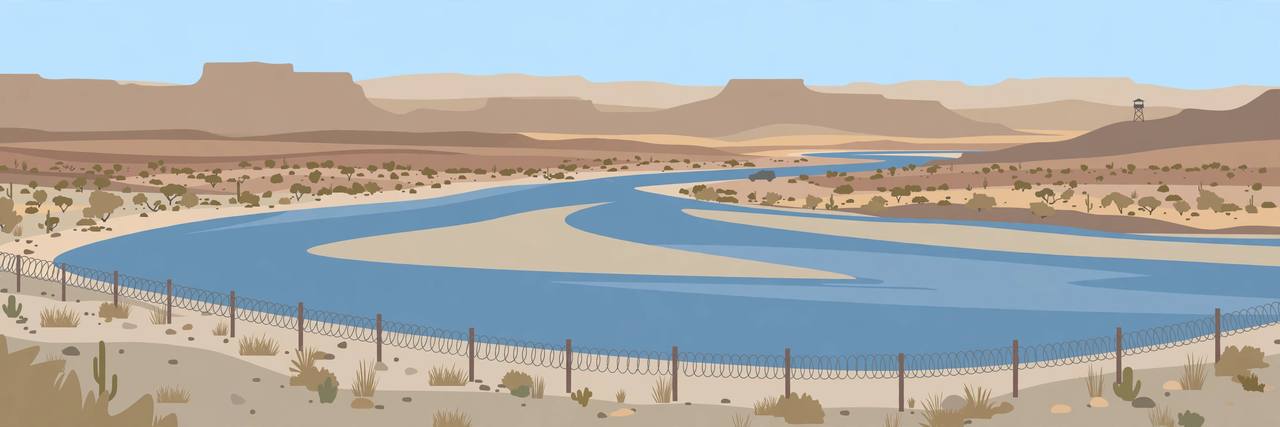
Texas has secured a 30-year deal to keep its concertina wire along the US-Mexico border, ending a three-year legal fight over the razor-wire barrier that became one of the sharpest symbols of the clash between the state and the federal government over immigration enforcement. Attorney General Ken Paxton announced the settlement on Thursday, November 19, saying the agreement protects the wire Texas laid along the Rio Grande in the Border Patrol's Del Rio Sector.
Source: Bloomberg Law
Under the settlement, federal agents may not willfully cut, damage, destroy, remove, or otherwise interfere with Texas's concertina wire on non-federal land within 25 miles of the border in the Del Rio Sector. The agreement binds the US Department of Homeland Security, US Customs and Border Protection, and the US Border Patrol, including their current and future officials, and it will remain in effect for 30 years.
Source: Office of the Texas Attorney General
The deal does allow narrow exceptions. Federal agents may cut the wire to provide emergency aid, to apprehend and process people crossing the border illegally, to respond to serious public safety threats, or to repair federal border infrastructure. In those cases, federal officials must notify Texas within 72 hours, temporarily repair the barrier where feasible, and coordinate with the state in advance of any non-emergency work.
Source: Office of the Texas Attorney General
"Through coordination between federal and state authorities, this settlement ensures that concertina wire will remain in place to protect our southern border. We must never stop fighting to protect our nation from those who seek to destroy it," Attorney General Ken Paxton said in announcing the deal.
A three-year court fight
The dispute began in October 2023, when Paxton sued the Biden administration after Border Patrol agents cut concertina wire that Texas had deployed along the river to slow illegal crossings. Texas quickly won an emergency restraining order from a federal judge in Del Rio, who found the federal government's actions likely unlawful, but the judge later declined to grant a longer preliminary injunction.
Source: Office of the Texas Attorney General
Paxton appealed, and the US Court of Appeals for the Fifth Circuit first issued an administrative stay and then an injunction pending appeal, barring federal agents from destroying the wire while the case continued. In January 2024, the US Supreme Court, in a 5-4 decision, vacated that injunction and allowed Border Patrol agents to cut the wire. Then in November 2024, the Fifth Circuit granted Texas a preliminary injunction that barred federal agents from interfering with the wire near Eagle Pass.
Source: Texas v. DHS, 5th Cir. 2024
The new settlement replaces that litigation with a negotiated deal. Instead of relying on court orders that could be revisited, Texas now has a written agreement, signed with the Trump administration's Homeland Security Secretary Markwayne Mullin and Customs and Border Protection Commissioner Rodney S. Scott, that runs for three decades.
Source: Bloomberg Law
Why the wire matters
The concertina wire was laid as part of Operation Lone Star, the border-security programme Governor Greg Abbott launched in 2021. The state has spent more than $11 billion on the operation, deploying thousands of National Guard members and state troopers, building its own sections of border barrier, and placing wire along the banks of the Rio Grande, most visibly at Eagle Pass and in Shelby Park, where Texas at one point barred Border Patrol agents from the riverfront.
Source: Bloomberg Law
The Del Rio Sector is one of nine Border Patrol sectors along the southwest border, covering a long stretch of the Texas-Mexico line. The 25-mile zone named in the settlement covers the ground where the wire fight was fiercest, and the agreement means the state, not the federal government, now has the final say over that barrier for the next 30 years.
What it means for Texans — and the Punjabi community
Texas is home to one of the largest Punjabi communities in the United States, centred on Houston, and the settlement locks in a hard-line state border posture for a generation. For immigrant families in the state, it is another sign that the alignment between Texas and the federal government on enforcement is now written into a long-term agreement, not just a policy of the moment. Anyone navigating the immigration system in Texas should expect that posture to hold.
For Punjabi truckers who run the Texas corridors, the deal itself changes little day to day: it governs the wire on the riverbank, not the ports of entry or commercial crossings, so there is no direct change to freight inspections or border-crossing procedures. But the Del Rio and Eagle Pass corridor remains one of the most heavily enforced stretches of the southern border, and drivers should continue to expect a strong law-enforcement presence on the routes through the region.
What happens next
The settlement takes effect immediately, and the wire stays in place. If federal agents ever need to cut it, they must tell Texas within 72 hours and make temporary repairs where possible. Because the deal binds future federal officials as well, it will outlast the current administration. Texas voters elected Democrat Gina Hinojosa as governor on November 3, and she has criticised parts of Operation Lone Star, but this settlement is between the state and the federal government, so its terms stand regardless of who holds the governor's office. The next test will be how the two sides handle the first emergency cutting under the new rules.