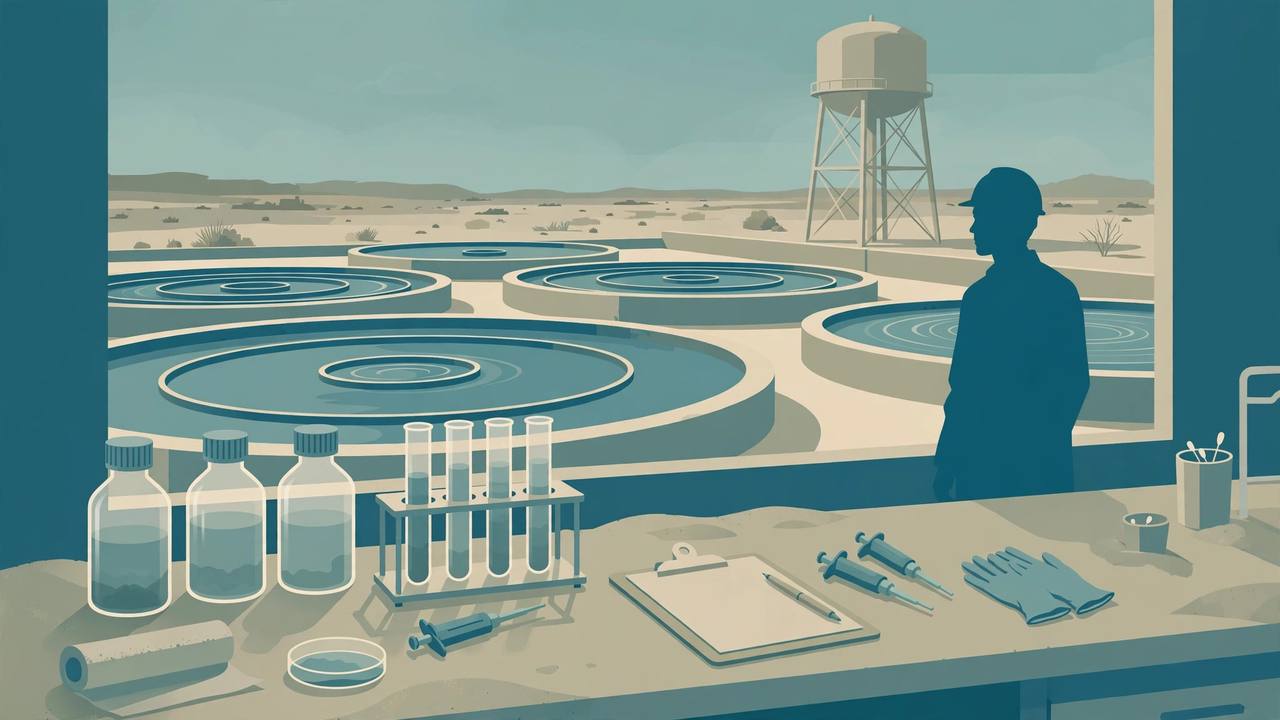
The former chief executive of a Texas wastewater-testing laboratory has been ordered to federal prison for falsifying the very test results that treatment plants rely on to prove their discharged water meets pollution limits. Derek McCoy, 52, of The Woodlands, was sentenced to 12 months in federal prison, followed by one year of supervised release, and ordered to pay a $250,000 fine for violating the Clean Water Act, the U.S. Attorney's Office for the Southern District of Texas announced.
Source: U.S. Attorney's Office, Southern District of Texas
Senior U.S. District Judge David Hittner imposed the sentence in Houston. McCoy had pleaded guilty on June 11 to falsifying, or aiding and abetting the falsification of, data required under federal and state law. The judge permitted him to remain on bond and to voluntarily surrender to a Federal Bureau of Prisons facility that will be designated in the near future. The Woodlands Online, the community's local news outlet, reported the same sentence, fine and case details.
Source: The Woodlands Online
Falsified results hid real pollution breaches
McCoy served as chief executive and part-owner of a laboratory that sampled and tested wastewater from local treatment facilities. Prosecutors said that for approximately three years, McCoy and others participated in falsifying wastewater test results to make it appear that the treatment facilities complied with the pollutant limits set in their state-issued discharge permits.
The falsified results concealed exceedances — readings above the legal limits — for ammonia, E. coli and phosphorus, and the doctored reports were submitted to both the U.S. Environmental Protection Agency and the Texas Commission on Environmental Quality, the state's environmental regulator.
A federal court filing in the case, the information filed in the Southern District of Texas (case 4:25-cr-00404), cited approximately 36 occasions between February 9, 2021, and February 14, 2024, on which false material statements were made in records required under the Clean Water Act.
Why wastewater test data matters
Wastewater plants do not police themselves on trust alone: their discharge permits set legal limits for what can flow out of the plant, and laboratory test results are the evidence regulators — and the public — rely on to know whether those limits were met. When the results are falsified, real breaches stay hidden on paper, and pollution above permit limits can pass into local waterways without ever triggering an inspection, a fine or a cleanup order.
The three pollutants in this case are standard warning signs in treated wastewater. E. coli is used as an indicator of fecal contamination, ammonia is toxic to aquatic life at elevated levels, and phosphorus feeds the algal growth that can choke waterways. Concealing exceedances of all three, prosecutors said, made non-compliant plants look compliant for years.
Co-defendants and the investigation
McCoy was not the only person at the laboratory to admit guilt. When the guilty pleas in the case were announced, prosecutors said two colleagues had also pleaded guilty: Higginbotham, 56, of Spring, who served as the laboratory's director of client services, and John Montgomery, 60, of Llano. Trade publication Wastewater Digest reported the same three guilty pleas and the same falsified pollutants.
Source: Wastewater Digest
The investigation was conducted by the EPA's Criminal Investigation Division and its Office of Inspector General, together with the Texas Commission on Environmental Quality's Environmental Crimes Unit, working through the Texas Environmental Enforcement Task Force.
McCoy remains on bond until he voluntarily surrenders to the federal prison facility designated for him. After his 12-month prison term he will serve one year of supervised release, and the $250,000 fine ordered by Judge Hittner stands as part of the sentence.
For communities north of Houston, including The Woodlands, the case lands close to home: the treatment facilities whose water was tested serve local neighborhoods, and their permits are only as reliable as the laboratory numbers behind them. It is now for the regulators who received the falsified reports — the EPA and the Texas Commission on Environmental Quality — to judge which of the results submitted over those three years can still be trusted.