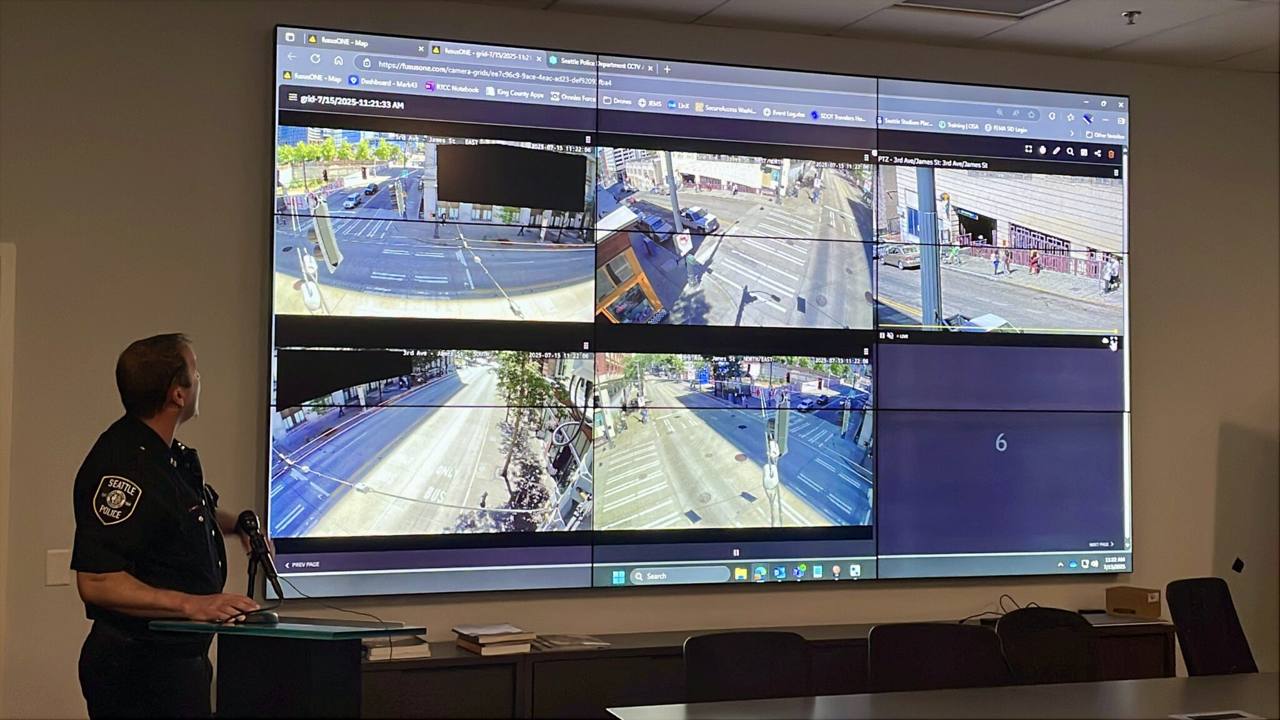
Seattle will expand its police surveillance camera network to three more neighborhoods after Mayor Katie Wilson announced on Tuesday, November 10, that she is ending the pause she placed on the program in March, the Mayor's Office confirmed. The decision follows an independent audit of the Seattle Police Department's Real Time Crime Center (RTCC) by New York University's Policing Project, released on Monday, which found the city had built “an important foundation” for overseeing the system but that “significant policy gaps remain.”
Source: GeekWire
The cameras in the Stadium District, installed before this summer's FIFA World Cup, will be switched on immediately, according to the Mayor's Office. Cameras around Garfield High School in the Central District and in the Capitol Hill nightlife district still have to be purchased and installed, a process the city says will take months. All three areas were approved by the Seattle City Council in 2025. Wilson briefly turned on the 22 stadium-area cameras during the World Cup, citing “credible threats” reported by law enforcement, and the audit noted police streamed live feeds throughout the tournament despite a department policy against monitoring cameras without an active call or case.
Seattle's closed-circuit television (CCTV) pilot began in April 2025 in three areas — the Chinatown-International District, downtown and Aurora Avenue. The City Council voted in September 2025 to expand it to the three additional areas, but Wilson, who had opposed the expansion on the campaign trail, paused the rollout in March 2026 over privacy and civil-liberties concerns and commissioned the NYU audit before deciding whether to proceed.
What the audit found
The NYU Policing Project audit made 19 recommendations, including clarifying and limiting how RTCC data is used, limiting unnecessary data retention, and being more transparent with the public about the system and the policies governing it. The auditors found the broader research evidence on whether crime centers prevent crime to be thin, and noted that the police department counts any analyst action — such as calling up a single camera — as “support” for a case. The department says the RTCC assisted in 17 homicide cases in 2025, helping to close 10 of them, and that officers and detectives are three times more likely to make an arrest with help from crime center analysts.
Source: PubliCola
“After reviewing the evidence, the recommendations, and the safeguards available to us, I believe there is an important and responsible role for the RTCC within Seattle's public-safety system,” Wilson said in a statement issued by the Mayor's Office. “We can gather evidence to hold those who commit violent acts accountable and protect our neighbors targeted by federal overreach.” Wilson said she paused the expansion because “we needed to ask some hard questions about data security and the protection of civil liberties, especially in the context of a federal administration that is targeting vulnerable communities and violating civil rights.”
Source: City of Seattle, Mayor's Office
The audit's most ambitious recommendation — requiring police to obtain a warrant before searching footage retrospectively to track a person's past movements — was not part of Wilson's announcement. The auditors also warned that no recommendation can fully put footage beyond federal reach, because outside agencies can obtain it through public records requests or court orders served on the city or on Axon, the vendor that stores some police video in its cloud. Wilson said that if the city receives a law-enforcement request it cannot legally refuse, “we will shut down the camera system at least for 60 days.”
Inside the RTCC, which launched in 2025, analysts in a command room at police headquarters watch 911 calls as they come in and pull up nearby cameras to give responding officers details callers may have missed, and they search recorded footage to help detectives investigate past crimes. The center draws on 303 police-owned cameras at 61 sites, 116 security cameras at police buildings, 96 city traffic cameras and 23 cameras owned by three local businesses that share their feeds. The system runs on Fusus software from Axon. Police are barred from using facial recognition with the system.
Interim Police Chief Andre Sayles welcomed the decision. “Keeping the public safe is my number one priority, but we must insure people's privacy rights and civil liberty concerns are addressed,” Sayles said in the Mayor's Office statement. Councilmember Rob Saka applauded the activation of the Stadium District cameras, and business groups backed the move: Jon Scholes, president and CEO of the Downtown Seattle Association, said police staffing is “still lagging” and additional tools “are essential for solving crimes,” while the Seattle Metro Chamber and Challenge Seattle cited a poll they commissioned this year that found 75% of Seattle voters support using cameras to help active investigations.
Source: City of Seattle, Mayor's Office
Civil-liberties advocates reacted sharply. Tee Sannon, technology policy program director for the ACLU of Washington, said the group was “deeply disappointed,” adding that with the audit having “reaffirmed significant gaps in privacy protections and accountability,” expanding the network “is a step in the wrong direction.” “Used together, CCTV and RTCC supercharge law enforcement's capabilities to monitor, track, and reconstruct people's movements across the city,” Sannon said. Critics have warned footage could end up with federal immigration agents or out-of-state prosecutors pursuing people who come to Washington for abortions or gender-affirming care; the audit found state and city laws limit such sharing but cannot fully prevent it.
For Seattle's immigrant communities — including the Punjabi diaspora families and truck drivers who live in and pass through the Puget Sound region — the federal-access question is the heart of the debate. Wilson framed her safeguards as a direct response to that concern, pledging nation-leading protections for “neighbors targeted by federal overreach,” while the ACLU of Washington argues the protections remain unenforceable promises until they are written into binding policy with strict limits on use, retention and sharing, plus independent oversight.
What happens next
The Mayor's Office said the police department will complete and publish a public dashboard reporting RTCC usage, finish an omnibus surveillance technology policy, and tighten its rules on permissible uses, access criteria and logs, data retention periods, requests from outside agencies and regular internal audits. An advisory group including the Community Police Commission, the Community Surveillance Working Group, city IT and council staff and police will meet over the next few months to draft policies on private-camera integration, use of the center during protests and other First Amendment activity, and criteria for any future camera placements. The city's Office of Inspector General plans periodic, unscheduled “spot checks” of the RTCC in 2027, and a University of Pennsylvania evaluation of the program, commissioned by the inspector general, is not expected until late 2027. The city also plans groundwork to connect cameras run by Seattle Center tenants and nearby businesses after interest followed the Bite of Seattle shooting in July; police have bought about 100 devices that let businesses stream video to the center but have not yet decided who will receive them.