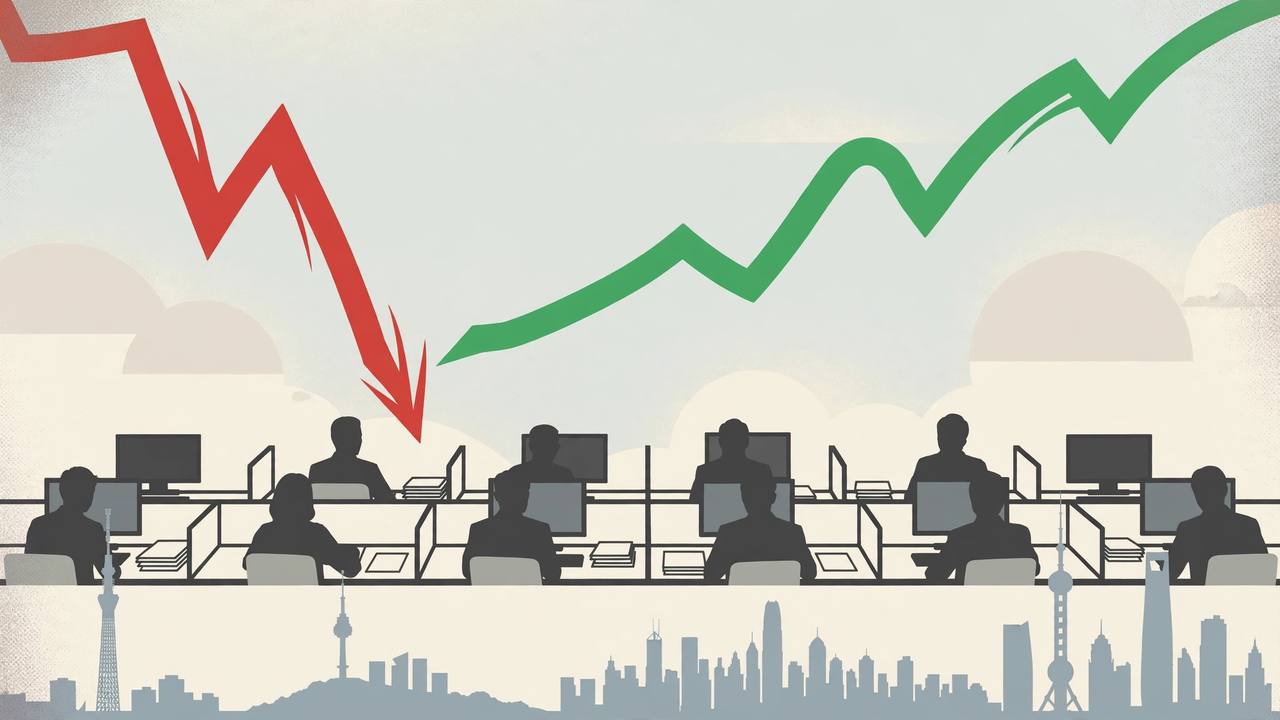
Asian stock markets staged a dramatic about-face on Wednesday, November 4: a morning selloff driven by the US midterm results and a rout in artificial-intelligence shares gave way to an afternoon relief rally as Democrats took control of both houses of Congress, Dow Jones Newswires reported in its second update of the day.
Source: Dow Jones Newswires via Morningstar
The reversal followed the morning plunge Awaaz Punjab reported earlier on Wednesday, when the Nikkei fell more than 4 percent to a five-month low as early midterm counts hit AI shares. Read the earlier story: Asian stocks plunge as the US midterm count hits AI shares
Investors sold stocks and the dollar and bought US Treasuries as results poured in early on Wednesday showing a Democratic wave across the United States, Dow Jones reported. But markets pulled off their lows later in the day in what analysts described as likely relief that some clarity had emerged — even if the result was not what most market participants had expected.
Source: Dow Jones Newswires via Morningstar
How the day turned
Japan's Nikkei, which had crashed 3,051.76 points intraday to 60,030.10 — down 4.8 percent from its previous close of 63,081.86 — ended the day only 1.42 percent lower at 62,188.63, according to dpa-AFX reporting carried by TradingView and exchange data cited by Upstox. Taiwan's Taiex was last 0.8 percent lower, also well off its lows.
Source: dpa-AFX via TradingView
South Korea's Kospi went furthest: after tumbling about 4 percent intraday to 5,421.72, it erased its losses completely and was last trading 0.3 percent higher, Dow Jones reported. Hong Kong's Hang Seng rose 1.3 percent in the same late snapshot before closing up 1.67 percent, and China's Shanghai Composite gained 1.7 percent after the lunch break before closing 2.16 percent higher, led by technology and healthcare stocks.
Source: Dow Jones Newswires via Morningstar
Dollar, bonds, gold and oil
The US dollar index steadied after touching its lowest level in over a month, firming to 101.50, while the benchmark 10-year Treasury yield calmed to 4.942 percent after slipping to around 4.900 percent — its lowest since early September — as the Democratic wave forced traders to rethink President Donald Trump's remaining policy agenda, Dow Jones and dpa-AFX reported. Spot gold and silver jumped 2.0 percent and 3.3 percent respectively, and gold held above $4,000 an ounce in Asian trade on the softer dollar and lower yields.
Source: dpa-AFX via TradingView
Oil reversed earlier losses too: front-month Brent futures were last up 0.1 percent at $103.73 a barrel and WTI at $96.18, after sharp swings in the previous session amid uncertainty over the US-Iran peace talks. Cryptocurrencies pared losses alongside equities, with bitcoin nearly erasing its fall to sit down 0.2 percent at $77,697.45 and Ethereum down 0.3 percent.
Source: Dow Jones Newswires via Morningstar
Why traders changed their minds
Analysts had warned against reading too much into knee-jerk reactions to the midterm outcome, expecting focus to return to fundamentals once the results gave some clarity. James Ooi, chief market strategist at Tiger Brokers, said in a note that market reactions would hinge less on which party won than on how the results compared with what investors had expected — a test the Democratic sweep initially failed in the AI-heavy Asian markets before the relief buying began.
Source: Dow Jones Newswires via Morningstar
The morning fear had a specific shape: a commanding Democratic win raised uncertainty over technology regulation, trade policy and the US budget deficit, and the selling was concentrated in the AI supply chain — the chip and equipment makers of Japan, South Korea and Taiwan that had carried Asia's rally. By the close, that fear had been repriced, not removed: the Nikkei still finished lower, and the questions over tech regulation and Trump's remaining agenda did not disappear with the closing bell.
Source: dpa-AFX via TradingView
What happens next
US equity futures narrowed their losses as Asia closed, led by shares tied to the tech-heavy Nasdaq — E-mini Nasdaq futures were last down 0.4 percent after slumping over 2 percent earlier. Whether Wall Street completes the same round trip Asia just made is the next test, along with how a Democratic Congress handles the budget, tech regulation and the Iran war that has kept Brent above $100 (yaani tel dian keemtan vich vada dabaa) and global inflation pressures alive.
Source: Dow Jones Newswires via Morningstar
Asia's midterm whiplash in one day: a 4.8 percent Nikkei crash in the morning became a 1.42 percent dip by the close, the Kospi erased its losses entirely, and Shanghai and Hong Kong finished firmly higher — relief that the US result was finally clear beat the first fear of what it meant.