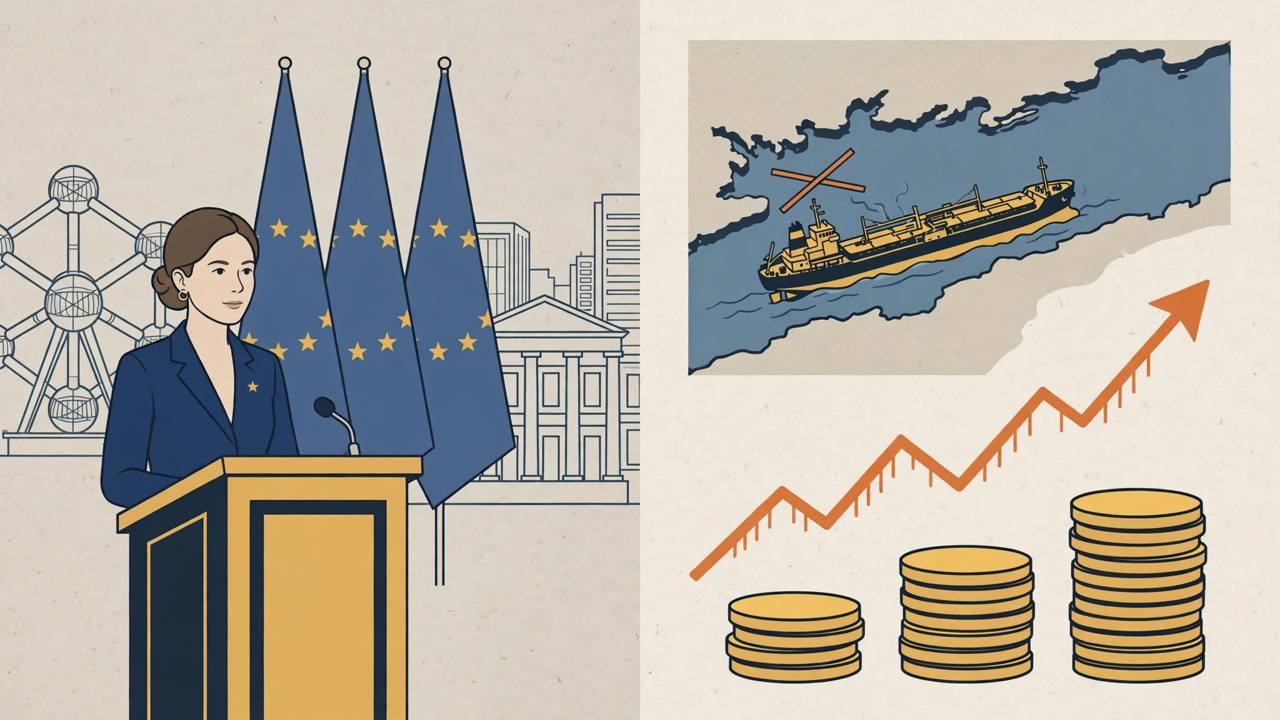
BRUSSELS, November 3 — The closure of the Strait of Hormuz has cost Europe an additional €127 billion in fossil-fuel import bills, European Commission President Ursula von der Leyen said on Tuesday, amid fears of a re-escalation of the US-Iran war after Monday night's US strikes on Iran's Qeshm Island at the mouth of the strait, the Brussels outlet Rapporteur reported.
Source: Rapporteur
"Since the closure of the Strait of Hormuz, imported fossil fuels cost Europe an additional €127 billion without a single molecule of energy in addition," von der Leyen said, speaking at the WinWin Summit at the Royal Library of Belgium in Brussels, according to Italy's ANSA news agency. "€127 billion just because of the closure of this Strait of Hormuz. So when we import oil and gas, we also risk importing the shocks and the crisis that come with them."
Source: ANSA via Europe Says
Why a blocked strait in the Gulf bills Europe
Roughly a fifth of the world's seaborne oil and liquefied natural gas passed through the Strait of Hormuz before the United States and Israel attacked Iran in late February, Rapporteur noted. Tehran then de facto closed the strategic waterway and attacked energy infrastructure in neighbouring Gulf states, and shipping through the strait has since fallen to a fraction of its peacetime flow. The International Energy Agency has called the resulting disruption the biggest energy shock in history, and analysts cited by Al Jazeera estimate that the closure and attacks on energy infrastructure have cut global daily oil production by about 14.5 million barrels.
Source: Rapporteur
On November 2, the chief executive of the Abu Dhabi National Oil Company (ADNOC) said global oil inventories had declined by nearly 1 billion barrels since the US-Israeli war on Iran disrupted shipping through the strait — a drawdown that keeps prices high even on days when no shot is fired.
Source: Seoul Economic Daily
A bill that keeps climbing: €27 billion, then €90 billion, now €127 billion
Von der Leyen has been counting the cost in public since the spring. On April 29 she told the European Parliament in Strasbourg that the bloc was losing nearly €500 million a day and that the import bill had already risen by more than €27 billion in the war's first 60 days. EU Energy Commissioner Dan Jorgensen separately put the extra bill at more than €30 billion (about $35 billion). In her September 16 State of the Union address, von der Leyen raised the figure to €90 billion. Tuesday's €127 billion is the same measure, six weeks on — evidence that every additional week of closure adds tens of billions to Europe's bill even as Brent crude, at about $105 a barrel on Tuesday, sits below its wartime peaks.
Source: ANSA via Europe Says
Independent analysts tracking the same shock have produced smaller but consistent numbers for parts of the bloc: the Centre for Research on Energy and Clean Air estimated that just four EU countries — the Netherlands, Italy, France and Spain — absorbed roughly €41 billion in extra fossil-fuel costs between March and August. Von der Leyen's figure covers all 27 member states over the full period since the closure, and concerns fossil-fuel imports specifically; it is not a total estimate of the war's damage to the European economy.
Source: Rapporteur
Oil markets: a 7.6% plunge, then the Qeshm strikes
The Brussels speech landed in a week of violent oil-price swings that show how completely the market now trades on Hormuz headlines. On Monday, Brent crude futures fell 7.63% to settle at $104.77 a barrel — the sharpest one-day drop in months — as hopes rose that Washington and Tehran could reach a deal to end the war, the Seoul Economic Daily reported. Hours later, US forces struck Iranian targets on Qeshm Island, which guards the strait's entrance, in what US officials described as defensive strikes after Iranian fire at US assets; by Tuesday, Brent had recovered part of the fall, trading up about 0.5% at $105.25 in Asian trade, Reuters reported. Iran has offered to reopen the strait within two days if Washington meets its conditions — including lifting the US naval blockade of Iranian ports and sanctions on its oil — and Qatar says both sides are studying mediator proposals for an interim deal, but no agreement has been announced.
Source: Seoul Economic Daily
The Qeshm strikes were the latest in a series of unannounced, limited US attacks on Iranian positions around the strait in recent weeks, which President Donald Trump confirmed on Tuesday as a 'minor attack' on an Iranian air-defence system. Read the earlier report: Trump confirms 'minor' Qeshm attack
What it means beyond Europe — Gulf workers and the diaspora
Europe's €127 billion is only the most precisely counted part of a worldwide bill. The same closure that taxes European importers keeps Gulf shipping at a standstill, squeezes the oil and gas revenues of the Gulf states where lakhs of Punjabi and Indian workers are employed, and holds freight and fuel costs high on the routes those workers fly home. Von der Leyen used the figure to argue that Europe must cut its dependence on imported oil and gas and speed up homegrown clean energy — and, speaking at a summit for start-ups, that Europe must again become a place where its scientific discoveries create industries and jobs at home, ANSA reported.
Source: ANSA via Europe Says
What is solid
- Von der Leyen said on Tuesday in Brussels that the Hormuz closure has cost Europe an extra €127 billion in fossil-fuel imports 'without a single molecule of energy in addition' (Rapporteur; ANSA).
- The figure is the same measure she has updated through the war: over €27 billion after 60 days (April 29), €90 billion on September 16, €127 billion on November 3.
- About a fifth of the world's seaborne oil and LNG used the strait before the war; traffic has since fallen to a fraction of peacetime levels.
What is only claimed
- The €127 billion is the European Commission president's figure for extra fossil-fuel import costs across the EU-27; independent trackers counting fewer countries or shorter periods report lower totals (for example CREA's roughly €41 billion for four countries, March-August), and the figure does not measure the war's total economic damage.
Von der Leyen travels to Bratislava on Wednesday, November 4, for the Visegrad Four presidents' summit, where energy costs are expected to feature. The bigger lever sits in the Gulf: if the Qatar-mediated US-Iran track produces even an interim deal that reopens the Strait of Hormuz, Europe's weekly bill stops growing; if the post-midterm escalation Washington and Tehran are both threatening materialises instead, oil traders warn Brent could move sharply higher again — and Brussels will be updating the €127 billion figure upward within weeks.