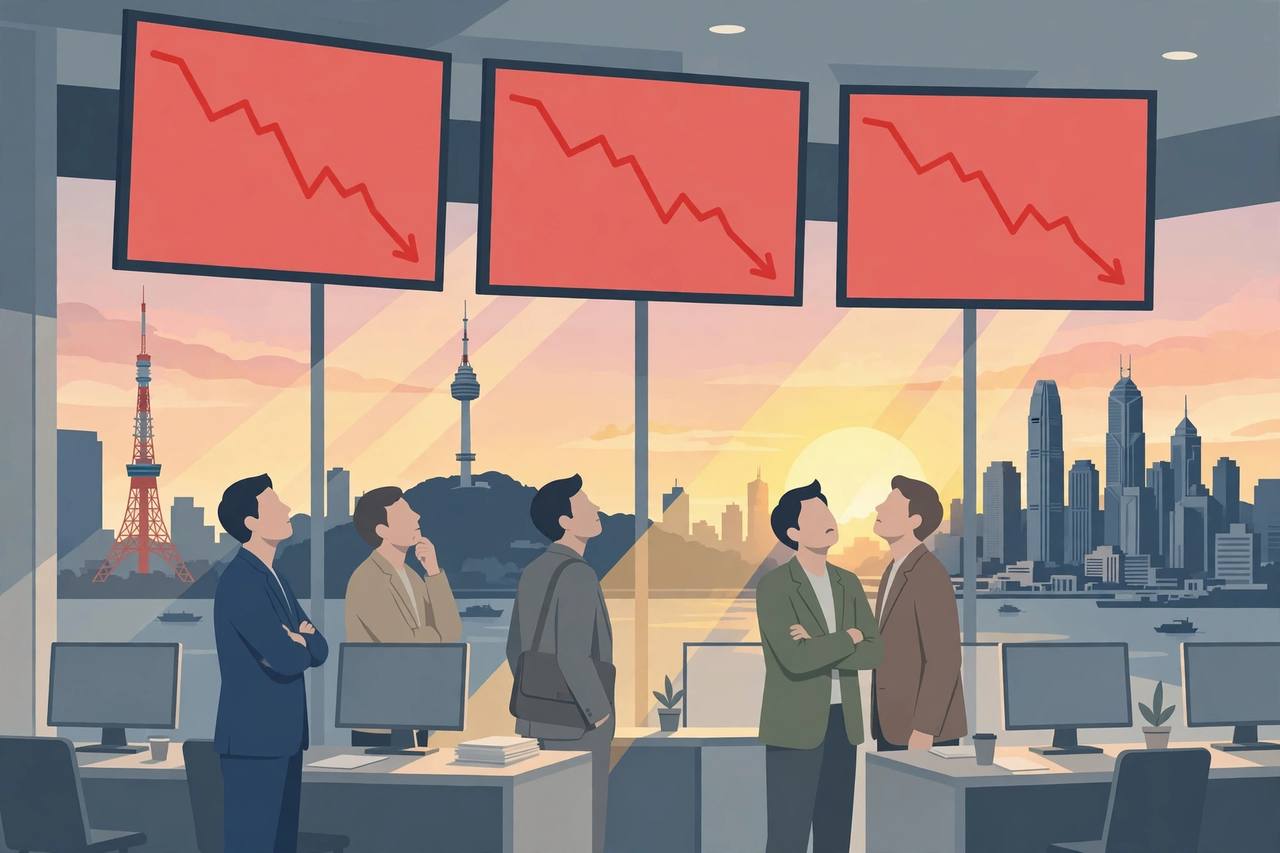
Asia's tech-heavy stock markets sank on Friday, November 6, as fear of increased regulatory scrutiny and a slowdown in the artificial-intelligence build-out unleashed the steepest fall in US stocks since the tariff-triggered 'Liberation Day' rout a year and a half ago, Reuters reported from Singapore. South Korea's KOSPI plunged more than 8 percent, triggering exchange circuit breakers for a 20-minute trading halt, while Japan's Nikkei was down 5 percent.
Source: Reuters
Friday's Asian session extended the Wall Street rout this desk reported on Thursday, when US chip stocks plunged and the Nasdaq fell into correction territory. Read: Nasdaq correction as chip stocks plunge on Wall Street
On Wall Street overnight, the Nasdaq sank 5.5 percent and has now shed 12 percent from its record-high close a month ago, the Philadelphia Semiconductor Index slumped 12.2 percent, Wall Street's volatility 'fear gauge' soared, and $3 trillion was wiped off S&P 500 companies — yaani about $3 lakh crore in Indian terms — Reuters reported.
Source: Reuters
China and Hong Kong fall, AI shares hit hardest
China and Hong Kong stocks tumbled in early trade on Friday, tracking the global tech rout, Reuters reported. China's blue-chip CSI300 Index and the Shanghai Composite Index were both down 1.5 percent. Tech led the drop, with the startup board Star 50 Index and the AI Index both down more than 5 percent at the open before narrowing some of the losses. In Hong Kong, the benchmark Hang Seng was down 1.6 percent while the Hang Seng Artificial Intelligence Index was down some 7 percent.
Source: Reuters via Devdiscourse
Bloomberg reported the Kospi slid as much as 8.8 percent in early trading, with chipmakers Samsung Electronics and SK Hynix both plunging more than 9 percent, Japan's Nikkei 225 lost 5.5 percent and the MSCI Asia Pacific Index declined 2.5 percent, while futures pointed to declines in Taiwan, Hong Kong and China. The Nasdaq 100 had slid 6.4 percent on Thursday, wiping out $2.3 trillion in value — yaani about $2.3 lakh crore — in its worst session since March 2020, Bloomberg said.
Source: Bloomberg via TradingView
Why investors turned on the AI trade
Investors worried that Democrats, who swept to power in this week's US midterm elections, will apply the brakes to the AI boom, Reuters reported. The political jitters are hitting an AI trade already on shaky footing due to worries about the return on investment for the enormous sums being poured into the technology. Market participants see Asia's chipmakers and data-centre equipment suppliers in South Korea, Taiwan and Japan as especially vulnerable, and they had already tumbled on Wednesday and Thursday. The selling also indicates investors are starting to factor in increased local opposition to building data centres, with analysts saying markets have yet to fully consider the cost such building has imposed on communities.
Source: Reuters
"It's pretty clear there's been a real shift in sentiment," said Michael McCarthy, chief executive for Australia and New Zealand at online brokerage Moomoo. "Market turning points are often accompanied by strong disagreement, and that shows up in the market by huge swings in either direction. That's what we appear to have had — and last night's emphatic sell-down suggests that is the direction that we're now headed in." Nick Ferres, chief investment officer at Vantage Point Asset Management in Singapore, said: "Treasuries can probably rally a lot further. And I suspect it will be an ugly day for semiconductor and memory (stocks)."
Source: Reuters
What happens next: bonds were poised to gain in Asia while the US dollar slipped against haven currencies such as the yen and the Swiss franc, Reuters reported, and investors will look to the US payrolls report on Friday for more clues on the path for interest rates. For Punjabi and Indian investors and diaspora savers with pension and index funds exposed to US and Asian tech shares, the question for the coming sessions is whether Friday's circuit-breaker fall in Seoul marks a short panic or the start of a deeper repricing of the AI boom.