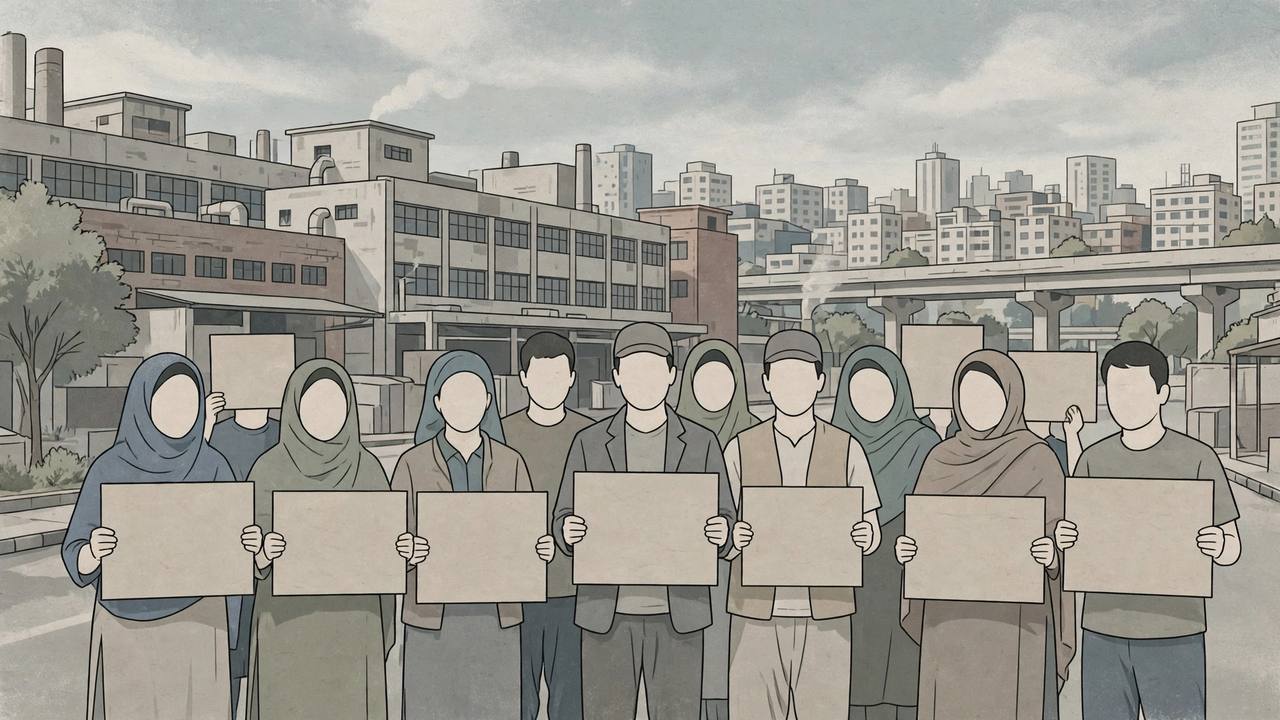
Bangladesh's newly formed garment wage board was set to hold its first meeting on Wednesday, November 4, as protests demanding a higher minimum wage entered their fifth day and fresh clashes broke out between workers and police in the garment hubs of Gazipur and Savar, on the outskirts of Dhaka, Reuters reported.
Source: Reuters
The meeting is the next step in the dispute Awaaz Punjab reported on November 1, when Bangladesh formed the six-member wage board as garment protests turned violent in Dhaka. Read the earlier story: Bangladesh forms wage board as garment protests turn violent
It also follows the reopening Awaaz Punjab reported on November 2, when garment factories reopened after protests had disrupted 529 plants — a reopening that did not hold in Gazipur and Savar on Wednesday. Read the earlier story: Bangladesh garment factories reopen after wage protests
Workers are demanding that the monthly minimum wage be raised to 30,000 taka ($243) from the current 12,500 taka, saying the existing wage no longer covers basic household expenses after years of rising food, housing and other living costs, Reuters reported. Yaani, the demand is 2.4 times the current wage — the current rate was set in 2023.
Source: Reuters
Wednesday's clashes in Gazipur
In Gazipur, protests resumed on Wednesday morning despite a decision to reopen all factories, Industrial Police Superintendent Mohammad Amjad Hossain said, according to reporting by The Daily Star and The Business Standard. Most factories reopened, but several declared holidays, including a Lyric Group unit and Odessa Garments, which employs around 4,000 workers.
Source: The Daily Star / The Business Standard via Beyond Headlines
Police dispersed workers moving towards Joydebpur at around 8:30 a.m., then fired at least 10 sound grenades at around 8:45 a.m. when more than 100 workers blocked the Chandana Chowrasta-Shibbari road and pelted Basan Police Station with bricks, witnesses said. At around 9:30 a.m., between 2,000 and 4,000 workers blocked the Dhaka-Mymensingh highway at Signboard in Gacha and hurled brickbats, prompting police to fire tear gas and sound grenades, Amjad Hossain said; Salna, Rajendrapur, Sofipur and Palli Bidyut remained normal, while tension persisted in Kashimpur.
Source: The Daily Star / The Business Standard via Beyond Headlines
Assistant Commissioner Md Arif Hossain said 25 platoons were deployed in Gazipur under 25 executive magistrates from 6:00 a.m. — 12 Border Guard Bangladesh (BGB) platoons, eight Special Response Battalion platoons and five Ansar platoons. Gazipur Metropolitan Police Additional Commissioner Md Taherul Haque Chauhan said officers were acting with patience to protect lives and property, while the district administration reported four cases and 36 arrests over recent highway blockades and arson attacks on police vehicles, a police box and a warehouse.
Source: The Daily Star / The Business Standard via Beyond Headlines
Savar, Hemayetpur and Mirpur
In Savar, police fired tear gas in two phases to disperse workers marching from Padma Mor in Hemayetpur towards Baghbari Mor, before protesters regrouped and blocked the Dhaka-Aricha highway in Hemayetpur and Fulbaria by burning waste; traffic resumed at 10:30 a.m. after nearly an hour of clashes, with three BGB platoons deployed alongside executive magistrates, and protesters beat three media workers at Padma Mor. At 8:35 a.m., Civil Engineers Woven, Civil Engineers Wash, Shamsh Styling Wear, Rupkatha Apparels, Padma Cans, Babylon Casual Wear, Aboni Knitwear and Jeans Manufacture sent workers home in the Padma Mor and Hemayetpur area, while Maxcom International BD and Pioneer Apparels suspended operations. In Dhaka's Mirpur-11, police were forced to leave after a heated argument with workers gathered outside a factory.
Source: The Daily Star / The Business Standard via Beyond Headlines
A worker has died
Toufiq Hossain, 21, a cutting-section worker at Laila Styles Limited who came from Gobindaganj in Gaibandha and lived in Gazipur's Banglabazar, died at Shin Shin Japan Hospital in Dhaka's Uttara on Tuesday afternoon. Fellow workers rescued him after he was critically beaten on Sunday; Gazipur Metropolitan Police Deputy Commissioner Mohammad Belayet Hossain, confirming the death, said Toufiq was beaten by fellow workers while filming a demonstration on his mobile phone and was not injured during any police operation. His family took his body to Gaibandha on Tuesday.
Source: The Daily Star / The Business Standard via Beyond Headlines
The board, the workers and the buyers
The six-member minimum wage board, formed on Sunday, was scheduled to hold its first meeting at 11:00 a.m. on Wednesday to review the 12,500-taka minimum wage set in 2023, the labour ministry said. It is chaired by Senior District Judge Sheikh Ashfaqur Rahman, with Dhaka University Professor Mosleh Uddin Ahmed as independent member, ABM Shamsuddin of the BGMEA and Asif Ayub of the Bangladesh Employers' Federation representing employers, and Babul Akhter and Anwar Hossain representing workers.
Source: The Daily Star / The Business Standard via Beyond Headlines
"Every month is a struggle," garment worker Bithi Begum told Reuters. "After working hard all day, the money we earn is hardly enough to cover even our basic needs." The sector employs about 4 million workers, generates more than 80 percent of Bangladesh's export earnings and supplies brands including H&M, Inditex's Zara and Walmart; Bangladesh is the world's second-largest garment exporter after China. Swedish retailer H&M told Reuters some factories had closed temporarily, though it had not experienced major supply-chain disruptions.
Source: Reuters
Manufacturers said the industry was already under pressure from rising costs, stronger regional competition, energy-market uncertainty linked to the conflict in the Middle East and weaker demand in key export markets. Selim Raihan, an economics professor at the University of Dhaka, told Reuters Bangladesh could absorb a significant wage increase without necessarily losing its competitive advantage if factories improved productivity, that any revision should reflect inflation, living costs and factories' ability to pay, and that international buyers should support better labour standards through fairer purchasing practices and prices. Prolonged labour unrest, he warned, could pose a greater threat to the industry than higher wages, because it undermines delivery reliability and buyer confidence: "Treating cheap labour as the industry's permanent competitive strategy would be a mistake."
Source: Reuters
What happens next
The board is expected to begin formal discussions on reviewing the industry's wage structure, with no new wage figure announced yet. International buyers are closely watching as factories enter a key production period for spring and summer orders, and protesters have already forced hundreds of factories to suspend operations at points during the five days, raising concerns about shipment delays. Whether Wednesday's first meeting produces a timetable — and whether the Gazipur and Savar streets stay calm while it works — is the next test.
Source: Reuters
On the fifth day of Bangladesh's garment wage protests, the new six-member wage board sat for the first time to review the Tk 12,500 wage workers want raised to Tk 30,000 — while fresh clashes shut highways in Gazipur and Savar and a 21-year-old worker, Toufiq Hossain, was buried after being beaten for filming a protest.