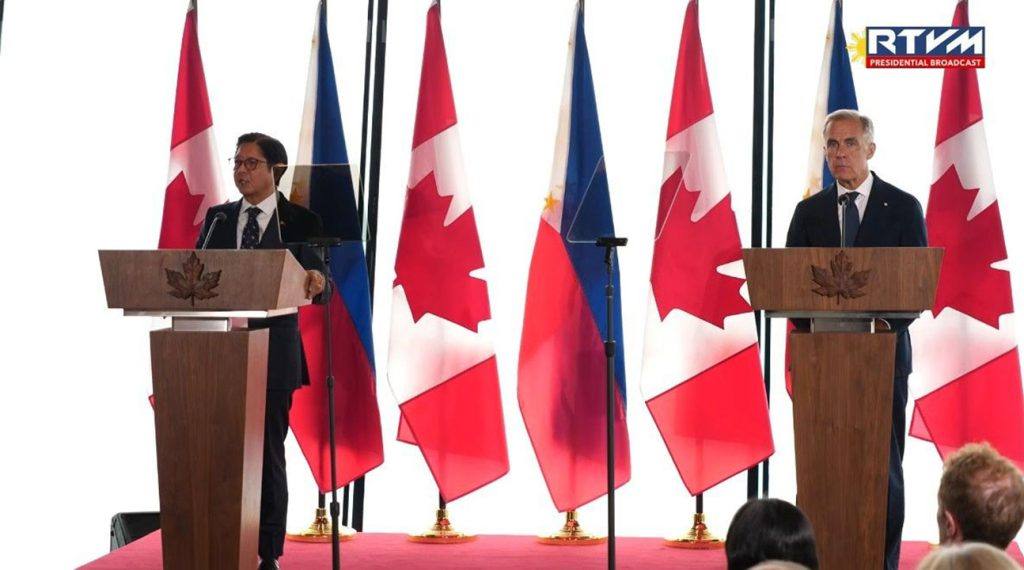
Canada has concluded negotiations on a free-trade agreement with the Philippines and announced the substantial conclusion of negotiations toward an ASEAN-Canada free trade agreement, Prime Minister Mark Carney's office said in Manila on Saturday, November 14. Carney travelled to the Philippine capital as Guest of the Chair at the 49th ASEAN Summit and for a bilateral visit with President Ferdinand Marcos Jr.
Source: Prime Minister of Canada — news release, Nov 14, 2026
The Canadian Press reported that the two leaders oversaw the signing of a document that formally ends the Philippines negotiations, which started just over a year ago. Both countries are now working toward signing the agreement in 2027, and Carney said Ottawa will move just as fast to finalize the deal and bring it into force next year.
Source: The Canadian Press, Nov 13, 2026 (via EuropeSays)
What the two deals promise
The Philippines has an economy of $680 billion and a market of more than 110 million people, and is one of the fastest-growing economies in Asia, the Prime Minister's Office said. Once in force, the bilateral agreement could increase Canadian exports up to three times by 2035 — a target Carney also put at more than $10 billion a year in two-way trade — particularly in agriculture and forest products. Canada's stock of direct investment in the Philippines was about $1.7 billion in 2025, up 44% from 2024.
Source: Prime Minister of Canada — news release, Nov 14, 2026
On the ASEAN deal, Ottawa said the ACAFTA — under negotiation since 2021 — will expand Canada's integration into Asian supply chains and create more predictable conditions for Canadian workers and businesses, with the remaining steps to be completed as quickly as possible and an ambition of signing in 2027. Carney also announced $5 million in assistance so every ASEAN economy can support the agreement's swift ratification; together with other summit investments, the package totals over $15.9 million.
Source: Prime Minister of Canada — news release, Nov 14, 2026
Defence, drones and $26 million for the Philippines
The visit was not only about trade. Canada announced closer cooperation between the two countries' armed forces, a new cyber security dialogue, steps toward customs-cooperation and sensitive-information agreements, and the extension of the Dark Vessel Detection program until 2033 — the MDA Space satellite platform that tracks vessels that switch off their location transmitters to combat illegal fishing. Ottawa also announced $26 million for the Philippines covering nuclear security and safety, climate-resilient agriculture, community resilience, and food security and infrastructure, including in the G7-supported Luzon Economic Corridor.
Source: Prime Minister of Canada — news release, Nov 14, 2026
Commercial agreements announced alongside included an ocean-technology MOU between Canada's Ocean Supercluster, the Makati Business Club and the University of the Philippines Visayas; an MOU between Canadian drone maker Draganfly Inc. and the Razon Group for drone technology, training and investment; and an MOU between JCM Power and the Aurora Pacific Economic Zone Authority on renewable-energy projects.
Source: Prime Minister of Canada — news release, Nov 14, 2026
"With the Philippines, we concluded a new free trade agreement in just one year — creating new opportunities for our farmers, ranchers, foresters and miners, and putting us on track to triple our exports by 2035. With ASEAN, we are opening a market of nearly 700 million people through a landmark free trade agreement." — Prime Minister Mark Carney, Manila, November 14 (PMO release). International Trade Minister Maninder Sidhu added: "Trade diversification is our Plan A."
Why it matters — including for Canada's diaspora communities
The twin announcements are the latest step in Carney's push to diversify Canadian trade away from dependence on the United States — the Philippines deal is the fourth agreement his government has concluded, after Indonesia, the United Arab Emirates and Ecuador. For Canada's large Filipino community, and for Punjabi and other South Asian Canadians whose families and businesses trade across the Pacific, the deals matter directly: cheaper and more predictable access both ways for food products, forest products, minerals and services. One open question, the Canadian Press noted, is whether the agreement resolves the Philippines' temporary barriers to foreign pork imports, which Canadian producers have been watching closely — the deal's full text has not yet been published.
Source: The Canadian Press, Nov 13, 2026 (via EuropeSays)
What happens next: neither agreement is in force. The texts must be finalized, signed — both sides are aiming at 2027 — and then ratified and implemented, which in Canada means implementing legislation in Parliament. Carney's trip continues to Cambodia and China, his office said.
Source: Prime Minister of Canada — news release, Nov 14, 2026