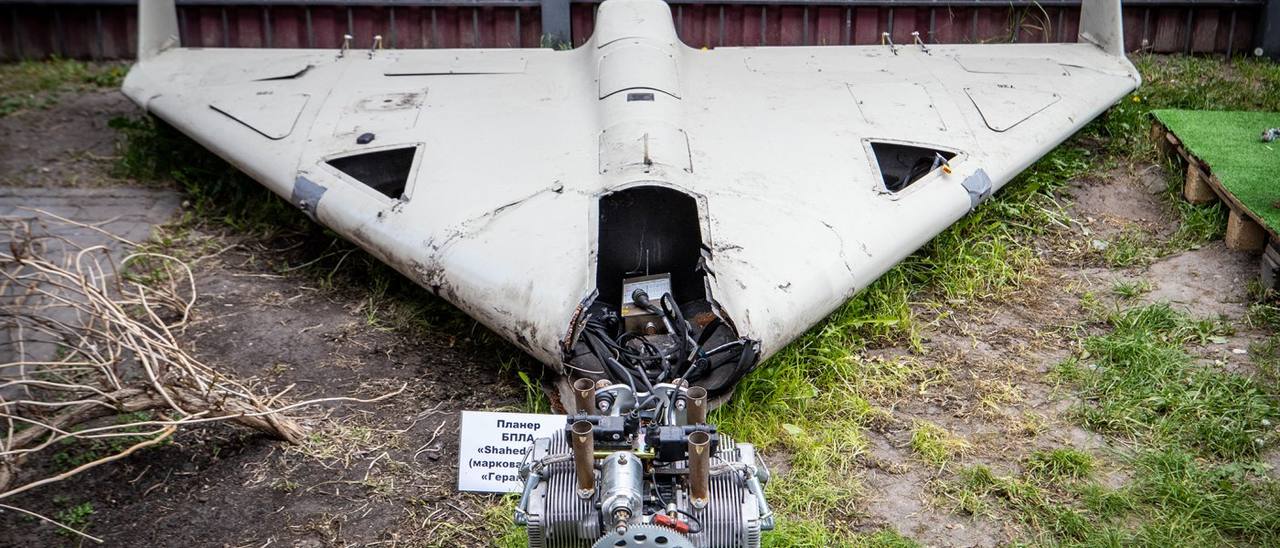
China has imposed new export licensing on the drone components used to build and fly Russia's Geran attack drones, in rules that took effect on Wednesday, November 18 — the same day President Vladimir Putin arrived in the southern Chinese city of Shenzhen for talks with Chinese leader Xi Jinping and US President Donald Trump.
Source: EuropeSays
Under Announcement No. 49, issued on October 19 by China's Commerce Ministry, the General Administration of Customs and the Central Military Commission's Equipment Development Department, exporters must now obtain licences to ship a list of sensitive items — including turbojet engines producing 400 newtons of thrust or more, piston and rotary engines built for unmanned aircraft, autopilots, jam-resistant navigation systems, radio modules, speed controllers, high-power brushless motors and carbon-fibre propeller blades.
The rules matter most for one weapon: the Geran, Russia's version of the Iranian-designed Shahed drone, assembled at the Alabuga facility in the republic of Tatarstan. The engines covered by the controls include those fitted to Gerans, and the turbojets for the jet-powered Geran variants — the long-range strike drones Russia fires at Ukraine night after night.
Welcomed in Kyiv — with a warning
Ukraine welcomed the move. Vladyslav Vlasiuk, the Ukrainian president's commissioner for sanctions policy, said the core components of Russia's long-range attack drones had formally come under export controls. But he added the same caveat as every analyst watching the file: whether anything changes in practice depends on how the rules are enforced.
A licence, not a ban
Licensing is not a ban, and Beijing has been clear about that. The Commerce Ministry signalled when the rules were published that approval is the default for compliant applications, and exporters China deems reliable can obtain general licences lasting up to three years. The thresholds also miss most parts for frontline FPV drones — their motors and speed controllers, batteries, cameras and fibre-optic cables are not covered, and neither is manufacturing equipment.
Source: Defence Ukraine
The controls land as Ukraine's campaign against Russian energy infrastructure bites. Reuters reported on November 18 that repeated Ukrainian strikes had cut daily crude processing at Russian refineries by around 45 percent since late October, from more than 700,000 metric tons a day to about 400,000.
Ukraine has been hitting Russian oil sites deep inside Russia — including the Kaleykino pumping station in Tatarstan this week: Read the full story
What is solid
- Announcement No. 49 was issued October 19 by three Chinese agencies and took effect November 18
- The controls cover Geran drone engines, turbojets, autopilots and jam-resistant navigation systems
- Ukraine's sanctions commissioner Vladyslav Vlasiuk publicly welcomed the rules
What is only claimed
- Whether licensing will actually slow Geran production — Beijing says compliant applications will be approved, Kyiv says enforcement is the test
- How much of Russia's drone supply chain the thresholds really catch, given the FPV exemptions
What happens next is a watch, not a verdict. The test will be visible in licence decisions from Beijing, in Geran production rates at Alabuga, and in whether Russia's nightly long-range drone salvos against Ukraine thin out in the coming weeks. The rules arrived on the same day the Shenzhen trilateral produced a four-point peace declaration — and the gap between paper and practice is now the story.
Beijing has put the parts for Russia's long-range attack drones behind a licence wall — but left the door open. Whether it slows the Geran line depends on what China refuses, not what it announced.
The Shenzhen trilateral — Trump, Xi and Putin's first three-way meeting — and the four-point peace declaration: Read the full story