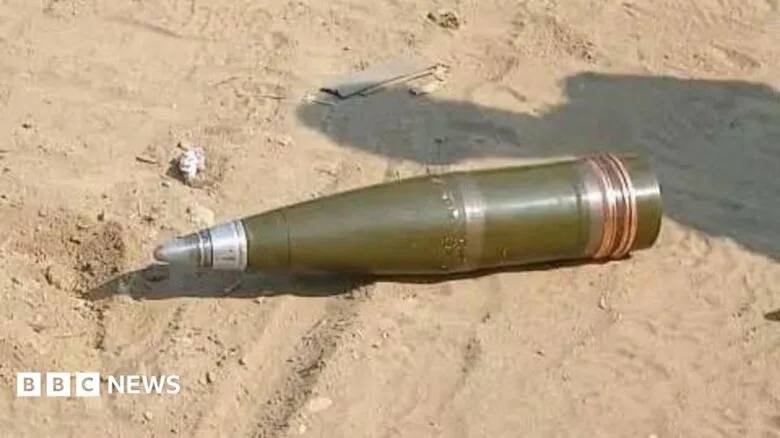
PORT MORESBY — A 32-kilogram metal object found in Papua New Guinea has set off a public dispute between Port Moresby's police and China's embassy. Police in the capital arrested four Chinese nationals last Friday, October 30, after the object was discovered in a commercial shipping container at a construction site, and Police Commissioner David Manning called it “a very concerning discovery”. On Tuesday the Chinese Embassy answered in a Facebook post: the object, it said, is a “shell-shaped wine bottle” that “poses no danger at all”. The BBC reported the embassy's denial on Wednesday, November 4, alongside a report by the Australian Broadcasting Corporation that points the other way.
Source: BBC News, Nov 4, 2026
The Australian Broadcasting Corporation reported on Wednesday, citing unnamed sources, that the object has been identified as an unexploded Chinese Type 59 130mm artillery projectile, containing chemical explosives and a fuse. The BBC said plainly that it has not independently verified that identification. Papua New Guinea police, for their part, had earlier rejected speculation that the object was “merely a dummy”, the Port Moresby newspaper Post-Courier reported. So three positions are now on the record: the police say the find is concerning and not a dummy; ABC's sources say it is a live Chinese-made projectile; and Beijing's embassy says it is a decorative wine bottle.
Source: ABC (Australia) via BBC News, Nov 4, 2026; Post-Courier via BBC
What the Chinese Embassy said
The embassy's statement, posted on Facebook on Tuesday, said that after verification with the company involved and an on-site check, the object “is in fact a shell-shaped wine bottle and poses no danger”, and that the Royal Papua New Guinea Constabulary had been kept fully updated. It argued that China enforces some of the world's strictest firearms control laws, is widely recognised as one of the safest countries globally, and that it is therefore “virtually impossible” for an illegal military-grade artillery shell to be smuggled out of China to Papua New Guinea. The statement added that the Chinese government consistently requires its citizens and enterprises overseas to abide strictly by local laws. The embassy's account is published here as China's official position; the underlying facts — what the object is — remain under police investigation.
Source: Chinese Embassy in Papua New Guinea, Facebook statement, Nov 3, 2026
The explanation drew open scepticism online. “What sort of wine bottle weighs 32 kilograms?” one commenter wrote under the embassy's post, the BBC reported; another noted that the object bore no labels indicating it was a wine bottle. The photograph published with the BBC's report shows a green, finless projectile-shaped object with a pointed fuse assembly and copper driving bands, lying on sand — the classic silhouette of a 130mm artillery shell, which is why the embassy's wine-bottle description, and not only the find itself, has become the story.
Source: BBC News, Nov 4, 2026
Why a single object in Port Moresby draws embassies in
Papua New Guinea, Australia's nearest neighbour, sits in the part of the South Pacific where China and the Australia–United States camp compete hardest for influence, contracts and construction work. Chinese companies and workers are a large presence in PNG's building sector, which is how a shipping container at a Port Moresby construction site became the scene of the find. A confirmed live Chinese artillery projectile in a civilian container would raise smuggling and security questions far beyond one construction site; a confirmed decorative bottle would make the episode an embarrassment for everyone who treated it as a weapon. Neither confirmation exists yet — which is precisely why both the police commissioner's language and the embassy's unusually detailed rebuttal matter.
Source: Awaaz Punjab analysis of BBC and ABC reporting, Nov 4, 2026
What is solid
- A 32kg projectile-shaped object was found in a shipping container at a Port Moresby construction site and four Chinese nationals were arrested on October 30 — BBC, citing police and local reports
- Police Commissioner David Manning called the discovery 'very concerning' and police rejected the suggestion the object was 'merely a dummy' — BBC; Post-Courier
- China's embassy states the object is a 'shell-shaped wine bottle' posing 'no danger at all', verified with the company involved and an on-site check — Embassy statement, Nov 3
- ABC reported, citing unnamed sources, that the object is an unexploded Chinese Type 59 130mm artillery projectile with explosives and a fuse — ABC via BBC, Nov 4
What is only claimed
- What the object actually is: live artillery projectile (ABC's unnamed sources) versus decorative wine bottle (Chinese Embassy) — the BBC has not independently verified the ABC identification and PNG police have not published a final determination
- How the object reached Papua New Guinea, and in whose container and for what purpose, is not established in any of the reporting
What happens next
The Papua New Guinea police investigation is the deciding process: a formal identification of the object by PNG authorities — and any charges arising from the October 30 arrests — will settle which of the two public accounts is right. Watch for a police or defence-force statement naming the object, the status of the four arrested men, and any response from Australia, whose broadcaster produced the projectile identification and whose government treats PNG's security as a first-order concern. Until then, the verified position is narrow: an object was found, four men were arrested, the police call it concerning, and China calls it a wine bottle.