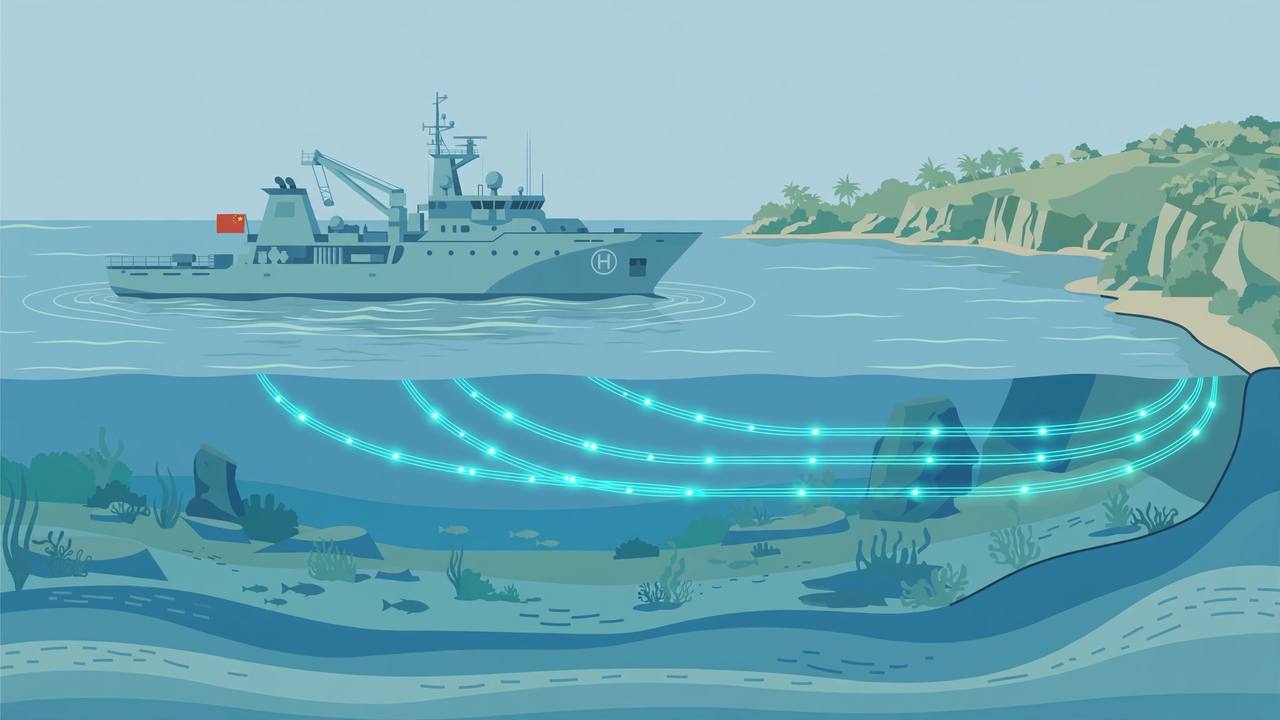
TAIPEI / TOKYO, November 4 — Chinese research vessels have repeatedly shown abnormal movements along stretches of seabed where undersea cables are laid in waters near Taiwan over the past several months, according to a new analysis reported as a front-page story by Japan's Yomiuri Shimbun on November 4 and carried the same day by South Korea's Seoul Economic Daily. The findings raise the question — posed by the analysts themselves, and not established as fact — of whether Beijing is gathering information in advance so that it could sever the cables and cripple Taiwan's communications in the event of a conflict over the island.
Source: Yomiuri Shimbun via Seoul Economic Daily, November 4
The analysis comes from ingeniSPACE, a geospatial intelligence firm, which examined the Automatic Identification System (AIS) tracks of four Chinese scientific research ships between May and September 2026. The ships sharply reduced speed, remained stationary for long periods and changed course irregularly in waters north and east of Taiwan and in the Bashi Channel to the south — and the points where they slowed or stopped overlapped with the routes of undersea cables linking Taiwan to Japan, the United States, Singapore and the Philippines, the firm said.
Source: ingeniSPACE analysis summary
The four ships, named
ingeniSPACE identifies the four vessels as: Xiangyang Hong 22, operated by China's Ministry of Natural Resources, which worked north of Taiwan; Jiageng, a university-owned vessel, east of Taiwan; a ship broadcasting the name MUSHANZI, whose owner is unknown, in the Bashi Channel; and Tongji, which circled Taiwan stopping at particular points. Taiwan's Coast Guard Administration photographed Tongji deploying survey equipment in waters around Taiwan in May, the reports note.
Source: ingeniSPACE / Yomiuri Shimbun
Taipei says the picture matches its own
Taiwanese authorities are also aware of the movements, according to the report. Yomiuri cited a Taiwanese government official as saying ingeniSPACE's track analysis broadly matches the situation the authorities have identified, and a second official said the ships may also be charting seabed topography, depth and currents at the cable sites. No cable damage linked to this activity has been reported, and the reports carry no response from Beijing to the analysis.
Source: Yomiuri Shimbun via Seoul Economic Daily
Why experts read it as preparation, not just surveying
Chisako Masuo, a professor at Japan's Kyushu University, told Yomiuri the Chinese ships appear to be preparing for the possibility of a conflict over Taiwan or a dispute between the United States and China, and that if necessary China could cut undersea cables along the Pacific coast to sow confusion in Japanese society and disrupt communications between Japan and the United States. Keio University professor Tsuchiya Motohiro assessed that the activity may anticipate cable-cutting operations. ingeniSPACE chief operating officer Jason Wang said similar behaviour has been confirmed off Japan and the Philippines, and that China appears to be accumulating information on undersea infrastructure to prepare grey-zone options along the First Island Chain. These are expert assessments of a track pattern, not proof of intent.
Source: Yomiuri Shimbun; ingeniSPACE
The stakes are set by the cables themselves. A total of 24 undersea cables pass near Taiwan, and 14 of them are international links connecting the island to Japan, the United States, Singapore and the Philippines. Hu Xijin, the former editor-in-chief of China's Global Times, wrote recently on the social media platform Weibo that if those cables were cut simultaneously or for the most part, the impact on Taiwan would amount to paralysis — a comment by a prominent nationalist voice, reported here as his stated view, not as an official position.
Source: Seoul Economic Daily, November 4
What is solid
- Four named Chinese research ships showed slow, stopping and irregular AIS tracks over subsea cable routes around Taiwan between May and September 2026, per ingeniSPACE's analysis reported by Yomiuri Shimbun on November 4
- Taiwanese officials told Yomiuri the analysis broadly matches what their own authorities have observed
- 24 undersea cables pass near Taiwan, 14 of them international links to Japan, the US, Singapore and the Philippines
- No cable damage linked to this activity has been reported
What is only claimed
- Whether the activity is cable reconnaissance for a future conflict (the analysts' and professors' assessment) or marine surveying that also charts topography, depth and currents (a possibility a Taiwanese official also raised)
- Hu Xijin's Weibo claim that cutting most of the cables would 'paralyse' Taiwan — his stated view, not a verified capability finding
Background: cables have become a grey-zone front line
Yomiuri links the findings to repeated suspected deliberate cable cuts off Taiwan since 2021 and in the Baltic Sea since 2024. The analysis also aligns with what Taiwan's government has been forecasting: Shen Yu-chung, deputy minister of the Mainland Affairs Council, said at a forum on November 2 that China may deploy non-military vessels more frequently after the Chinese Communist Party Central Committee's fifth plenary session to challenge the maritime jurisdiction of Taiwan, Japan and the Philippines while avoiding all-out confrontation, invoking its own laws and sovereignty claims. For Punjabi and Indian readers, the angle is direct: the same undersea cable web carries the internet traffic, remittance systems and call-centre links between the Gulf, North America and Punjab — a cable crisis in the Taiwan Strait would not stay in the Taiwan Strait.
What happens next: watch for a formal response from Beijing, any Taiwanese Coast Guard publication of its own track data, and whether Japan and the Philippines — where ingeniSPACE says similar behaviour was confirmed — publish parallel findings. None of those had appeared in the reporting available at publication time.