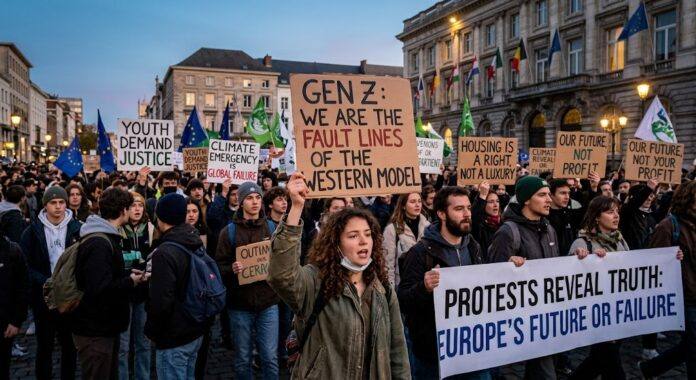
On Friday, November 20, tens of thousands of young people took to the streets across Europe in a coordinated "international youth strike" that organisers said spanned at least 25 countries, from Britain and Germany to Spain, Italy and Croatia, demanding more money for schools and public services and less for war.
Reuters reported the protests were inspired by the youth demonstrations that have shaken France in recent months, but were far more muted than the French wave, with demands ranging from education funding and higher wages to climate justice and an end to conscription.
Italy: general strike and protests in 100 cities
In Italy, tens of thousands of workers and students protested in more than 100 cities, coinciding with a general strike by CGIL, the country's largest trade union, covering private- and public-sector workers including schools and healthcare. CGIL leader Maurizio Landini claimed more than one million people would take part in Italy, though exact figures were still to be determined.
There were clashes in places: demonstrators in Rome threw objects at the Ministry of Education, some protesters clashed with police in Bologna, news agency ANSA reported, and in Milan demonstrators set fire to a cardboard tanker and cardboard figures of Israeli Prime Minister Benjamin Netanyahu and US President Donald Trump.
Germany, Britain and beyond
In Germany, the campaign group "Gen Z regelt" — "Gen Z sorts it" — said it was organising protests in 73 cities and towns. About 4,000 people gathered at Alexanderplatz in Berlin, police said, and the Cologne protest drew thousands, fewer than the 5,000 expected.
In Britain, students from more than 350 schools, colleges and universities walked out, according to Socialist Students, one of the groups taking part, marching toward Parliament Square in London. "Young people will not sit quietly while our schools, colleges and universities are cut and billions are found for war," the group's national chair, Adam Powell-Davies, said.
Students boycotted classes and protested in about a dozen cities in Croatia. In Austria, several hundred people gathered outside the University of Vienna calling for more spending on education and less on weapons. Demonstrations were also planned for Saturday in many French cities.
In Rome, protesters chanted "Money for schools, not war" and "We want to live life without the high cost of living." CGIL leader Maurizio Landini said: "Across Europe and among ordinary people, the demand for change is growing."
The movement builds on a year of Gen Z-led protests across Europe and beyond. In Serbia, student-led protests culminated last month in the election defeat of long-time leader Aleksandar Vucic, Reuters noted. Italy's October 17 mobilisation descended into rioting and looting, after which Prime Minister Giorgia Meloni's government approved sweeping security measures and deployed the army alongside police at later demonstrations.
What happens next: organisers describe the November 20 action as the start of a sustained campaign to press governments to shift defence spending into education, housing and welfare, with further demonstrations planned in France on Saturday and more actions expected in the coming weeks.