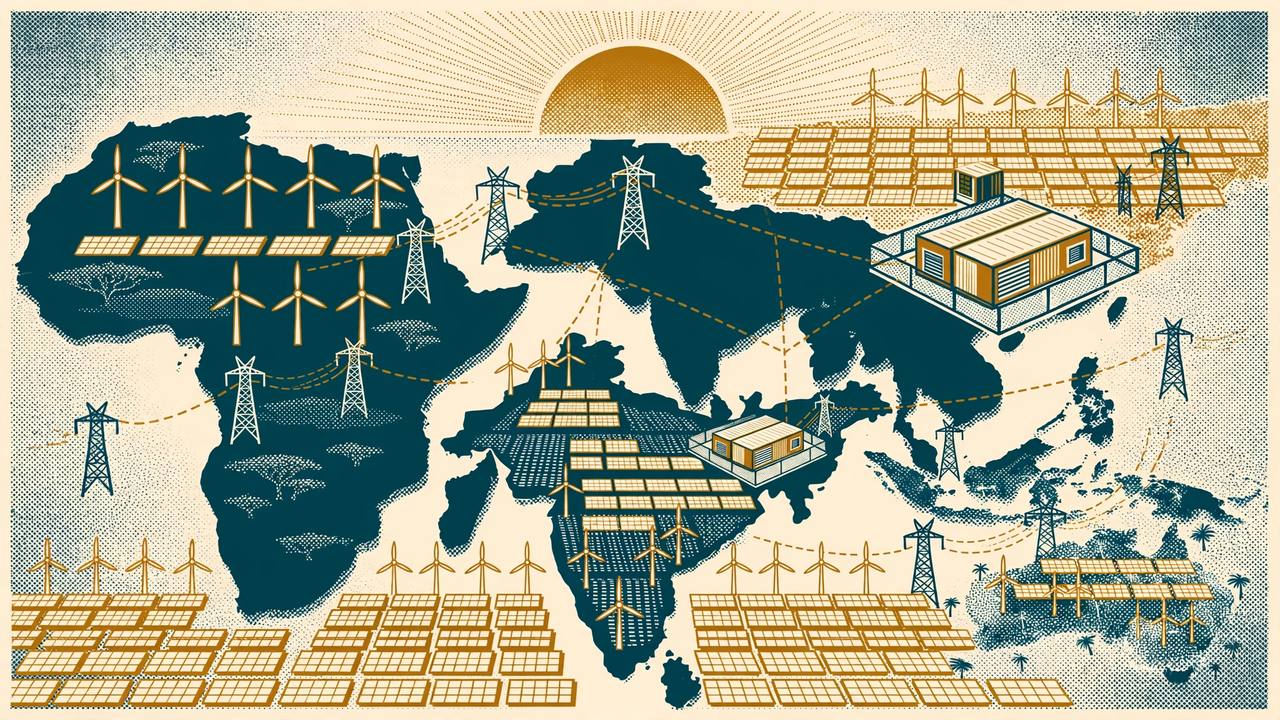
The International Energy Agency (IEA) has forecast that global renewable power capacity will increase by almost 4,800 gigawatts (GW) between 2026 and 2031 — almost 60 percent more than was added in the previous six-year period — as governments race to strengthen energy security and cut their exposure to imported fuels and volatile prices. The forecast was published on Friday, November 6, 2026, in the agency's annual report, Renewables 2026.
Source: IEA
For the first time, the amount of renewable power capacity added in emerging and developing economies outside China is expected to match the amount added in advanced economies over the forecast period, the IEA said. Solar photovoltaic (PV) power is set to account for more than three-quarters of all global renewable capacity growth to 2031, followed by onshore wind.
Hormuz crisis pushes energy security to the top
The IEA linked the acceleration directly to the energy market disruption since the outbreak of the Iran war at the end of February, saying the Hormuz crisis has sharpened governments' focus on domestic energy sources. "Previously, environmental concerns were the policy priority behind the growth of renewables, whose falling costs have made them a competitive option in many markets — but today, it's mainly energy security that is driving renewables' expansion as more and more countries seek to reduce their exposure to imported fuels," said IEA Executive Director Fatih Birol.
"The new chapter of the renewables growth story is a truly global one as their deployment spreads well beyond major markets into every corner of the world," Birol added. "This is making them a key pillar of the global power sector. Today, they account for a third of global electricity generation; in the next five years, they will be getting closer to half of it." The report forecasts renewables will supply almost 45 percent of global electricity in 2031, up from a third in 2025.
India second-largest market; China still biggest, but share falling
China will remain the largest contributor to the global increase in renewable capacity, but its share is set to decline from over 60 percent in 2025 to an average of 53 percent over the forecast period, amid changes to its renewable energy policies, the IEA said. India is emerging as the world's second-largest growth market, with its total renewable capacity set to more than double by 2031.
Growth is also increasing across Southeast Asia, the Middle East and North Africa, and sub-Saharan Africa. Across these regions, the amount of renewable capacity added in the 2026-2031 period is forecast to almost triple compared with the previous six-year period, according to the IEA.
Rooftop solar, transport and supply chains
The growth is not only coming from big utility projects. Faced with high fuel prices and unreliable electricity supplies in some markets, households and small businesses are increasingly turning to affordable rooftop solar systems that can be installed quickly. These small-scale installations have already helped improve electricity services for around 70 million households worldwide, the report finds.
The IEA also forecasts that the use of renewable energy for transport will rise by more than 60 percent by 2031, by which point it will cover 6 percent of the transport sector's energy demand worldwide. Renewable electricity used by electric vehicles accounts for around 45 percent of this increase, while biofuels make the second-largest contribution, and the forecast for biofuels is revised up by 40 percent compared with last year's report. On supply chains, India is emerging as an important alternative source of supply, with its share of global solar PV module manufacturing expected to almost double to 17 percent over the next five years.
The bottleneck: grids
The report warns that investment in electricity grids must keep pace with the growth of renewable capacity. The amount of advanced-stage renewable energy and storage projects waiting for grid connections worldwide increased by 60 percent over the past year to 3,000 GW — four times the wind and solar PV capacity connected to the grid last year. Battery storage deployment is accelerating, and digital technologies, including artificial intelligence, can help shift demand towards periods when renewable power supply is abundant, the IEA said.
For Punjabi and Indian families in the Gulf and back home, the shift matters twice over: the region's economies are being pushed to diversify away from oil revenues that fund jobs and remittances, while cheaper solar at home is already changing household electricity bills in Punjab and across India.
What is solid
- Global renewable capacity to rise almost 4,800 GW in 2026-2031, per IEA Renewables 2026
- Emerging and developing economies outside China to match advanced economies' additions for the first time
- Solar PV to account for more than three-quarters of growth; renewables to near half of global electricity by 2031
- India the second-largest growth market, capacity to more than double by 2031
What is only claimed
- The exact pace of delivery depends on grid investment and policy follow-through, which the IEA itself flags as the main risk
- China's share falling to 53 percent is a forecast average, not a measured outcome