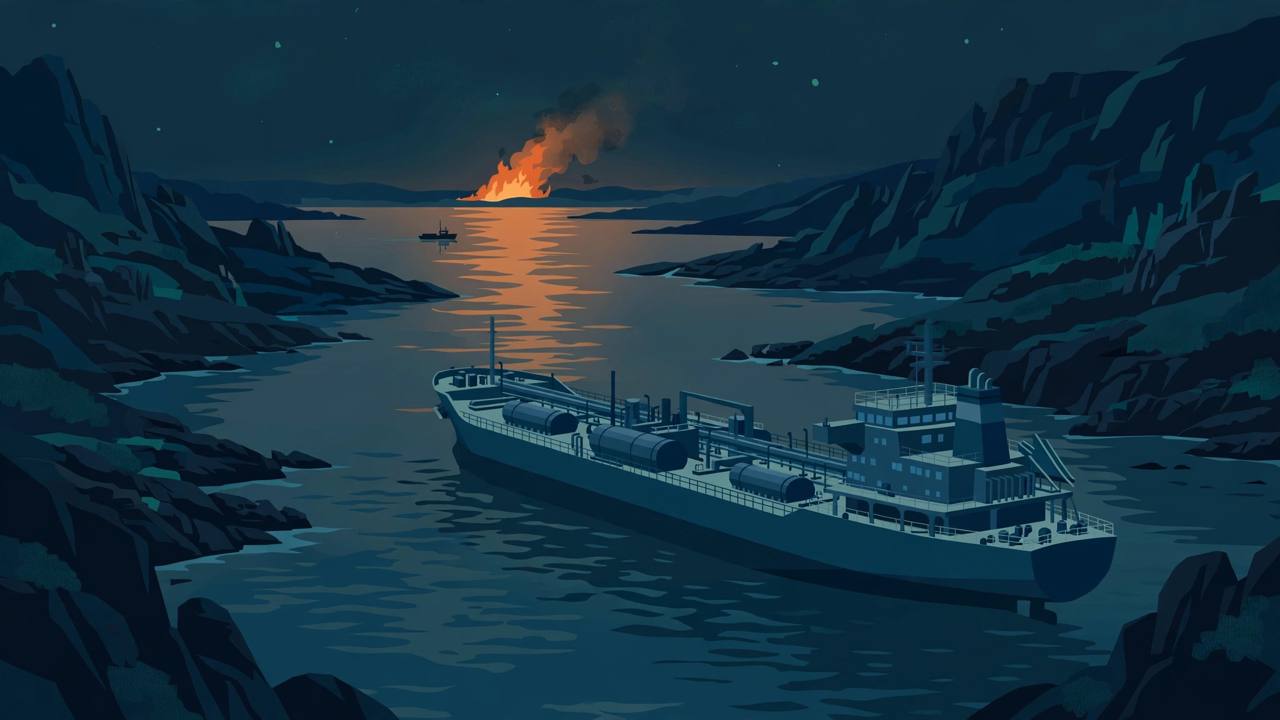
DUBAI / CAIRO, November 4 — Iran's Revolutionary Guard said four oil tankers were destroyed after striking naval mines while trying to traverse a route described as prohibited south of the key waterway of the Strait of Hormuz, Reuters reported on Wednesday, November 4. In its statement, the elite corps said the tankers were still ablaze, and added that two other vessels had been seized.
Source: Reuters, November 4
The statement did not identify the vessels, their owners or flags, the cargoes they were carrying or the exact location of the incidents, and there was no immediate independent confirmation of the claims. No statement from the United Kingdom Maritime Trade Operations agency (UKMTO) or from US Central Command (CENTCOM) confirming four burning tankers had appeared in the reporting available at publication time. Readers should treat the destruction and seizure claims as the IRGC's claims, not as established fact.
Source: InvestingLive market wrap, November 4
This is the IRGC's third tanker-mine claim in a week. On Tuesday, November 3, it said three tankers had hit naval mines on unauthorised routes in the strait — a claim CENTCOM rejected — and it made an almost identical three-tanker claim on October 29. The November 4 statement raises the number to four tankers and adds the seizure of two further vessels, neither element independently confirmed. Read: IRGC's November 3 three-tanker claim
In a further claim the same morning, the Guards said they had shot down a US MQ-9 drone over the strait, which they said was the 56th of its kind. That claim, reported in market coverage of the statement, also had no independent confirmation. A day earlier the IRGC said it had downed a US MQ-9 and two Lucas drones near the strait, and said it brought down two US MQM-170 reconnaissance drones over Qeshm Island — claims the United States has not confirmed.
Source: InvestingLive, November 4; Reuters via The Edge, November 3
Tehran: Hormuz stays shut until our demands are met
The tanker claim came as diplomacy stalled in public. A senior Iranian official told Reuters on Tuesday that Iran and the United States are still far from a deal to end their war, and Tehran says the Strait of Hormuz will stay closed until Washington waives oil sanctions, ends its naval blockade and releases frozen funds. The official said Washington's response to the latest peace proposal was not convincing.
Source: Reuters, November 3, via The Edge
Mediator Qatar has intensified its efforts to bridge the differences and avert a renewed escalation after the US midterm elections, which were held on Tuesday, November 3. Qatari mediators travelled to Tehran on Monday to discuss a draft agreement that has been under negotiation for about eight days, and later returned to Doha. Iran's Foreign Minister Abbas Araghchi said on Tuesday that talks between Iran and Saudi Arabia are also continuing, aimed at new regional security arrangements for the countries of the region without foreign military involvement, and that Tehran harbours no hostility toward Gulf Cooperation Council countries.
Source: Reuters, November 3
Background: Qeshm, target lists and a war since February 28
Overnight on Monday, November 2, the US carried out what American officials called defensive strikes on Iran's Qeshm Island, in the strait, targeting surface-to-air missiles said to have been used against US assets; President Donald Trump later confirmed the strike on an air defence facility, called it a small attack and said Washington had watched the facility being built for about two months. Iran's armed forces chief of the general staff, Ali Abdollahi, said Iran's military was updating target lists that included US and Israeli assets and would respond immediately to any threat, while the hardline newspaper Kayhan said US facilities in Britain, Italy, Greece, Romania, Albania and Cyprus could be targeted in a renewed war. The wider war began when the US and Israel launched large-scale strikes on Iran in late February, and shipping through Hormuz — the route for about one-fifth of the world's oil and liquefied natural gas — has been severely disrupted ever since.
Source: Reuters, November 3; Awaaz Punjab earlier reporting
Oil prices: holding above $100 despite the claims
Oil markets absorbed the claim without a spike. Brent crude traded around $103 a barrel and US West Texas Intermediate around $96 in Asian trading on Wednesday, November 4, as traders weighed the Hormuz tensions against the stalled talks and the US midterm results. On Tuesday, oil prices had risen by about 1.3%, having dropped more than 7% the previous day on hopes that diplomacy was progressing — a pattern that has repeated for weeks: every mine or tanker headline lifts prices, and every mediation headline pulls them back. (Yaani: at about $103 a barrel, Brent is still roughly 50% above its level before the war began in February.)
Source: InvestingLive / Reuters market reporting, November 4
What is solid
- The IRGC issued a statement, reported by Reuters on November 4, saying four tankers struck naval mines south of the Strait of Hormuz, were destroyed and still ablaze, and that two other vessels were seized
- The statement named no vessels, flags, cargoes or exact location, and there was no immediate independent confirmation
- A senior Iranian official told Reuters on November 3 that the US and Iran remain far from a deal, and Qatar has stepped up mediation
- Brent crude traded around $103 a barrel and WTI around $96 in Asian trading on November 4
What is only claimed
- That four tankers were in fact destroyed and two vessels seized — the IRGC's claim only, unconfirmed by UKMTO, CENTCOM or any named shipowner at publication time
- The IRGC's further claim to have shot down a US MQ-9 drone over the strait, described as the 56th — also unconfirmed
- How long Hormuz will in practice stay shut, and on what terms — Tehran's stated conditions (sanctions waiver, end of blockade, release of frozen funds) have not been accepted by Washington
Why this matters for Punjabi and Indian readers in the Gulf
The strait is not a distant map line for this audience. Lakhs of Punjabi and Indian workers live and work across the Gulf states on both shores of these waters, Indian seafarers crew a large share of the tankers that run the Hormuz route, and every sustained move in crude feeds directly into diesel, freight and remittance economics back home in Punjab. An Indian sailor was killed in a separate ship attack near Oman earlier this week, a reminder that the crews on these vessels are often Indian. No Indian casualty or Indian-flagged vessel was named in the November 4 IRGC statement — because no vessel was named at all.
What happens next: watch for a UKMTO or CENTCOM statement confirming or disputing burning or seized vessels, any shipowner or flag-state identification of the six vessels the IRGC mentioned, Qatar's next mediation move now that the US midterms are over, and whether Washington answers Tehran's three stated conditions. A confirmed loss of four tankers would be a major escalation in the shipping war; another unconfirmed claim, following the pattern of October 29 and November 3, would leave the strait in its current state — formally shut by Tehran's account, dangerous in practice, and still carrying a reduced flow of oil at wartime prices.