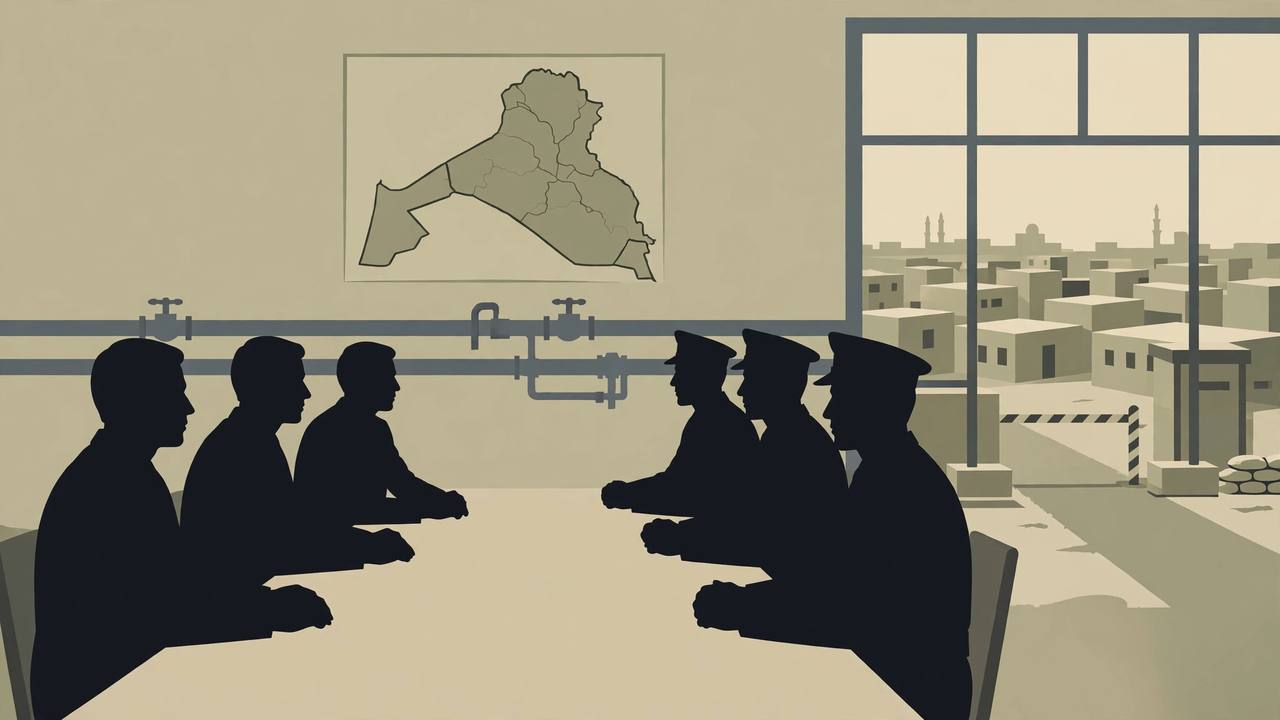
BAGHDAD — Esmail Qaani, the commander of the Quds Force of Iran's Islamic Revolutionary Guard Corps (IRGC), has arrived in Iraq to push for a solution to the standoff over Jurf al-Sakhr, the stronghold of the Iran-backed armed group Kataib Hezbollah, an Iraqi official told Al Jazeera on Tuesday, November 17. Qaani met Prime Minister Ali al-Zaidi and held meetings with figures in the Coordination Framework, the umbrella bloc of Shia parties in Iraq's parliament, in an effort to reach an agreement as tensions rise over a government investigation into suspected oil smuggling in the town.
Source: Al Jazeera
A proposal to relocate Kataib Hezbollah's brigades from Jurf al-Sakhr to the Iraq–Syria border emerged from the talks between Coordination Framework leaders and Qaani, a source within the alliance told the Iraqi outlet Shafaq News on Tuesday. The town, also known as Jurf al-Nasr, lies in northern Babil province, about 60 kilometres southwest of Baghdad.
Source: Shafaq News via Hatha Alyoum
Under the proposed arrangement, three brigades of the Popular Mobilization Forces (PMF) would replace Kataib Hezbollah forces in Jurf al-Sakhr, while a limited number of the group's commanders and fighters would remain at designated positions, and the Federal Police's Third Division would also help secure the district — potentially allowing government forces to return without further escalation, the source said. A three-member committee made up of Badr Organization leader Hadi al-Amiri, PMF chairman Falih al-Fayyadh and PMF chief of staff Abdul Aziz al-Muhammadawi, known as Abu Fadak, was expected to present the proposals to Kataib Hezbollah later on Tuesday evening. The Coordination Framework source told Shafaq News there were signs of a breakthrough in the crisis.
No settlement has been announced yet. The Iraqi official told Al Jazeera that the judicial committee handling the case has not yet reached an agreement with the factions to enter the area, and Al Jazeera's correspondent in Iraq reported that at least three leaders of the Coordination Framework have rejected any armed clash, or any entry of federal forces, before a political understanding is reached with Kataib Hezbollah.
Source: Al Jazeera
Kataib Hezbollah fighters were stationed at entrances and at military and security sites across Jurf al-Sakhr on Tuesday, Shafaq News documented during a media tour of the town. The group's official Abu Talib al-Saeedi ruled out a confrontation with government troops, calling it “a distant dream”. But a Kataib Hezbollah commander told AFP during the same press visit: “I can state decisively and with absolute certainty that the dream they dream of the Kataib withdrawing [from Jurf al-Sakhr] will not come true, not even over our dead bodies.”
Source: Shafaq News via Hatha Alyoum
How the standoff reached this point
On Monday, Prime Minister al-Zaidi told military and security commanders to deploy additional forces around the town and to prepare for government troops to enter, government spokesman Haidar al-Aboudi told the state-run Iraqi News Agency. Security agencies were also instructed to stop tankers carrying oil or petroleum products from leaving the area. A security source told AFP the deadline for the group to leave is Friday, and a senior Iraqi official earlier told Al Jazeera the same deadline applies.
Awaaz Punjab reported the army entry order and the Friday deadline on Monday. Read: Iraq Orders Army Into Jurf al-Sakhr, Gives Kataib Hezbollah Until Friday to Leave
The crisis began with a leaked intelligence report last week which said two strategic oil pipelines running through the town had been tapped. The government's investigation committee said it had detected clear tampering with the pipelines and attempts to conceal the traces; nine security and oil officials were dismissed on November 14. Sources told Reuters the alleged smuggling network had cost the government hundreds of millions of dollars since 2021 — yaani several tens of crores of dollars. These are allegations, not proven findings: Kataib Hezbollah, one of dozens of armed groups with semi-official status in Iraq, denied them on Sunday, saying an inspection found no interference with the pipelines, and accused the prime minister's office of fabricating lies and running a “blackmail operation” to force the group to give up its weapons.
What is solid
- IRGC Quds Force commander Esmail Qaani is in Iraq and has met Prime Minister al-Zaidi and Coordination Framework leaders (Al Jazeera; Shafaq News)
- Baghdad has ordered more forces around Jurf al-Sakhr and set a Friday deadline for Kataib Hezbollah to leave (Iraqi News Agency via government spokesman; AFP security source)
- Kataib Hezbollah fighters remain deployed across the town (Shafaq News media tour, Tuesday)
What is only claimed
- Whether the oil pipelines through Jurf al-Sakhr were tapped for smuggling — the government committee says it found tampering; Kataib Hezbollah says an inspection found no interference
- Whether the group will accept relocation to the Syria border — the proposal is reported by a Coordination Framework source and has not been confirmed by Kataib Hezbollah
What happens next turns on two deadlines. The Amiri–Fayyadh–Muhammadawi committee was due to put the relocation proposals to Kataib Hezbollah on Tuesday evening; if the group refuses, Baghdad's Friday deadline for it to leave Jurf al-Sakhr still stands, with Iraqi forces already ordered to prepare to enter. A negotiated move to the Syria border would let the government re-enter the town without the first direct army-versus-militia clash of the crisis — and would explain why Tehran sent its Quds Force commander in person, rather than leaving the mediation to Iraqi parties alone.