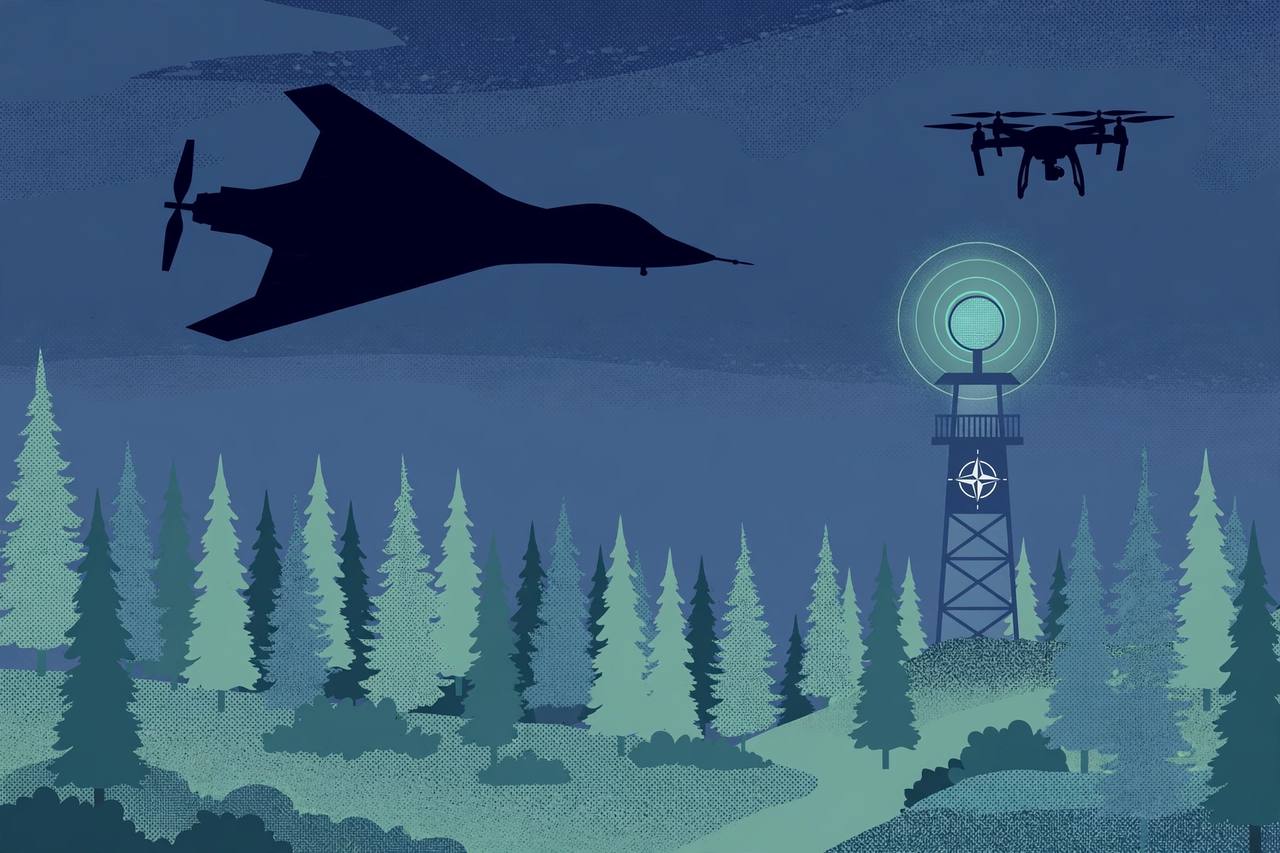
RIGA, November 3 — Latvia's military said on Tuesday it believed that one of two drones that violated the country's airspace in recent days was of Russian origin, while the other was of Ukrainian origin, Reuters reported. The statement is the first preliminary answer to two incidents Awaaz Punjab reported as they happened — an unidentified object on November 1 and a second alert, with NATO jets activated, on November 2 — at a time when the Latvian armed forces had not yet identified either object.
Source: Reuters, November 3
When this site reported the November 1 intrusion and the November 2 alert, Latvia's military had not identified either object. On November 3 it gave preliminary origins for both: the first was most likely a Russian Geran, the second looked Ukrainian. Both findings are preliminary and neither drone's wreckage has been recovered. Read the November 2 Latvia airspace alert story
Sunday, November 1: a Geran that went home
The Baltic Security Monitor, working from the Latvian National Armed Forces' own release, sets out the first incident in the military's timeline. At 18:57 on November 1 a threat was declared over the Kraslava and Ludza districts. The military tracked the aircraft and launched an interceptor drone. At 19:16 the intruder crossed back into Russia, and at 19:19 the interceptor was self-destructed rather than follow it across the border — that self-destruction was the explosion residents heard. The military's assessment is that the intruder was most likely a Russian Geran-type drone. Whether it carried a warhead is unknown, and there is no wreckage, since it returned to Russia.
Source: Baltic Security Monitor, November 3, from the Latvian National Armed Forces release
Night of November 2-3: a Ukrainian-looking drone, still missing
At 00:10 local time on the night of November 2-3 a threat was declared over the Balvi and Ludza districts. Two Latvian interceptor drones, launched from separate positions, detected the target and made an initial identification, while NATO Baltic Air Policing fighters were activated. The alert was lifted at 00:35. Initial visual identification found the aircraft similar to drones used by Ukraine's armed forces. Its exact type and origin are not confirmed. It is suspected to have come down in Balvi district, where the National Guard, the Zemessardze, is involved in an ongoing search. No wreckage has been found so far.
Source: Baltic Security Monitor, November 3; Reuters, November 3
The first of the two incidents — the November 1 object that triggered Latvia's Blaze interceptor — was reported here on the day, before any origin was known. Read the November 1 Latvia intrusion story
The wider pattern is not in dispute. Military drones, mostly of Ukrainian origin, have strayed into the airspace of Finland, Estonia, Latvia and Lithuania, creating concerns that the war in Ukraine is spilling over into NATO countries that border Russia and its ally Belarus, Reuters reported. As Ukraine attacks Russian Baltic Sea oil shipping ports, some of its drones have missed their targets and led to security warnings in neighbouring countries; in Latvia's case, such an incident led to a government collapse earlier this year. Moscow has accused Kyiv of using NATO airspace as cover for attacks, while Kyiv says some of its drones have been steered off course by Russian signal jamming. The NATO countries generally blame Russia for the incidents, saying it ignited the war by invading its neighbour nearly five years ago.
Source: Reuters, November 3
What is solid
- Latvia's military gave preliminary origins on November 3: the November 1 drone was most likely a Russian Geran-type, the November 2-3 drone looked similar to Ukrainian armed forces drones — Reuters; Baltic Security Monitor from the National Armed Forces release
- Latvian interceptor drones were used in both incidents and NATO fighters were activated in the second — both sources
- The first drone flew back into Russia at 19:16 on November 1; no wreckage exists for it — Baltic Security Monitor
- The second drone is suspected to have come down in Balvi district and has not been found — Reuters; Baltic Security Monitor
What is only claimed
- The exact type, origin and armament of both drones: the Geran was assessed without physical debris, the second drone only visually — neither is confirmed
- Whether either incursion was deliberate: neither finding shows a deliberate strike on Latvia
- Why Ukrainian drones stray: Moscow accuses Kyiv of using NATO airspace as cover; Kyiv says Russian signal jamming steers its drones off course — Reuters
Poland moves on the same day, on the same flank
Latvia's answers landed on a day when the flank moved on the ground as well. Polish national police chief Marek Boron announced a large security operation in the Warmia-Masuria and Podlaskie regions, which border Kaliningrad and Belarus; it began on Monday and will run until at least November 8, with additional police and counter-terrorism units, troops from the GROM special forces unit, and a dedicated command centre at national police headquarters. Prime Minister Donald Tusk said suspicious movement had been seen near the Kaliningrad border overnight, including people carrying flashlights, and that intelligence had pointed for weeks to possible sabotage or a more serious provocation; by Tuesday evening Polish authorities had published no evidence of specific sabotage plans. The two regions flank the Suwalki corridor, the only land link between the Baltic states and the rest of NATO.
Source: Baltic Security Monitor, November 3
What happens next
The test of Latvia's preliminary findings is physical: wreckage in Balvi district. If the second drone is recovered, its type and origin stop being a visual judgement from interceptor cameras and become evidence — and the search, with the National Guard involved, was still under way when the military released its assessment. For the first drone there will be no such test, because it flew home. Latvia also noted that its interceptor-drone system has been in service for less than six months, with several teams on standby — a new capability being used, twice in 48 hours, against aircraft from both sides of the same war. In Poland, watch whether the border operation is extended beyond November 8, whether arrests follow, and whether any evidence is published. On NATO's north-eastern flank, identification now has to come before something happens, not after — and on November 3, for the first time, Latvia said plainly that its sky is crossed by both sides.