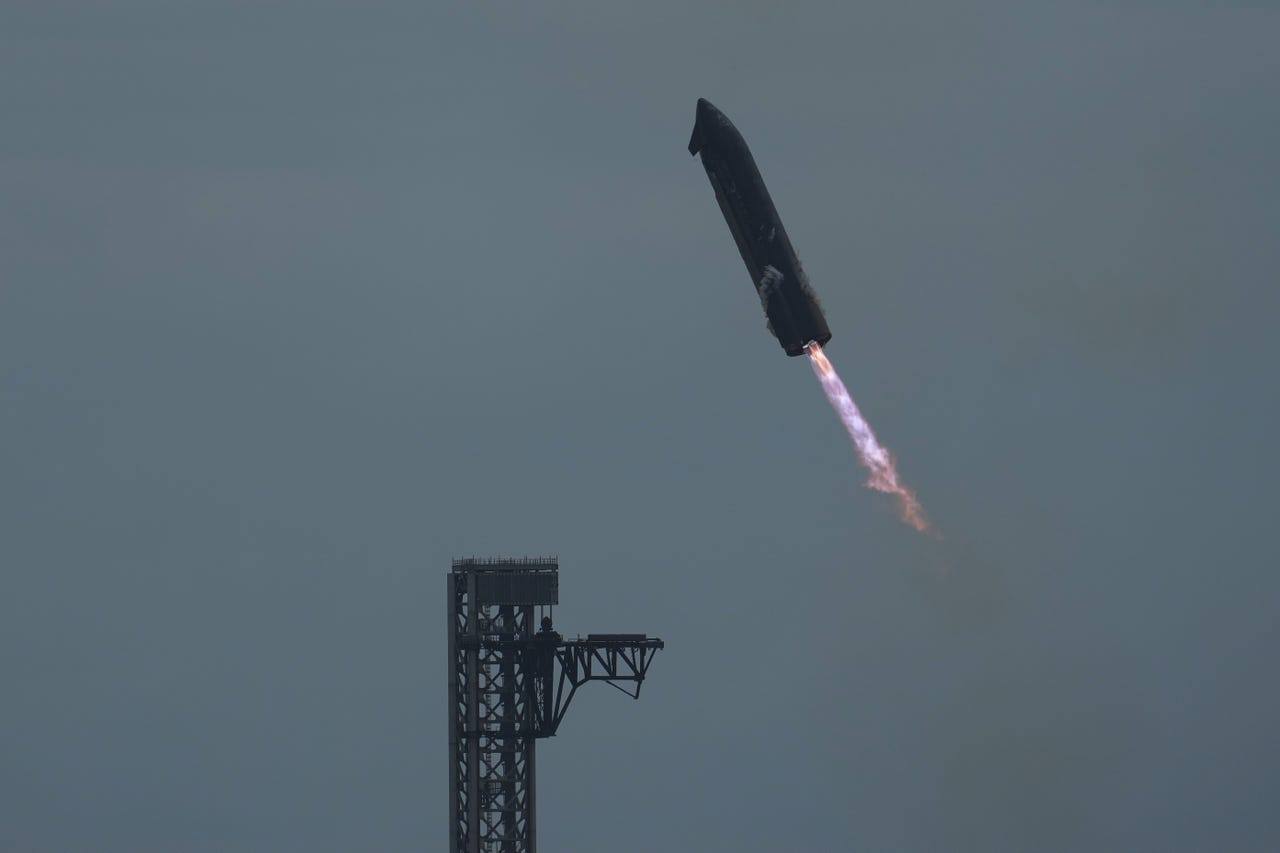
SpaceX's Starship made a triumphant return to Earth on Saturday, caught in mid-air by the giant mechanical arms of its launch tower at Starbase, Texas, where its journey had begun 22 hours earlier — the first-ever capture of a Starship spacecraft flying back from space, the Associated Press reported.
Source: Associated Press via NPR Illinois
The ship, Ship 42, came in for its landing at 3:29 p.m. Central Time on Saturday, completing a flight of about 22.5 hours and 14 revolutions of Earth, Aerospace America reported. SpaceX describes the recovery as a critical benchmark in making Starship a reliably and rapidly reusable rocket.
The catch completes the mission Awaaz Punjab reported on Friday, when Flight 15 lifted off and the booster's own catch was called off while the ship flew on to orbit. Read the earlier Flight 15 launch report
Flight 15 began at 4:47 p.m. Central Time on Friday, when the 407-foot (124-metre) Starship — the world's largest and most powerful rocket — blasted off from SpaceX's base near the U.S.–Mexican border. The upper stage separated from its booster, soared into orbit at about 165 miles (265 kilometres) up, and completed 14 laps around Earth, far outstripping the previous mission's one to two laps. It was SpaceX's 15th flight of a full-scale Starship since 2023 and only its second trip to orbit.
In orbit, the ship released 26 advanced Starlink V3 satellites. Its return began at about 2:20 p.m. Central Time on Saturday, when it restarted one of its six Raptor engines for a 10-second re-entry burn. SpaceX reported that everything on the spacecraft, including its vital heat shield of some 18,000 hexagonal ceramic tiles, appeared to work well, before the ship descended belly-first, flipped upright and settled into the Mechazilla tower's arms.
The booster that did not make it back
The mission fell short of the double catch SpaceX had hoped for. On Friday, the Super Heavy booster's engines stopped firing too soon on the way back down; its guidance system sensed it was not in the right position and automatically diverted it to the Gulf of Mexico, where it exploded, leaving wreckage cordoned off by buoys. SpaceX's Kate Tice said early indications pointed to a low fuel mass alarm ending the booster's return burn early, and that engineers are still investigating the root cause. SpaceX had already made three previous booster catches, validating that technique.
"That was the missing link, the holy grail of spaceflight," SpaceX commentator Dan Huot said at the end of the mission livestream. "We caught a Starship and now everything changes." SpaceX officials said Saturday's catch demonstrates the full reusability of Starship, which is intended for Moon and Mars travel.
Why NASA is watching
NASA welcomed the result. NASA Administrator Jared Isaacman wrote on X that it was "almost magic", adding: "Making more believers by the day … one step closer" to the Moon. The space agency has awarded SpaceX $2.9 billion in contracts for Starship lunar lander variants for its Artemis crewed missions, and is paying billions of dollars for Starship to land Artemis astronauts on the Moon later this decade and help build a permanent lunar base. SpaceX expects to begin launching Starships from Florida's Kennedy Space Center within the next few months, and NASA is targeting as soon as 2028 for Artemis IV, humanity's first Moon landing since the Apollo era.
Source: Aerospace America (AIAA)
What happens next: SpaceX engineers are investigating why the booster was lost, while the caught ship — which SpaceX hopes can fly again without its heat shield being replaced — is the proof the company needed that both halves of the world's biggest rocket can, in principle, be recovered and reused.