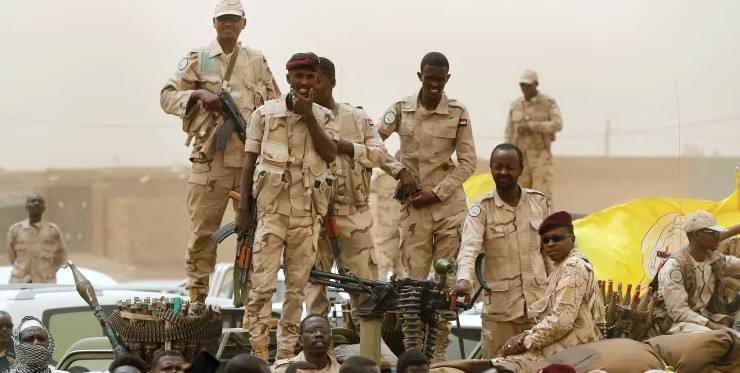
The Sudanese Armed Forces said on Friday that they have taken control of al-Mazroub in North Kordofan state after fierce battles with the paramilitary Rapid Support Forces (RSF), marking a significant gain in one of the main battlegrounds of Sudan's civil war.
Source: Al Jazeera
An army source told Al Jazeera that al-Mazroub was the RSF's largest stronghold in North Kordofan. In a statement on Friday, the military said the fighting caused casualties among RSF forces and heavy combat vehicle losses, and urged citizens in the recaptured areas to "rest assured and return to their normal lives".
Army Special Forces spokesman Mohammed Deidan told the Anadolu news agency that al-Mazroub links North Kordofan and West Kordofan states, and that by seizing it the army was advancing its goal of cutting the RSF's supply lines.
RSF advances in Blue Nile toward Damazin
On a second front, the RSF and the allied Sudan People's Liberation Movement–North (SPLM-North) advanced in Blue Nile State on Thursday and Friday, November 19–20, capturing the headquarters of Bau locality and moving into communities in Geisan locality, bringing the fighting closer to the state capital, Damazin.
Source: Sudan War Monitor
Sudan War Monitor, which said it verified geolocated video filmed by RSF fighters outside the Bau headquarters building, reported that the allied forces entered Bau on Thursday and also captured Dayreng, about eight kilometres southeast of Bau, on Thursday afternoon. Sudanese army units withdrew north to Miganza, about 20 kilometres away, along the main road toward Damazin.
In Geisan locality, the forces attacked Madina 12 on Thursday and entered Madina 11 on Friday, the Monitor reported, putting the fighting within about 40 kilometres of Damazin. Bau lies about 65 kilometres southwest of the capital.
Bau locality commissioner Abdel Ghani Dagais told local television on Friday that residents of 35 villages had fled to Damazin following the RSF attacks. Humanitarian activists told Sudan Tribune that about 500 families had fled Bau locality, about 309 families had left Madina 12, and about 600 families from Wad al-Mahi had reached Al-Mahal. Aid agencies have reported shortages of food, shelter and basic services among the displaced.
Some Damazin residents have begun leaving as the fighting approaches. Elham Kamal, a resident who spoke to Radio Tamazuj, said others wanted to leave but could not afford travel to safer areas.
The Blue Nile government said on Friday that the army retains the initiative and is working to restore security, and the regional government said it was coordinating with the army's 4th Infantry Division. Blue Nile government spokesman Saif al-Nasr Minallah urged residents to remain calm and denied that the advancing fighters were nearing Damazin — a claim that contrasted with the reported proximity of the fighting in Geisan locality.
Sudanese army sources told Sudan War Monitor that the military had deployed reinforcements to Blue Nile as new military leadership took command in the state. No casualty figures were reported in the cited accounts for the Blue Nile fighting.
Why Kordofan and Blue Nile matter
The SPLM-North faction fighting alongside the RSF is led by Abdelaziz Adam al-Hilu and is part of the Ta'sis coalition. A separate SPLM-North faction, led by Malik Agar, has members serving with the Sudanese army — so SPLM-North fighters are present on both sides of the conflict.
Fighting in Sudan's Kordofan region — North, West and South Kordofan — has intensified since late 2025. The vast region lies where the two sides' areas of control meet, between the army-held central region and RSF-controlled Darfur in the west. Al Jazeera reported that since the war began in April 2023, one in five recorded attacks in Sudan has taken place in Kordofan.
The Blue Nile offensive coincides with a Sudanese army advance in West Kordofan. The army and allied groups entered Al-Khuwai, a locality headquarters the RSF had held since May 2025, on November 13 and continued toward Al-Nahud, in an offensive that began on November 5 outside El-Obeid. Sudan War Monitor has assessed that the Blue Nile offensive may be intended in part to draw army troops and equipment away from the fighting in Kordofan — that remains the Monitor's analysis, and the forces' stated objectives have not been established.
The army's Kordofan offensive broke the siege on El-Obeid earlier this month — read our earlier report. Sudan army takes Al-Khuwai as Kordofan offensive breaks El-Obeid siege
The war between the army and the RSF, which erupted in April 2023 over disagreements on integrating the military establishment, is now in its fourth year. It has left tens of thousands dead and displaced around 13 million people, in one of the world's worst humanitarian crises.
What is solid
- The army says it captured al-Mazroub, its claim reported by Al Jazeera on November 21.
- RSF and SPLM-North fighters captured Bau locality headquarters on November 19, verified by geolocated video, according to Sudan War Monitor.
- Residents of 35 villages fled to Damazin, according to the Bau locality commissioner.
What is only claimed
- Whether the army still holds the initiative in Blue Nile — the regional government says it does; RSF claims of control near Damazin are disputed by the government.
- The purpose of the Blue Nile offensive — Sudan War Monitor assesses it may be a diversion from Kordofan; the forces' objectives are not established.
Watch whether the army can hold al-Mazroub and cut RSF supply lines between the Kordofan states — and whether the RSF push in Blue Nile reaches Damazin, which has so far been spared the worst of the fighting. Aid agencies warn displacement will grow if the fighting reaches the capital.