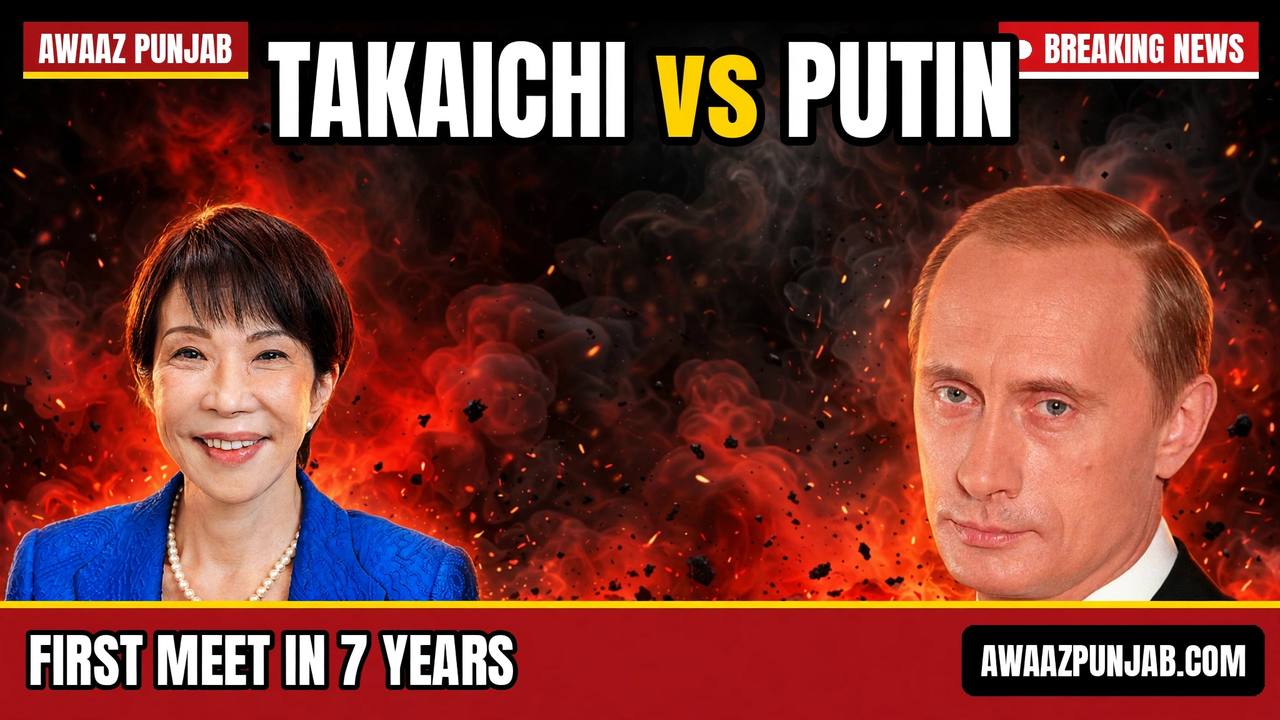
Japanese Prime Minister Sanae Takaichi met Russian President Vladimir Putin for about 30 minutes on Wednesday evening in Shenzhen, China, on the sidelines of the APEC leaders' summit — the first meeting between the leaders of Japan and Russia in seven years.
Source: The Japan Times
It was also the first face-to-face contact between the two countries' leaders since Russia launched its full-scale invasion of Ukraine in February 2022. The last formal meeting between Japanese and Russian leaders took place in September 2019, when then prime minister Shinzo Abe met Putin in Vladivostok to discuss the disputed Kuril Islands, known in Japan as the Northern Territories.
Source: Bloomberg
Takaichi raised two long-running irritants, according to Japan's government. She pressed Putin on the detention of Yuki Imai, a reporter for the Hokkaido Shimbun newspaper who was arrested in October in Russia's Sakhalin region on suspicion of espionage and later moved to a detention centre in Moscow, and on Moscow's move to put the local subsidiary of Japan Tobacco under Russian management.
No agreement was announced on either issue. Japan's government said only that the two sides agreed to keep communicating at various levels. Chief Cabinet Secretary Minoru Kihara confirmed the talks on Thursday morning, and Japan's Jiji Press reported, citing the Foreign Ministry, that Tokyo had requested the meeting.
Source: Jiji Press
An informal exchange, not a summit
The Kremlin had said no formal bilateral meeting was planned, and the talks appear to have been an informal exchange rather than a full summit. No official statement or readout of what was discussed has been published, and the account of the meeting rests on Japanese government briefings and media reporting.
Speaking at a news conference after the APEC summit, Takaichi described the biggest step forward as creating an opportunity for direct communication with Putin in the future. She said she had also raised the protection of Japanese companies operating in Russia.
Seven years of frozen ties
Relations between Tokyo and Moscow have been strained since the invasion of Ukraine. Russia suspended peace-treaty negotiations in 2022, citing Japan's participation in international sanctions, and Japan has kept those sanctions in place — on October 2 it added 33 organisations and nine individuals to its sanctions list.
The territorial dispute over the four islands seized by the Soviet Union at the end of the Second World War remains unresolved, and visits by former Japanese residents to their ancestral graves there were halted after the invasion. In August, Putin visited Etorofu, one of the disputed islands, in a trip Tokyo called "absolutely unacceptable".
Jiji reported that Putin may have pressed Takaichi to halt Japanese support for Ukraine. Japan has been one of Kyiv's leading Asian backers, and any such request would go to the heart of the disagreement between the two sides.
What is solid
- Takaichi and Putin spoke for about 30 minutes on Wednesday evening in Shenzhen, after the APEC welcome dinner
- It was the first meeting of Japanese and Russian leaders in seven years and the first since the 2022 invasion of Ukraine
- Takaichi raised the detained Hokkaido Shimbun reporter Yuki Imai and the treatment of Japanese companies
- No agreement was announced; both sides agreed to keep communicating
What is only claimed
- What Putin said in reply — no readout has been published, and Moscow has not confirmed the meeting in the same terms
- Whether Putin pressed Takaichi to halt Japanese support for Ukraine, as Jiji reported
The Takaichi–Putin meeting came a day before the first-ever trilateral summit of the US, Chinese and Russian leaders, also held in Shenzhen. Read: Trump, Xi and Putin meet in Shenzhen
What happens next: watch for any Russian account of the exchange, for movement on Imai's case or on Japan Tobacco's subsidiary, and for whether the direct channel Takaichi described produces a follow-up contact. Japan's government has stressed that the meeting does not signal any change in its sanctions policy toward Moscow.