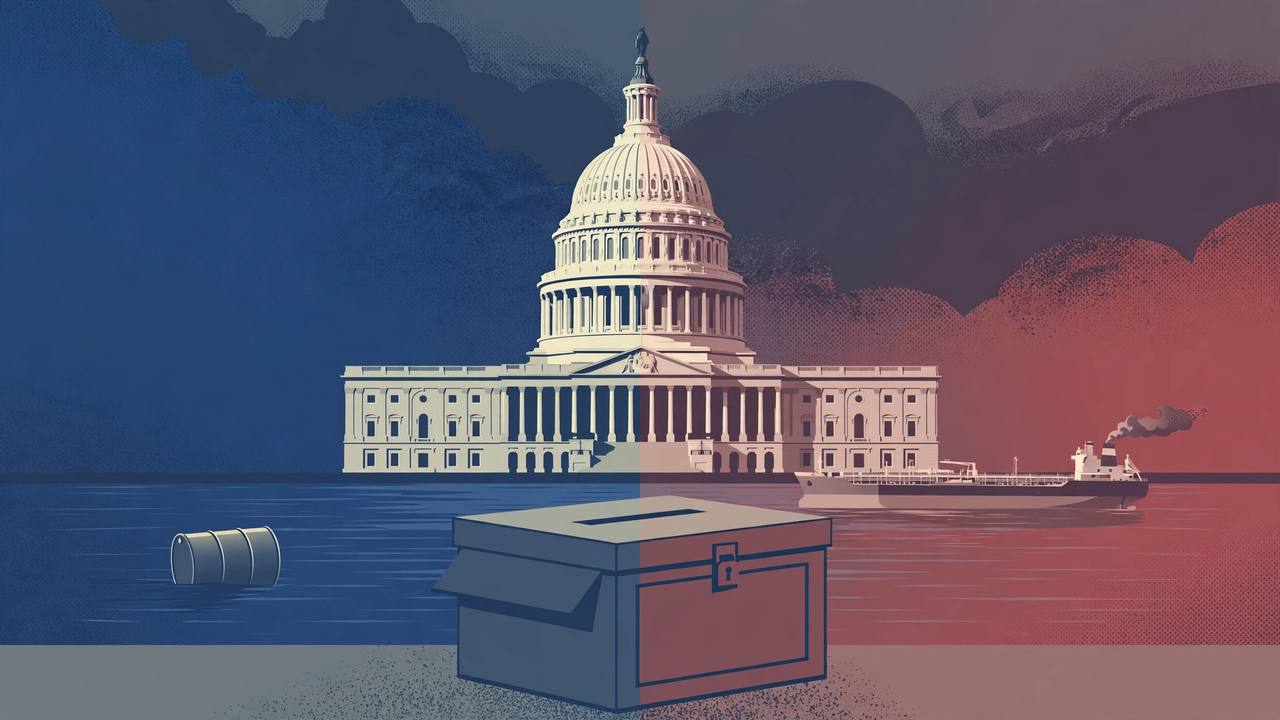
US President Donald Trump has acknowledged that the war in Iran played a role in his Republican Party's losses in Tuesday's midterm elections, telling Fox News that the conflict had weighed on Republican candidates even as he insisted voters backed his handling of it. It is the first time the president has publicly linked the war — now more than eight months old — to his party's defeat at the ballot box, as Democrats prepared to take control of both the US House of Representatives and the Senate and challenge his legislative agenda.
Source: Reuters via WIXX
“I think a part of it was Iran, but at the same time people understood the importance of what I've done with Iran,” Trump said in the interview, reported by the Reuters news agency on Wednesday, November 4.
Source: Reuters via WIXX
Trump also vowed to block the incoming Democratic Congress with his veto pen. “They'll send over things that are insane, and I'll veto them,” he said. “And after a couple of months of vetoes, they'll call and they'll say, ‘How do we get this stuff done?’ And we'll work together.”
Source: Reuters via WIXX
Democrats were projected on election night to retake the House of Representatives, ending the Republican majority and setting up divided government for the last two years of Trump's second term, as Awaaz Punjab reported: read the Democrats-win-the-House story
A war that reached the ballot box
The war began on February 28, when the United States and Israel launched strikes across Iran. Tehran retaliated against Israel and US assets across the region, the Strait of Hormuz — the waterway that normally carries about one-fifth of the world's oil — was largely shut, and crude prices surged above $100 a barrel, pushing up fuel and food costs far beyond the Middle East. The AFP news agency reported that Tuesday's election was won on anger over living costs, tariffs and the Iran war.
Source: AFP via The Continental Patriot
The admission came barely two days after the latest exchange of fire. On Monday night, November 2, US forces struck an Iranian air defence facility on Qeshm Island in the Strait of Hormuz. A US official said the strikes were defensive, aimed at Iranians who were “using surface-to-air missiles against US assets”, and Trump later confirmed what he called a small, minor attack on a facility Washington had watched being built for about two months.
Source: Reuters via 94.1 The Duke
Awaaz Punjab reported the Qeshm Island strikes and Trump's confirmation in full: read the US strikes on Qeshm Island story
Trump's public signals on what comes next have pointed in two directions at once. He told Axios he was “in no rush” to resume strikes — “We crippled them financially. They have no money” — and told the Financial Times on Tuesday that the United States had no immediate plans to strike Iran, while writing on Truth Social that “Iran wants a settlement, as soon as possible. It could happen!” He also said indirect talks on Iran's stockpile of enriched uranium were continuing.
Source: Reuters via InvestingLive
Before the vote, Trump had said he was not considering strikes on Iran after the midterms, as Awaaz Punjab reported: read the no-post-midterm-strikes story
Tehran is not blinking
Iran's position has not softened with the American vote. A senior Iranian official told Reuters on Tuesday that Iran and the United States remain far from a deal to end the war. Mohsen Rezaei, secretary of Iran's Supreme National Security Council, said Washington's reply to Tehran's conditions was “not convincing” and that the Strait of Hormuz would stay shut to the United States until those conditions were met — among them waiving sanctions on Iranian oil sales, ending the US naval blockade of Iranian ports and releasing frozen Iranian funds.
Source: Reuters via InvestingLive
Iran's parliament speaker had already warned that a deal was out of reach and that the ball was in Washington's court, as Awaaz Punjab reported: read the Iran deal-out-of-reach story
Mediation is now running on a short clock. Qatar, which is leading the mediation effort, said both sides were reviewing proposals, and an official briefed on the talks told Reuters that feedback from Washington and Tehran was expected within 36 hours. Qatar's foreign ministry spokesman Majed Al Ansari said both sides were still reviewing the proposals presented by Doha and that there was still hope for a deal.
Source: Reuters via InvestingLive
Oil markets took the election result as one more reason for caution on Iran. Brent futures rose 82 cents, or 0.8 percent, to $104.42 a barrel by 0510 GMT on Wednesday, and US West Texas Intermediate crude gained 50 cents, or 0.5 percent, to $96.59, reversing earlier declines, Reuters reported from Singapore. “Markets remained on watch for any progress in talks to end the US-Israeli war with Iran, as Qatar stepped up mediation efforts to avert an escalation of attacks after the US elections,” the agency wrote. Official US inventory data from the Energy Information Administration was due at 10:30 a.m. EST on Wednesday.
Source: Reuters via 94.1 The Duke
What a Democratic Congress can — and cannot — do to the war
A Democratic House and Senate can challenge Trump's legislative agenda, open investigations, and pass war-powers or funding measures aimed at the Iran campaign — but the president commands the military, directs foreign policy, and has now promised to veto bills he dislikes; overriding a veto takes two-thirds of both chambers. That is why Trump's own framing matters: he is presenting the veto fights as temporary, predicting Democrats will come to him asking how to get things done. Whether the new Congress tries to use its funding power over the war is one of the first tests of the post-midterm order.
Source: Reuters via WIXX
For the lakhs of Punjabi and Indian workers who live and work across the Gulf states, the stakes in this Washington fight are direct: every escalation of the US–Iran war has put their workplaces, flights home and remittances at risk, and crude above $100 a barrel keeps diesel and petrol expensive for Punjab's truckers and farmers. A negotiated end to the war — or a Congress that pushes Washington toward one — would ease both pressures at once.
Source: Reuters via 94.1 The Duke
What happens next
Three clocks are now running. The mediation clock: Washington and Tehran owe Qatar answers on the latest proposals within about 36 hours. The Congress clock: Democrats take their majorities with a president already promising vetoes, and the Iran war is the largest foreign-policy file on their desk. And the market clock: with Brent above $104 and Hormuz still shut, traders are pricing in a war that neither side has yet found a way to end — a war its own president now admits cost his party an election.
Source: Reuters via InvestingLive
Trump has admitted the Iran war hurt Republicans at the ballot box — and the Democratic Congress it produced now becomes a new player in whether the war expands, freezes or ends.