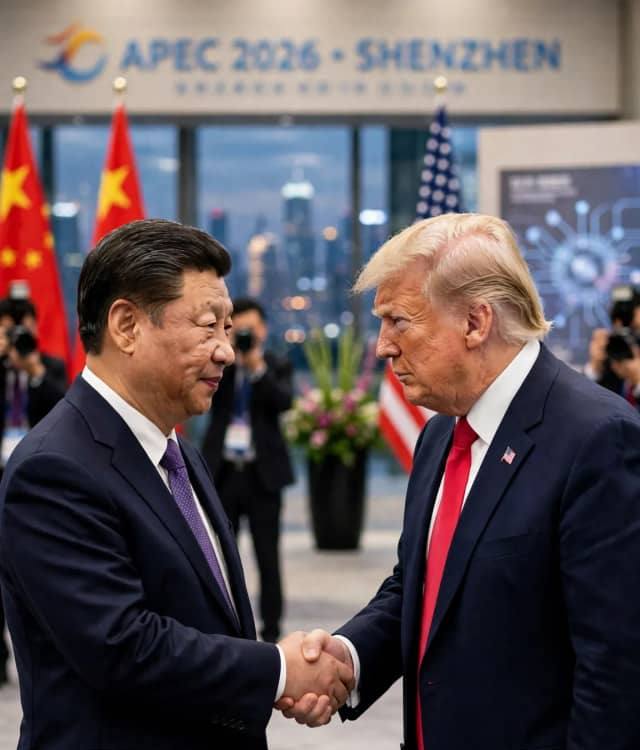
US President Donald Trump and Chinese President Xi Jinping agreed that humans should always be involved in military decisions that use artificial intelligence, Treasury Secretary Scott Bessent said on Friday, describing the understanding as one of the major achievements of Mr. Trump's trip to Asia.
Source: Reuters
“I think it was very important that President Trump and President Xi agreed that humans should always be involved in any military decisions that SI makes, and the SI should not be allowed to be autonomous for major military actions,” Mr. Bessent told CNBC after returning from Mr. Trump's meeting with Mr. Xi in Shenzhen, China. “SI” is the Trump administration's preferred term for the technology — “super intelligence.”
Mr. Bessent said the agreement on military use of the technology, requiring human involvement and other safeguards, would not be affected by the two countries' competition for AI supremacy. “Both sides agree that no major military operation should be launched without a human being involved,” he said.
What was actually agreed — and what was not
No joint statement or treaty text on the AI understanding has been released, and neither side has published details of any safeguards. The account so far rests on Mr. Bessent's description of the understanding in his CNBC interview — it was not part of the written declaration the three leaders issued in Shenzhen.
That declaration came a day earlier, after the first-ever trilateral meeting of Mr. Trump, Mr. Xi and Russian President Vladimir Putin on November 19. The four-point “peace declaration” reaffirmed that a nuclear war cannot be won and must never be fought, and promised a dialogue on reducing nuclear risks — but it set no arms-control talks and did not mention the AI understanding.
Source: Reuters
Trump, Xi and Putin signed the four-point peace declaration after their first-ever trilateral summit in Shenzhen — with no arms-control deal and no mention of Ukraine or Iran. Read the summit story
Why it matters
The United States and China are competing hard for AI supremacy, and who — or what — decides to use force is one of the most sensitive questions in their rivalry. A shared rule that a human must stay in the loop for major military action would be a guardrail between the world's two biggest military powers, if Beijing confirms it in its own words.
The backdrop is a thinning arms-control architecture. New START, the last major US–Russia nuclear arms treaty, expired in February 2026, leaving the United States and Russia without its treaty-based limits on strategic arsenals. Against that background, even an unwritten understanding on AI carries weight — but only as far as both sides honour it.
“No major military operation should be launched without a human being involved.” — US Treasury Secretary Scott Bessent, describing the Trump–Xi understanding on military AI.
What happens next is a test of whether the understanding exists on paper as well as in words: watch for any confirmation from Beijing, and for any written text or safeguards. Neither has appeared yet. Awaaz Punjab will follow the story as it develops.