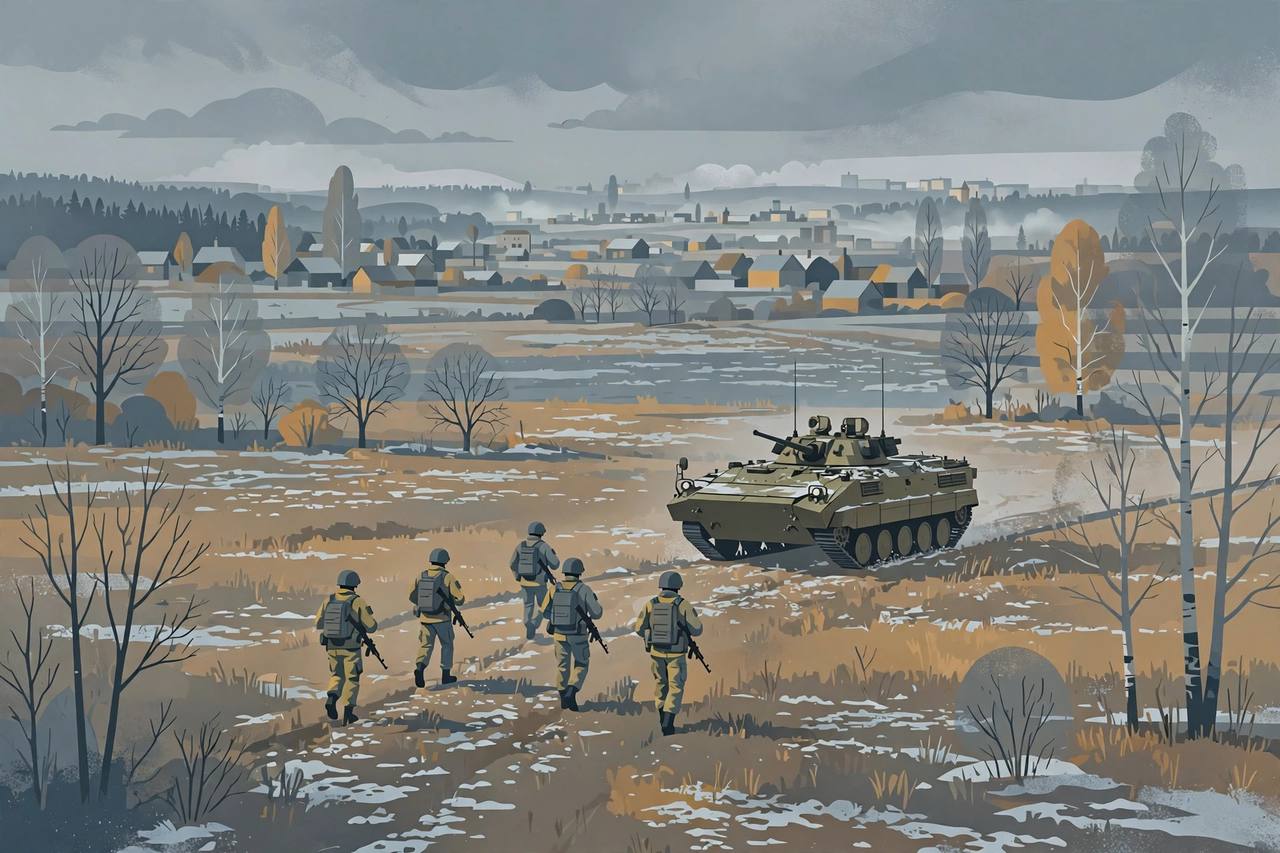
Ukrainian forces have revealed a covert counter-offensive in northern Kharkiv region, saying troops liberated 14 settlements and retook nearly 200 square kilometres of territory in an operation codenamed "Bear Trap". The operation, kept secret for weeks, was disclosed on November 20 by the unit that carried it out.
Source: Institute for the Study of War
The operation was carried out by the 475th Separate Assault Regiment, known as CODE 9.2. The unit said it received its orders on September 10 and active fighting began on September 20, in the area north and north-east of Velykyi Burluk, near the villages of Prykolotne and Vilkhuvatka, close to the Russian border.
Source: Gwara Media
How the trap was set
According to the unit and Ukrainian reporting, the operation used a decoy armoured thrust — including tanks driving towards Vilkhuvatka — to draw Russian forces forward, while drones and flanking assaults cut them off in what commanders called "deep isolation". Ukrainian forces said the trap stopped a Russian advance that had pushed up to 20 kilometres into the region since June, when Moscow launched its own offensive there, codenamed "Bear Corner".
Source: 112.ua / UATV
The Institute for the Study of War, in its November 20 assessment, said Operation Bear Trap "was able to stop the planned Russian encirclement and liberate territory north and northeast of Velykyi Burluk". The institute noted that BBC's Ukraine service had reported Russian forces planned to attack along the Artilne–Vilhuvatka and Vovchansk–Bilyi Kolodiaz lines to close an encirclement near Prykolotne, and that Ukrainian military sources told the BBC the situation had come "close to critical" after Russian troops crossed the border near Artilne.
Source: Institute for the Study of War
Moscow had claimed in September and October that its forces had encircled around 2,000 Ukrainian troops in the area — a claim repeated by the Russian Defence Ministry and by Chief of the General Staff Valery Gerasimov. The Institute for the Study of War said it had seen no indication of a successful Russian encirclement in the area, contrary to those claims, and noted that Russian military bloggers had echoed the official statements.
Source: Institute for the Study of War
The wider picture
The disclosure came on the same day Russia launched its largest missile and drone strike of November — 27 ballistic missiles, 84 cruise missiles and 404 drones, according to President Volodymyr Zelenskyy and the Ukrainian Air Force — hitting bridges and energy infrastructure in Kyiv. Ukraine's General Staff said 157 combat engagements were recorded across the front in 24 hours.
Source: Institute for the Study of War
A Russian Kh-101 missile also came down in Poland during the same night's strikes — read our earlier report on the airspace violation. Read the Poland report
Ukrainian forces said clearing operations were still under way in the recaptured area, but that the situation around Vilkhuvatka was now stabilised. The operation was part of a wider Ukrainian campaign in the north-east: a related operation, Vivaldi, recaptured 277 square kilometres around Sloviansk before ending in October.
Source: 112.ua
What is solid
- Ukraine disclosed Operation Bear Trap on November 20, 2026, through the 475th Separate Assault Regiment (CODE 9.2).
- The Institute for the Study of War assesses the operation stopped a planned Russian encirclement and liberated territory north and north-east of Velykyi Burluk.
- Ukrainian reporting puts the gains at 14 settlements and nearly 200 square kilometres (another report: 204 square kilometres).
What is only claimed
- The figures of around 800 Russian personnel killed and about 400 vehicles destroyed are Ukrainian claims and have not been independently verified.
- Moscow's claim that it encircled some 2,000 Ukrainian troops is disputed by the Institute for the Study of War, which says it saw no evidence of a successful encirclement.