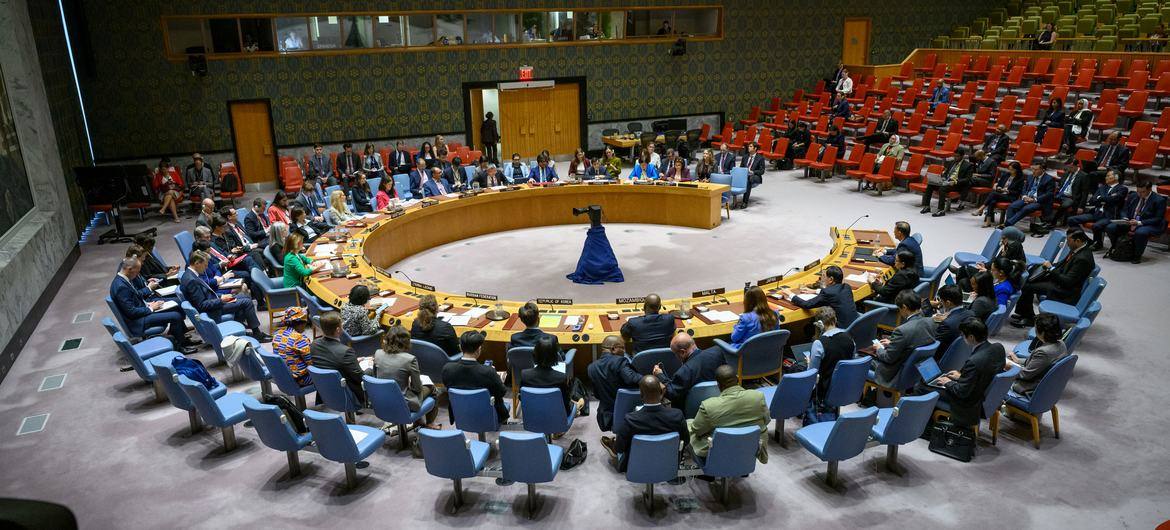
New York — The UN Security Council held closed-door consultations on Myanmar on Tuesday evening, taking up the International Court of Justice's landmark ruling that Myanmar committed genocide against the Rohingya — the first time the matter has reached the Council since the verdict.
Source: Arakan Journal
The meeting was held at the request of the United Kingdom and was taken up under "any other business" in closed consultations, according to Security Council Report, cited by Bangladeshi media. It followed a Council discussion on North Korea sanctions. European members of the Council — France, Denmark, Greece and Latvia — supported taking up the issue.
On 19 November the International Court of Justice ruled by nine votes to six that Myanmar committed genocide against the Rohingya during its 2017 military operations in Rakhine State — the first time in the court's 80-year history that a state has been found responsible for genocide. Read the earlier report
What the court decided
The court found that around 10,000 Rohingya were violently killed in the 2017 operations, more than 700,000 fled across the border into Bangladesh, and about 815,000 people were targeted in some way. Nearly 400 villages — roughly 40 per cent of those in the three northern townships — were partially or totally destroyed. The court ordered Myanmar to investigate and prosecute those responsible, allow the safe, voluntary and dignified return of displaced Rohingya, pay compensation — the amount to be decided later — and pass laws giving full effect to the Genocide Convention.
Myanmar's leader: 'will not comply'
Myanmar's leader, Min Aung Hlaing, has said the country will not comply with parts of the ruling it considers "inappropriate", in his first publicised comments on the judgment. According to state media, as reported by the BBC and AFP, he told a meeting on Wednesday that Myanmar "would take the actions appropriate for a responsible country but would not comply with requirements it considered inappropriate". He did not say which of the court's orders he meant. The state-run Global New Light of Myanmar quoted him calling the case a "one-sided accusation" and saying the word "genocide" had seriously affected the country's reputation. His government had already called the decision unfair.
Britain's response
Britain, which requested the Council meeting, has moved fastest since the verdict. On 23 November Foreign Secretary Ed Miliband formally recognised that Myanmar committed genocide against the Rohingya, imposed sanctions on five senior military commanders, pledged legislation to ban the export and supply of aviation fuel to Myanmar, and announced £8 million in new funding — £3 million for accountability work and £5 million in humanitarian aid, yaani lagbhag ₹94 crore. Britain also expelled Myanmar's defence attaché in London. Fourteen countries issued a joint statement on the ruling.
What happens next
Britain and France have requested a dedicated Security Council session on Myanmar in early December, and a separate closed-door Council meeting on the general situation in Myanmar is planned for 7 December. Rights groups, including the Burma Human Rights Network, are urging the Council to impose a global arms and aviation-fuel embargo on Myanmar's military, refer the situation to the International Criminal Court, and set up a mechanism to enforce the court's orders on reparations for survivors.
The judgment is final and binding and cannot be appealed — but the court has no police or prison of its own. Under Article 94 of the UN Charter, The Gambia can ask the Security Council to enforce it, but the Council has never used that power to enforce an ICJ judgment, and China and Russia, both permanent members with a veto, have repeatedly shielded Myanmar's military. UN Secretary-General António Guterres welcomed the judgment as "a powerful recognition of the Rohingya victims of genocide". Around 400,000 Rohingya remain in Rakhine State, where the Arakan Army has controlled nearly all of the state since late 2023, and nearly 1.2 million live in refugee camps in Bangladesh, where aid cuts have reduced food rations.