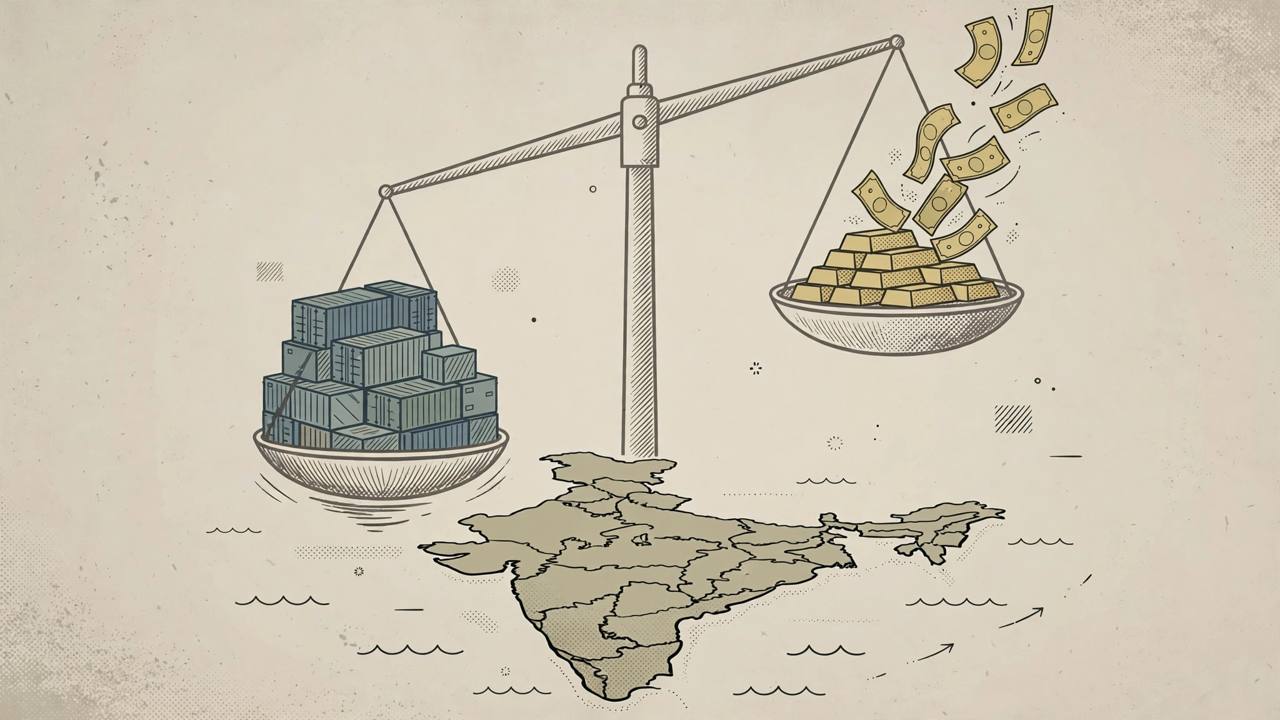
NEW DELHI: India's current account deficit (CAD) widened to $25.8 billion in April–September 2026, the first half of the financial year, from $18 billion in the same period a year earlier, according to preliminary balance of payments (BoP) data released by the Reserve Bank of India (RBI) on Friday, November 13. The wider deficit came as the merchandise trade gap and net income outflows grew, PTI reported.
Source: PTI via Bazar Observer, Nov 13, 2026
The overall external picture nevertheless improved sharply. India's balance of payments recorded a surplus of $66.8 billion in April–September, against a deficit of $6.4 billion a year earlier, the RBI's press release (2026-2027/1495) showed, with the improvement supported by a surge in banking capital inflows.
Source: RBI Press Release 2026-2027/1495 via Indian Banking Radar, Nov 14, 2026
The merchandise trade deficit widened to $176.1 billion from $158.1 billion, Finance Outlook India reported from the RBI data. Merchandise exports rose to $265.3 billion from $221.5 billion, but imports rose faster, to $441.4 billion from $379.6 billion. The net income deficit also expanded, to $32.4 billion from $25.8 billion. Stronger services and remittances cushioned the gap: net services exports rose to $105 billion from $98.8 billion, and net transfers — which include remittances from Indians abroad — rose to $77.7 billion from $67.2 billion.
Source: Finance Outlook India, Nov 14, 2026
Banking capital did the heavy lifting
The capital account surplus surged to $92.6 billion in April–September, from $11.6 billion a year earlier. Banking capital inflows stood at $125.2 billion, compared with just $0.3 billion a year earlier, and within that, net inflows through non-resident Indian (NRI) deposits reached $125.6 billion, against $6.1 billion in the first half of 2025-26. Net foreign direct investment was $8.8 billion, marginally higher than $7.4 billion a year earlier. Against that, foreign portfolio investors pulled out a net $10.4 billion, and external commercial borrowings recorded net outflows of $40.6 billion, compared with net inflows of $7.2 billion a year earlier.
In September alone, the current account deficit was $7.4 billion, against $5.2 billion in September 2025, even though the month's merchandise trade deficit narrowed to $30 billion from $33.4 billion. Net capital inflows of $16.2 billion in September — against net outflows of $0.4 billion a year earlier — lifted the month's BoP to a surplus of $8.8 billion, reversing a deficit of $5.6 billion in September 2025, though the surplus was well below August's $45.4 billion.
Gaura Sen Gupta, Chief Economist at IDFC First Bank, said India's BoP outlook was showing signs of meaningful improvement, with the September surplus supported by stronger-than-expected banking capital inflows of $22.2 billion, remittances of around $12 billion and an improved services surplus. She expected the external position to keep improving in the second half of the year, which could reduce pressure on foreign exchange reserves and keep the rupee range-bound.
The current account tracks what India earns and spends with the rest of the world on goods, services, income and transfers — a deficit there means imports and outflows exceeded earnings. The balance of payments adds capital flows on top: in April–September, very large banking and NRI deposit inflows more than covered the current account deficit, leaving an overall surplus.