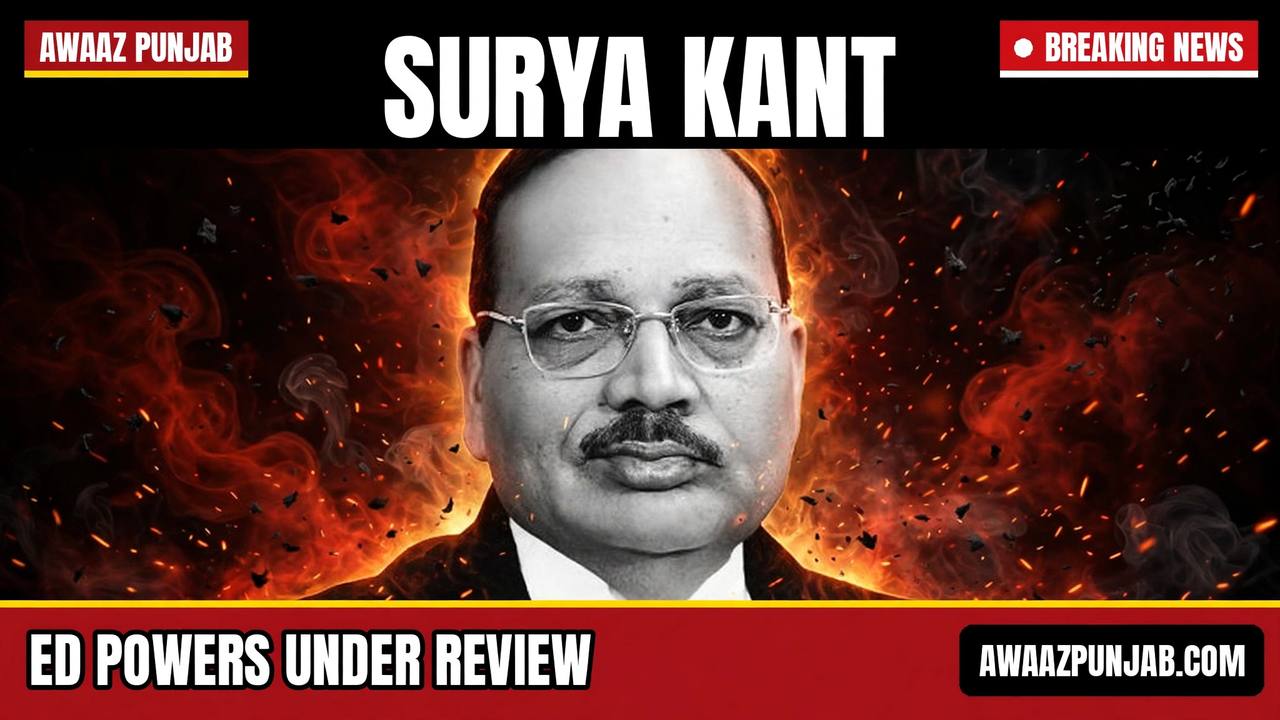
The Supreme Court on Friday said it will take up in January the petitions seeking a review of its 2022 judgment upholding the Enforcement Directorate's (ED) powers of arrest, property attachment, search and seizure under the Prevention of Money Laundering Act (PMLA), 2002.
Source: Press Trust of India via The Siasat Daily
A bench comprising Chief Justice of India Surya Kant and Justices Joymalya Bagchi and V Mohana indicated the timeline after lawyers for the parties sought an early hearing. The Chief Justice said the exact hearing date would be notified separately.
Source: Law Trend
What is under review
The review proceedings concern the court's July 2022 judgment in Vijay Madanlal Choudhary v. Union of India, which upheld several provisions of the PMLA, including those governing the ED's investigative powers, disclosure of the Enforcement Case Information Report (ECIR), the burden of proof and the stringent bail conditions under Section 45.
In that judgment, delivered on a batch of more than 200 petitions, the court held that money laundering was a serious threat to financial systems and could not be treated as an ordinary offence. It upheld the ED's powers to arrest, attach properties and conduct searches and seizures, held that ED authorities were distinct from police officers, and ruled that supplying an ECIR copy to an accused was not mandatory — disclosure of the grounds of arrest at the time of arrest was sufficient.
Maintainability comes first
Before the court reaches the substance, it must first decide whether the review petitions are maintainable at all. On July 31, 2025, the court decided it would examine maintainability first, and the January hearing is expected to follow that order.
The ED has raised three preliminary objections: whether the petitioners have shown an 'error apparent on the face of the record', whether the review is in substance an appeal in disguise, and whether the review's scope is confined to the two questions identified when notices were issued in August 2022. The review petitioners, including Congress MP Karti P. Chidambaram, have put forward 13 questions for consideration.
The Centre, represented by Solicitor General Tushar Mehta, has argued that the review should stay confined to two issues: whether the ED must supply a copy of the ECIR to an accused, and the reversal of the burden of proof under Section 24 of the PMLA.
The 2022 judgment has faced sustained criticism, and opposition parties have repeatedly alleged that the PMLA is used to target political opponents. If the court finds the review maintainable, some of the ED's most far-reaching powers could return to constitutional scrutiny.
During Thursday's hearing on maintainability, the bench observed that the ED 'cannot act like a thief' and that its conduct must remain within the four corners of the law, adding that the court was concerned about the agency's image. Additional Solicitor General S.V. Raju, appearing for the ED, contended that the review petitions were not viable because they were, in essence, appeals disguised as reviews.
The court will now list the review petitions for hearing in January 2027, with the precise date to be notified.