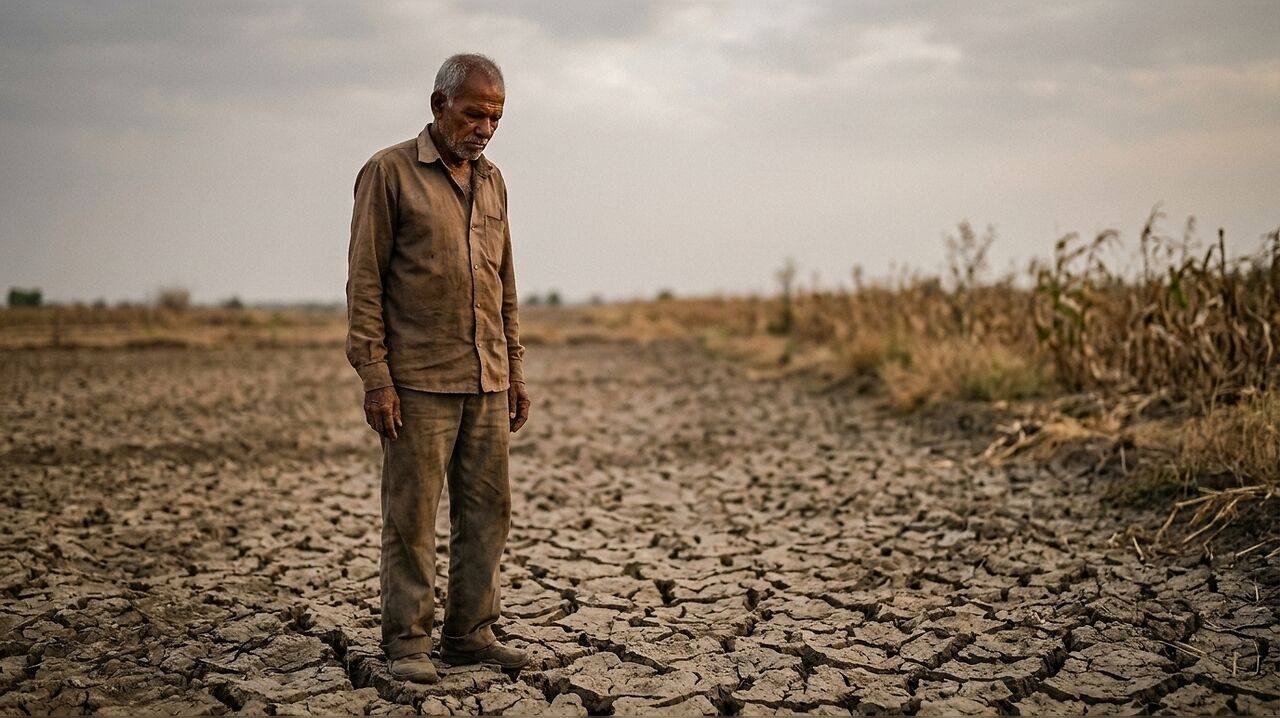
Maharashtra's Rabi sowing has fallen to just 14.74 lakh hectares so far in the 2026-27 season — below the level recorded during the devastating drought of 1972-73 — according to fresh data from the state Agriculture Department, raising fears that this could become the lowest Rabi season on record.
Source: Madhyamam
In the 1972-73 Rabi season, sowing covered 47.29 lakh hectares. This year the figure stands at only 14,74,304 hectares. The previous record low was 40 lakh hectares in 1991-92, while the state's usual Rabi area ranges between 55 and 60 lakh hectares.
The break-up underlines the scale of the collapse. Foodgrain sowing has reached only 7,79,812 hectares against 36,64,000 hectares in 1972-73, and oilseed sowing has fallen to a mere 16,106 hectares against 6,34,000 hectares then. Pulses, at 6,78,385 hectares, are the one exception, running above the 4,31,000 hectares of 1972-73.
A failed monsoon behind the crisis
The Agriculture Department attributes the crisis to a powerful El Niño that left Maharashtra with a 19 per cent rainfall deficit during the monsoon. Solapur recorded the steepest shortfall at 59 per cent below normal. Much of the rain that did fall was concentrated within a 15-day period in July, which damaged the Kharif crop and left the soil without the moisture Rabi sowing needs.
Dams at 64%, Marathwada worst hit
Water reserves have fallen sharply. As on November 17, the state's 3,042 dams held 923.60 TMC of live storage — 64 per cent of capacity — against 1,309.93 TMC, or 90 per cent, on the same date last year. Marathwada is the worst hit: storage in the Chhatrapati Sambhajinagar division has collapsed from 90 per cent to 36 per cent.
Across the state, 1,383 water tankers are supplying drinking water to villages, up from 1,302 a week ago. Marathwada accounts for 668 of them, with Beed district alone needing 326.
Agriculture Minister Dattatray Bharane said providing foodgrain to people is manageable, but supplying fodder and water for livestock is a massive challenge. The department has appealed to farmers to use whatever irrigation water is available to grow fodder crops, and the government says it is planning meticulously to tackle the impending crisis.
Relief measures and what comes next
The government has now declared 310 of the state's 358 talukas drought-hit for the Kharif 2026 season, after adding six more on November 19 — Dindori in Nashik, Wada and Vikramgad in Palghar, Chiplun in Ratnagiri, and Hatkanangle and Gadhinglaj in Kolhapur. Relief includes land revenue exemptions, crop loan restructuring, suspension of loan recovery and electricity concessions for agricultural pumps.
The state has sanctioned Rs 488 crore to complete pending rural drinking-water schemes, and Chief Minister Devendra Fadnavis has set a target of building 3,483,940 groundwater recharge structures by May 2027, alongside the Jalyukta Shivar 3.0 programme in 18,000 villages. Surveys have also been ordered to examine adding 13 more talukas to the drought list.
The drought is already visible in everyday life. The Kartiki Yatra at Pandharpur, a major pilgrimage of the Warkari sect, drew only about 3 lakh devotees this year against an expected 12 to 15 lakh.
Maharashtra's drought list had already grown to 308 talukas before the latest additions took it to 310. Read our earlier report on the expanding drought declaration. Read the earlier report