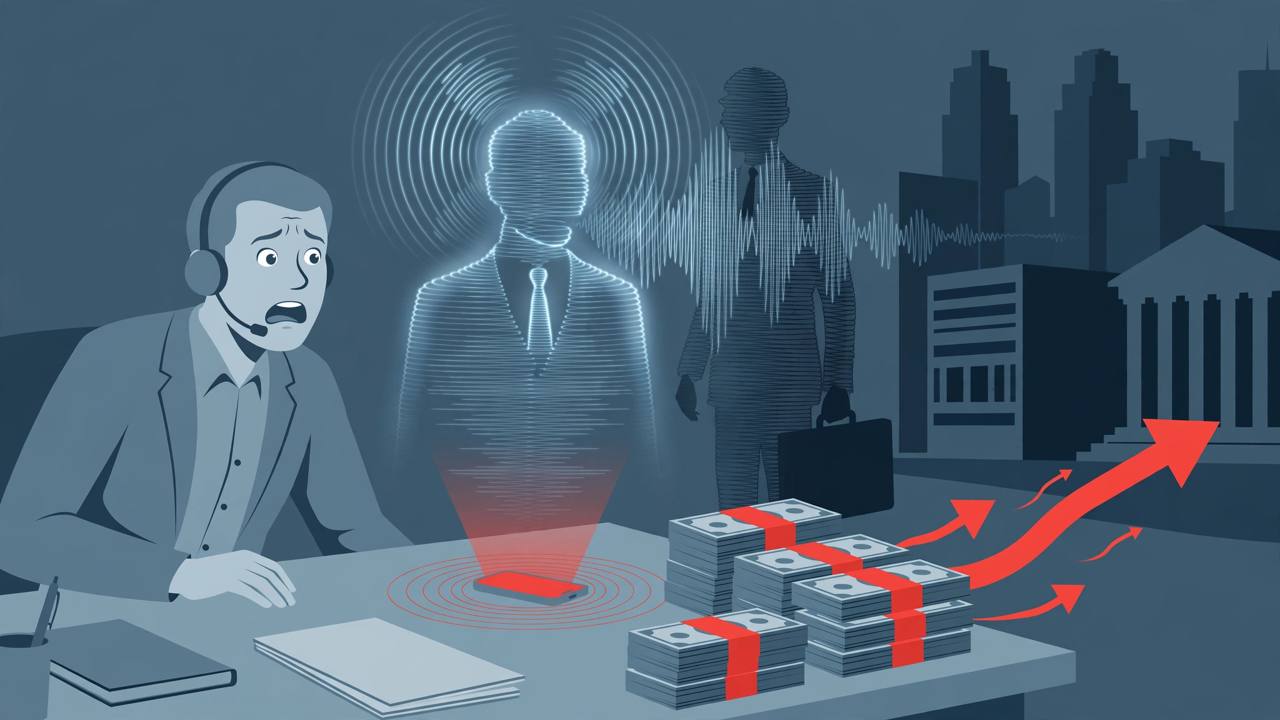
The voice on the phone sounded like the chief executive, the face on the call looked like him too — and, prosecutors say, neither was real. Federal prosecutors in Manhattan unsealed an indictment on Thursday, November 5, charging three foreign nationals with using what the Justice Department calls "super intelligence" (SI) technology to impersonate the voices and images of corporate executives and big-law-firm attorneys, tricking employees into wiring more than $129 million to bank accounts controlled by the conspiracy all over the world. U.S. Attorney for the Southern District of New York Jamie McDonald and FBI Assistant Director in Charge James C. Barnacle, Jr. announced the case.
Source: U.S. Attorney's Office, Southern District of New York (DOJ)
The defendants are Jacob Soall, 41, of Marbella, Spain, and the United Kingdom — who used the aliases "Seba Clarke" and "Rocky Balboa" — arrested in Spain on June 17, 2026; Sharon Hazan, 54, of Israel — aliases "Superman Cash," "Impossible Mission," "Fat Boy" and "Ron" — arrested in Spain on August 5, 2026; and Guy Sheetrit, 42, of Israel and the United Arab Emirates, arrested in the United Kingdom on September 7, 2026. Extradition requests for all three are pending, so none has yet appeared in the Manhattan court where the indictment was filed. Everything in the indictment is an allegation, and all three are presumed innocent unless and until proven guilty.
Source: ABC News
How the scheme allegedly worked, step by step
According to the indictment, the conspirators typically began by targeting an employee at a victim company while pretending to be that company's chief executive officer. The fake CEO would say he needed the employee's help on a confidential financial transaction, and would use SI to mimic the real CEO's voice and/or image in calls with the employee. The employee would then be directed to contact lawyers at large international law firms who were supposedly also working on the transaction — except those lawyers were impersonated too. Finally, a conspirator posing as one of those lawyers would direct the employee to wire a large sum, supposedly to complete the sham transaction, to a bank account that was in fact controlled by members of the conspiracy.
The money trail was global. Victim companies were directed to wire funds to accounts controlled by conspirators in the United States, Spain, Portugal, Greece, the United Arab Emirates, Singapore, Austria, Slovakia and China. Once a victim's money landed, the defendants and their co-conspirators converted it into cryptocurrency in an attempt to conceal the source, ownership and control of the stolen proceeds, and distributed it among themselves, the Justice Department says.
"SI technology offers tremendous potential. But the public should recognize that there are some who seek to use this emerging technology to pursue criminal goals. As alleged, Jacob Soall, Sharon Hazan, and Guy Sheetrit abused groundbreaking super intelligence technology to impersonate real people and deceive corporate executives into sending them and their co-conspirators approximately $129 million. I encourage individuals and the business community to consider how to best protect themselves from the emerging threat of SI-enabled crime."
The indictment adds colour that prosecutors say shows how practised the operation was. Soall primarily impersonated attorneys from the United Kingdom, and kept a handwritten script titled "Lawyer Call" that he used to sound like a real attorney when speaking with victims — including language designed to convince victim employees not to discuss their communications with fellow employees, the classic secrecy move that keeps a fraud from being spotted. Hazan, who prosecutors say laundered the scheme's funds along with Sheetrit, allegedly boasted that he had been laundering money since 1994, that he had laundered over $400 million in just the past three years, and that among professional money launderers he was "number one all over the world." Those boasts are allegations in the indictment, not findings.
The charges, the penalties — and a prior conviction
Each defendant faces seven counts: conspiracy to commit wire fraud (maximum 20 years), wire fraud (20 years), two counts of aggravated identity theft (2 years each), money laundering conspiracy (20 years) and two counts of money laundering (20 years each). The maximums are set by Congress and any actual sentence would be determined by the judge. Prosecutors also note that Hazan was previously convicted in the Southern District of New York of conspiracy to commit bank fraud in 2008. The case is being handled by the U.S. Attorney's Complex Frauds and Cybercrime Unit, with Assistant U.S. Attorneys Kevin Mead, Brandon C. Thompson and Jackie Delligatti in charge of the prosecution; McDonald thanked Spain and its Policía Nacional for help apprehending Soall and Hazan, and the United Kingdom and its National Crime Agency for help apprehending Sheetrit.
Source: Associated Press, via Internewscast
Background: an old fraud wearing a new face
The scheme described is the industrial evolution of business-email compromise — the long-running fraud in which criminals pose as a boss or a lawyer and pressure an employee into an urgent, secret wire transfer. What has changed is the performance: where the older fraud relied on a spoofed email, this indictment alleges cloned voices and images convincing enough to carry live calls, aimed at thousands of companies over more than a year and a half, from mid-2024 into early 2026. That is why the victims list cuts across sectors and states — hospital systems in Missouri and California, a Rhode Island bank, a Massachusetts mutual fund company, a Florida pet food company and a British fintech — and why the FBI is publicly asking anyone who believes they may be a victim, or who has information about the perpetrators, to come forward through its online tips page at tips.fbi.gov.
What it means for businesses, including diaspora-owned firms
The practical lesson prosecutors are pushing is procedural, not technical: McDonald urged "individuals and the business community to consider how to best protect themselves from the emerging threat of SI-enabled crime." For the family-run trucking companies, warehouses, gas stations, restaurants and import businesses that Punjabi and other immigrant families operate across the United States — workplaces where a call from "the owner" or "our lawyer" asking for an urgent, confidential payment is a normal part of the week — the indictment is a warning that a familiar voice on the phone is no longer proof of who is calling. A payment request that insists on secrecy, in particular, matches the exact pattern the indictment describes: the alleged "Lawyer Call" script was built to stop employees comparing notes.
What happens next
The case now moves on two tracks. In Spain and the United Kingdom, courts will decide the pending extradition requests; only if those are granted will Soall, Hazan and Sheetrit be brought to Manhattan to be arraigned and enter pleas. In New York, the online court docket was still shown as sealed on Thursday evening even as the indictment itself was unsealed and announced, the Associated Press reported, so details such as defence counsel are not yet public. No trial date exists, and the government's figures — the $129 million total, the victim-by-victim losses and the defendants' alleged roles — remain allegations the prosecution must prove in court.
What is solid
- Prosecutors in the Southern District of New York unsealed an indictment on November 5, 2026, charging Jacob Soall, Sharon Hazan and Guy Sheetrit over an alleged SI/AI impersonation fraud; all three were arrested in Europe in June, August and September 2026 and face pending extradition requests.
- The indictment alleges the scheme ran from 2024 to 2026, impersonated CEOs and law-firm attorneys, and stole more than $129 million, including the six itemised victim losses listed by the Justice Department.
- Each defendant faces seven counts, most carrying a statutory maximum of 20 years; Hazan has a prior 2008 SDNY bank-fraud conspiracy conviction, per the U.S. Attorney's Office.
- The charges are accusations only; the defendants are presumed innocent, no pleas or trial date have been reported, and the court docket was still shown as sealed on Thursday evening, per AP.
What is only claimed
- Every operational detail — the cloned voices and images, the 'Lawyer Call' script, Hazan's alleged laundering boasts and the cryptocurrency money trail — comes from the indictment as summarised by prosecutors; none of it has been tested in court.
- Whether the three men will be extradited, and how quickly, depends on courts in Spain and the United Kingdom; the timetable is unknown.