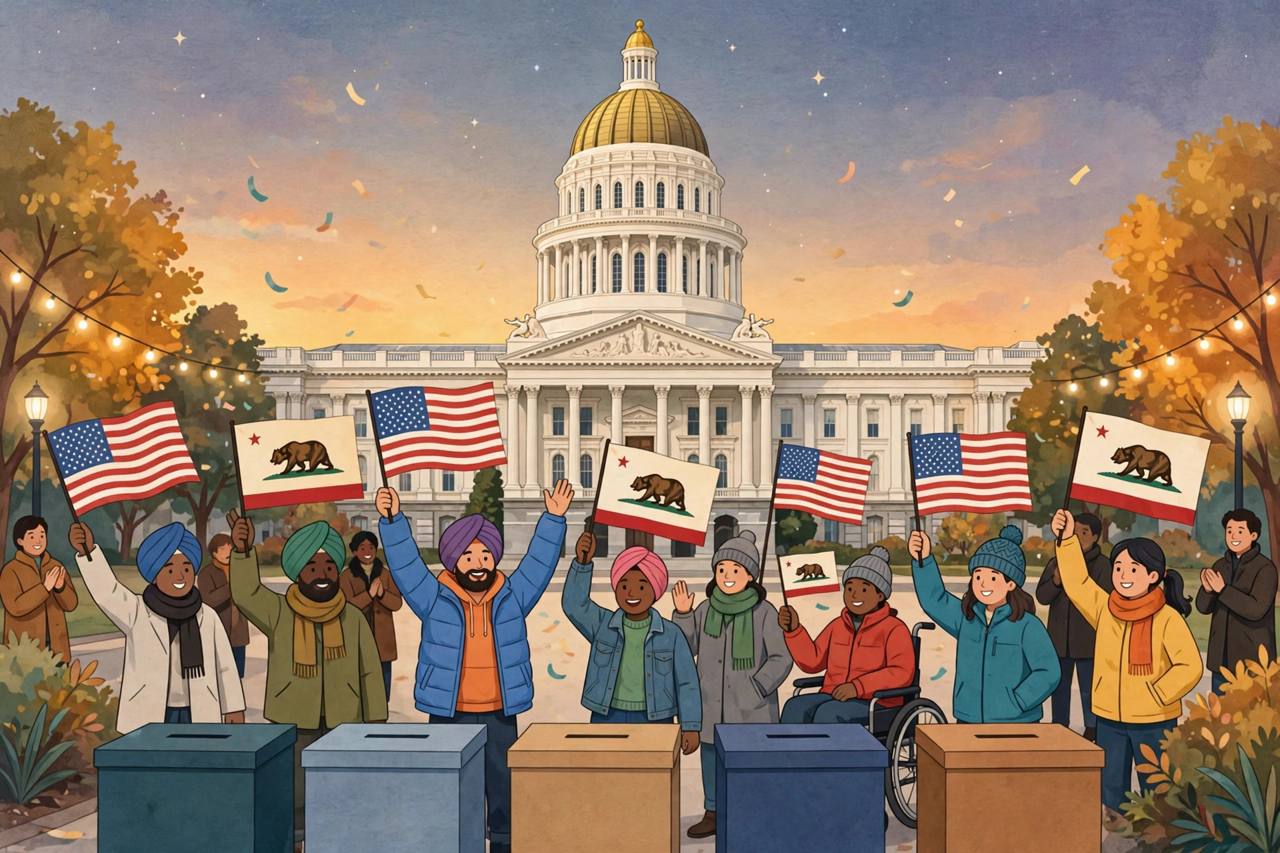
SACRAMENTO, California — The Associated Press called California's governor's race for Democrat Xavier Becerra on Tuesday night, November 3, projecting that the former U.S. health secretary and former California attorney general will succeed term-limited Governor Gavin Newsom as the leader of America's most populous state. Becerra defeated Republican Steve Hilton, a former policy adviser and television commentator, in a contest that opinion polls had shown him leading by more than 20 points for weeks.
Source: Associated Press election results — Governor, California
Polls closed across California at 8 p.m. Pacific Time, and the AP made its call on the first waves of counted ballots, with only 4.64 percent of precincts reporting. That early call reflects the size of the lead Becerra carried into election day rather than a completed count: California counts ballots for weeks after election day, and mail ballots that are postmarked by election day can still arrive and be counted for several days. The final margin will move as millions of remaining ballots are processed, but the outcome of the race itself is not in doubt, according to the AP's projection. A second election-night roundup of the governors' races, published by Astig, likewise recorded that Xavier Becerra won California, alongside Democratic wins in Ohio and Georgia and a Republican hold in Florida.
California is the state with the largest Punjabi and Sikh population in the United States, concentrated in the Central Valley — Fresno, Sacramento, Stockton, Modesto, Bakersfield and Yuba City — as well as in the San Francisco Bay Area and Southern California. Its governor sets policy on highways and trucking corridors such as Interstate 5 and Highway 99, on agriculture, on state taxes and housing costs, and on how state agencies work with federal immigration enforcement, all of which reach directly into the daily lives of Punjabi-American families and of the Punjabi truck drivers who run California's freight routes.
A lead that never really closed
The result matched the final published polling almost exactly in direction. A UC Berkeley Institute of Governmental Studies poll conducted for the Los Angeles Times from October 19 to 25 put Becerra ahead of Hilton by 61 percent to 34 percent among likely voters. Emerson College Polling's October 17–19 survey had the race at 60 percent to 33 percent, and the Public Policy Institute of California's late-October release had Becerra at 61 percent and Hilton at 37 percent. The tightest major survey, SurveyUSA's October 19–24 poll, still gave Becerra a 22-point lead, 54 percent to 32 percent. Hilton never led in a published general-election poll.
The matchup itself was set on June 2 under California's top-two primary system, in which all candidates appear on one ballot and the two highest finishers advance regardless of party. In the certified primary results published by the California Secretary of State, Becerra finished first with 2,591,857 votes (28.0 percent), Hilton finished second with 2,277,318 votes (24.6 percent), and Democrat Tom Steyer finished third with 2,110,707 votes (22.8 percent), out of 9,262,468 total votes cast in a 68-candidate field for governor.
Early voting also pointed the same way. Roughly 5.9 million ballots had already been returned by Monday afternoon, according to tracking by Political Data Inc. reported on election day, and registered Democrats accounted for about 51 percent of those returns, against roughly 28 percent — about 1.62 million ballots — from registered Republicans, in a state where Democratic registration has long outnumbered Republican registration.
Who the two men are
Becerra, 68, served as California's attorney general from 2017 to 2021, repeatedly suing the first Trump administration, and then as U.S. Secretary of Health and Human Services under President Joe Biden. Before that he spent 24 years in the U.S. House of Representatives representing Los Angeles. He will take over a state government dealing with a large budget deficit, some of the highest housing and living costs in the country, homelessness, and wildfire risk — the same list of challenges that election-night coverage identified as waiting for Newsom's successor. Newsom himself is term-limited and could not run again.
Hilton, a British-born former adviser to U.K. Prime Minister David Cameron who later became a Fox News host and author, ran as the Republican challenger in a state Republicans have not won a governor's race in since Arnold Schwarzenegger's re-election in 2006. He had received President Donald Trump's endorsement during the primary season. His campaign centred on the cost of living, crime and what he called one-party misrule in Sacramento.
The governor's office in Sacramento decides state trucking and clean-fleet rules, highway spending on I-5, I-80 and Highway 99, agricultural and water policy in the Central Valley, and the state's posture on immigration enforcement — issues that land directly on Punjabi farming families, trucking companies and small businesses across California, the state where the Punjabi diaspora in America is largest.
What happens next
County election offices will keep counting for weeks: California's count is famously slow because of the volume of mail ballots and the days allowed for postmarked ballots to arrive, and the result must then be certified by the Secretary of State before it is final. The race call itself will not change unless counting produces a dramatic shift far outside anything the polls or early returns suggested. Becerra is due to take office when the new governor's term begins in January, at which point the policy fights of the campaign — over housing costs, homelessness, the deficit and wildfire policy — become the work of his administration.
For now, the headline is simple: after eight years of Gavin Newsom, California has chosen another Democratic governor, and it chose him by the wide margin the polls had promised all autumn.