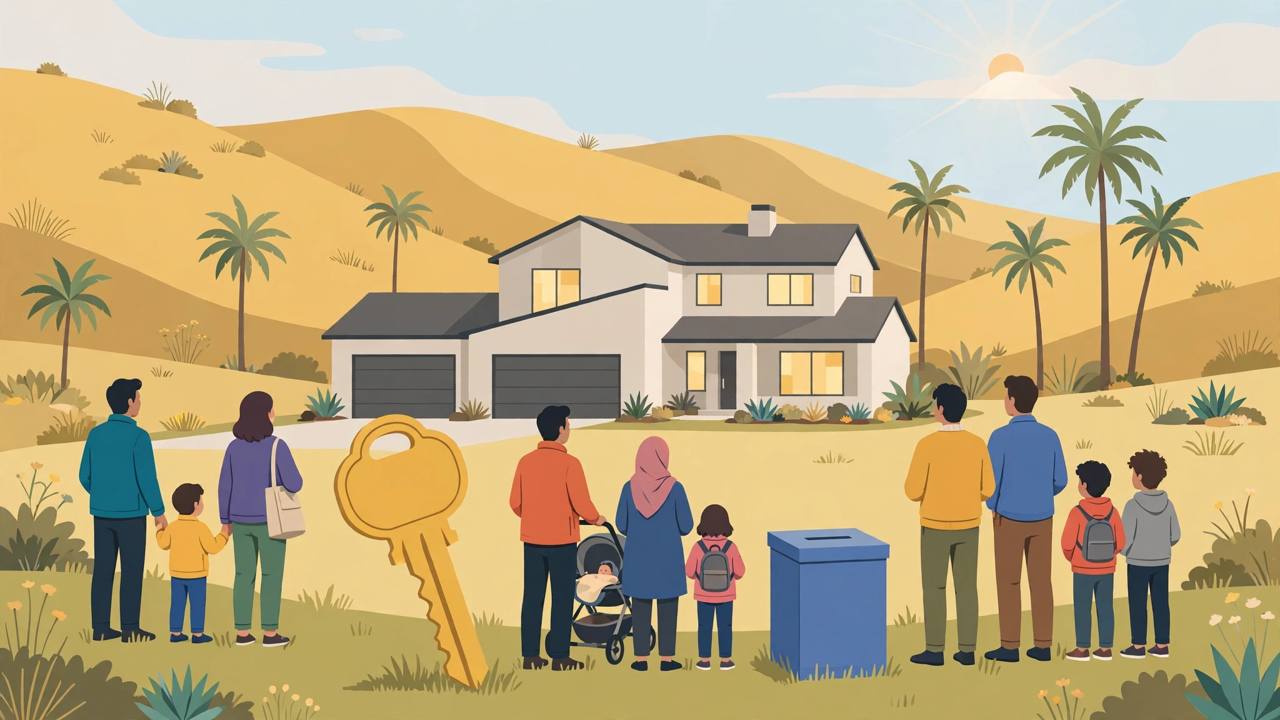
California voters have approved Proposition 37, the $25 billion home-loan measure that will let the state lend middle-income buyers up to 17 percent of the price of a newly built home. The Associated Press has called the measure, and CBS News also projects it approved — one of the clearest verdicts of California's November 3 ballot, delivered while millions of votes were still being counted across the state's 14 propositions.
Source: Associated Press — California Proposition 37 results
In the AP count, Yes led No by 1,416,904 votes — about 60.8 percent to 39.2 percent — with just over half of precincts reporting. CBS News, whose projection was published early on Wednesday, November 4, described the same outcome: Californians approved a program authorising up to $25 billion in bonds to offer buyers fixed-rate mortgages for up to 17 percent of the purchase price of a 'qualified new home.' The count is still unofficial, and mail ballots postmarked by Election Day can keep arriving at counties until November 10, but the margin is far beyond the reach of the remaining ballots on the trend of the count so far.
Source: CBS News via KION — Prop. 37 approved
How the Loan Works: 3 Percent Down, the State Covers 17
Proposition 37 — formally the California Middle-Class Home Ownership and Family Home Construction Act of 2026 — directs the California Housing Finance Agency (CalHFA) to run a new Middle-Class Home Ownership Loan Program. CalHFA may sell up to $25 billion in revenue bonds and lend the money to buyers as a fixed-rate second mortgage covering up to 17 percent of the price. The buyer puts in at least 3 percent of their own money, a conventional first mortgage covers the rest, and the state loan is repaid monthly at a fixed rate CalHFA sets high enough to repay the bondholders and its own administration costs.
Source: California Today — Proposition 37 guide
The arithmetic is the whole pitch. On an $800,000 new home, a buyer who would normally need $160,000 cash for a 20 percent down payment instead needs $24,000 of their own money, with the Proposition 37 loan covering $136,000. The Legislative Analyst's Office finds 'no direct state or local costs,' because borrowers' payments — not taxes or the General Fund — repay the bonds, and every bond must state on its face that it is not a debt or liability of the State of California.
Who Qualifies — and Which Homes Count
The measure sets four tests. An applicant must have lived in California for at least one year, must occupy the home as a primary residence within 60 days of closing, must earn no more than 200 percent of the area median income for a family of the same size in that county, and must pay the 3 percent from their own funds rather than a grant or another loan. There is no first-time-buyer requirement. The home must be newly built — a house, townhome, condominium or manufactured home — or a unit in a converted nonresidential building, and the buyer must be its first purchaser.
The price cap is a formula: 125 percent of the county's conforming loan limit. For 2026 that works out to about $1,040,938 in 41 counties — including Sacramento, Fresno, Riverside and San Bernardino — and about $1,561,406 in the ten highest-cost counties, including Los Angeles, Orange, San Francisco and Santa Clara, according to California Today's calculation from the measure's text and the Federal Housing Finance Agency's county table. Using state income-limit tables as an illustration, a family of four could earn up to about $194,200 in Fresno or Kern County, $248,000 in Sacramento County or $216,200 in Los Angeles County and still qualify — though CalHFA has not yet said which income table it will apply.
Why It Passed: a $894,630 Median Home
The measure reached the ballot by petition after supporters submitted more than 600,000 valid signatures, and its chief proponent, former state Senate Majority Leader Bob Hertzberg of Los Angeles, said in April that voters 'have the chance to unleash a wave of new home construction across our state and make the dream of homeownership a reality for more middle-class Californians.' Supporters included the California Association of Realtors — which notes the median price of a single-family home in California was $894,630 in the third quarter, the highest in the nation, with several Bay Area and Southern California counties above $1 million — the United Nurses Associations of California, the California Conference of Carpenters and State Treasurer Fiona Ma. Governor Gavin Newsom and his successor-elect Xavier Becerra and the California Democratic Party supported it; the California Republican Party was neutral. A PPIC survey in October found it the best-polling of the 14 measures, at 65 percent yes to 32 percent no.
Source: CBS News via KION — Prop. 37 approved
No opponent filed an argument against Proposition 37 in the state's official voter guide. The League of Women Voters of California did oppose it, saying the program could reinforce racial and economic gaps and that nothing requires the homes to be near jobs, transit, schools or services: 'California needs homeownership programs that lower families' total costs, confront racial barriers to building wealth, and support strong communities. Prop 37 does not meet that test,' the league said. The California Budget & Policy Center has also warned that, unlike CalHFA's existing deferred-payment help — the MyHome program lends up to 3.5 percent with nothing due until the home is sold or refinanced, and Dream For All lends up to 20 percent capped at $150,000, repaid with a share of appreciation — a Proposition 37 second mortgage is repaid every month, competing with the first mortgage, groceries and utility bills in a family's budget.
California is the site's largest diaspora state, and its Central Valley and Sacramento-region communities — Fresno, Bakersfield, Stockton, Yuba City, Sacramento — sit squarely in the counties where the roughly $1.04 million price cap and a $194,200 illustrative family-of-four income ceiling apply. For a trucking, warehouse or small-business family that has the income for a mortgage but not $160,000 in cash, the 3-percent-down structure is the difference between renting and buying — provided the monthly cost of two mortgages still fits the family budget, which is exactly the caution critics raise.
CalHFA must stand the program up within one year of the measure taking effect, and it will decide how many of the $25 billion in bonds to sell, and when. Tuesday's result remains unofficial until counties finish counting — including mail ballots arriving by November 10 — and the state certifies the election. No loans exist yet: buyers should wait for CalHFA's own program rules, rates and income tables rather than acting on campaign summaries.