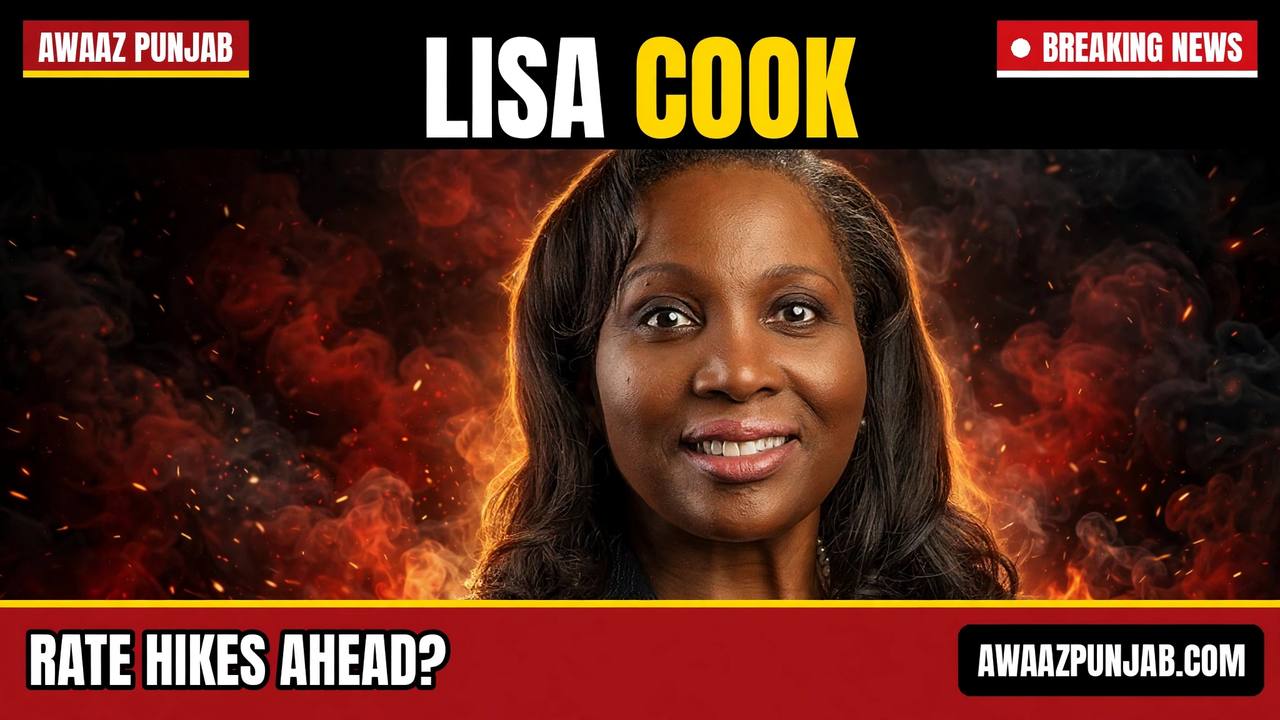
Federal Reserve Governor Lisa Cook said on Friday that the US central bank still needs to raise interest rates further, arguing that inflation is stuck far above target and that September's single quarter-point increase was not enough. Cook was delivering the keynote address at the 29th Annual Conference of the Central Bank of Chile in Santiago — her first public remarks since she dissented from the Federal Reserve's decision to hold rates steady in October.
Source: Reuters
Cook said the current policy rate is "not high enough to deal with inflation levels" she views with "great concern." "In a different environment, the (Federal Open Market) Committee could afford to be patient, but I continue to believe that in this economic climate we do not have that luxury," she said. "I am skeptical that September's single 1/4 point rate increase will be enough to change the path of inflation."
Source: Federal Reserve
Why she dissented in October
At its October 27–28 meeting, the Federal Open Market Committee voted to hold the federal funds rate in the 3.75–4.00% range, the level set by the quarter-point increase at the September 15–16 meeting. Cook was one of two officials who dissented, preferring another quarter-point rise. The other dissenter was Cleveland Fed President Beth Hammack, according to the Fed's October statement. "My vote reflected the urgency I feel to tackle inflation," Cook said, noting that inflation "has been above target for more than five and a half years, and every additional day poses greater risk that price- and wage-setters will adjust their inflation expectations upward."
Source: Reuters
Cook stressed that the data since September has given her no comfort. "Inflation data received since the September rate increase, including reports last week, fail to provide me with sufficient evidence that inflation is returning to a sustainable path," she said. "Thus far, there is little evidence inflation is declining." Prices, she noted, are rising briskly across a broad range of categories — including airfare, appliances, furniture, hotels and restaurants.
Source: Federal Reserve
At the same time, Cook was upbeat about the wider economy. She said growth is "strong and accelerating" and the job market remains "solid." The economy grew at a 3.4% annual pace in the third quarter, the unemployment rate was 4.1% in October, employers added 165,000 jobs that month, job openings stood at 7.5 million in September, and initial claims for unemployment benefits were running near historical lows at a four-week average of about 195,000. Real household spending rose at a 3.8% annualised pace last quarter despite higher energy prices.
Source: Federal Reserve
The global forces behind her warning
Cook framed the US inflation fight as part of a global story. She pointed to Russia's war in Ukraine and the conflict in the Middle East pushing up energy prices, to higher US tariffs on a wide range of imports over the past two years, and to China's limits on exports of critical minerals. She also spent much of the speech on the artificial-intelligence buildout: companies have announced plans for more than $2 trillion in data-centre construction projects, roughly half of the world's data-centre capacity now under construction is being built outside the United States, and generative-AI tools are already used by roughly 25 to 45% of the working-age population in higher-income economies. Chile itself, she noted, is the world's largest copper producer and its second-largest lithium producer — two minerals central to AI infrastructure.
Source: Federal Reserve
Cook also warned that the AI transition is already changing parts of the jobs market: demand has cooled for coding jobs in the software industry and in simultaneous translation, and younger adults are experiencing prolonged job searches. She said she remains hopeful that job creation will keep pace with job destruction, but that it is too soon to feel comforted.
Source: Federal Reserve
"Waiting longer to implement rate increases risks getting behind the curve. If we fall behind, additional and larger rate increases may be required later to catch up, which could increase stress on our financial system and have unnecessarily damaging effects on American households." — Governor Lisa Cook, Santiago, November 20, 2026
What happens next: December 8–9
The Federal Open Market Committee next meets on December 8–9, and financial markets broadly expect it to raise rates then, with further increases to follow next year, Reuters reported. A wide range of Fed officials have signalled support for more rate hikes in recent weeks, and the minutes of the October meeting, released on November 18, showed broad support among officials for further increases. Cook said the number and size of future adjustments should be guided by how the economy reacts — but that holding the rate steady is itself a policy action, not a neutral pause. "I see the act of holding the rate steady as much a monetary policy action as the act of increasing the rate," she said.
Source: Reuters
What it means for American households
Higher interest rates make borrowing more expensive — mortgages, car loans, credit cards and small-business loans all cost more when the Fed pushes rates up. Cook's argument is that waiting would be worse: delay risks forcing bigger, sharper increases later, which would put more stress on household budgets and on the financial system. For Punjabi diaspora families in the United States, the December decision matters directly: families carrying mortgages, truckers financing rigs and equipment, and small businesses from trucking firms to shops and restaurants all feel every move in borrowing costs. Cook's message was that restoring stable prices is what protects those households in the long run — "this promise will be best supported if we restore stable prices on which sustainable growth depends."
Source: Federal Reserve
Cook has been making the same case all year. In February she said she was frustrated that inflation appeared stalled above target; in May she said she was prepared to raise rates if disinflation did not arrive; in July she called inflation "unacceptably high"; and in late September she backed the rate increase because inflation had been too high for too long. Her governorship has separately been contested by the White House, which has moved a hearing over her seat to December 14 — a separate matter from the policy debate in her speech.
Source: Reuters