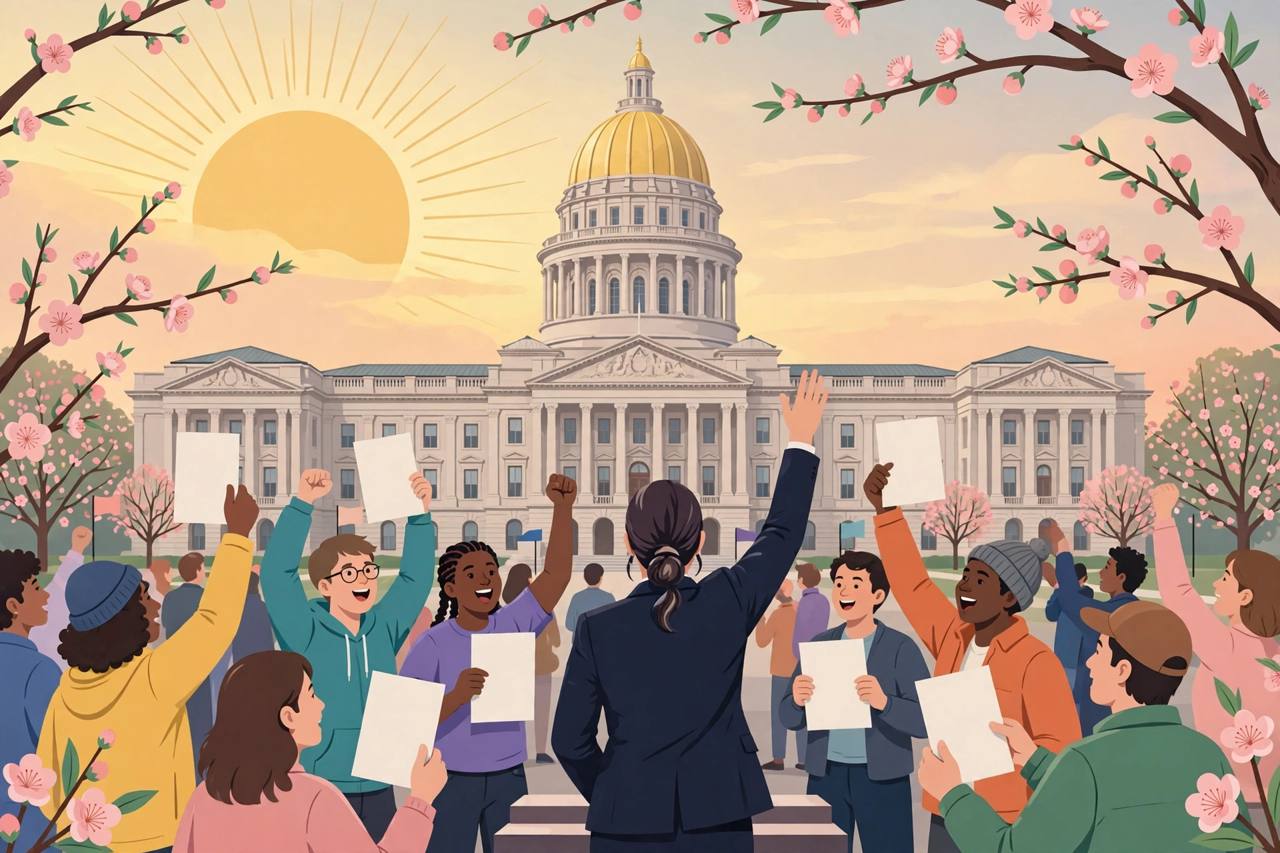
Keisha Lance Bottoms, the former mayor of Atlanta, won the governor's race in Georgia on Tuesday night, November 3, 2026, defeating Republican healthcare executive Rick Jackson and flipping the state's highest office to the Democrats for the first time in more than two decades. The Associated Press called the race for Bottoms with about three-quarters of the expected vote counted. The victory is historic twice over: Bottoms becomes Georgia's first Black governor and its first woman governor, and, as NBC News noted in its projection, the first Black woman elected governor anywhere in United States history. All election-night figures are unofficial until Georgia's Secretary of State certifies the results.
Source: Associated Press election results, Georgia Governor (race called for Bottoms)
The scale of the win surprised even a race that forecasters had rated a pure toss-up. In the Associated Press count, Bottoms had 1,833,374 votes to Jackson's 1,478,243 — roughly 55 per cent to 44 per cent, a margin of about 355,000 votes — with 1,182 of Georgia's 2,582 precincts reporting, representing an estimated 75 per cent of the total vote. Decision Desk HQ, whose projection was reported by The Hill, had Bottoms leading by about 11 points with 71 per cent reporting when it called the race. Because Bottoms cleared 50 per cent comfortably, Georgia's majority-vote rule will not force the December general-election runoff that hung over the contest.
Source: Associated Press count; The Hill / Decision Desk HQ projection via alabamas42.com
A two-decade Republican hold, broken
Georgia has not had a Democratic governor since Roy Barnes, elected in 1998, left office in 2003 — a 23-year Republican run that Bottoms has now ended. The seat was open because incumbent Republican Governor Brian Kemp was barred from seeking a third consecutive term. Georgia is one of America's true battleground states — Donald Trump carried it in 2024 — and Bottoms is now also the only Democrat who will hold its governorship after a night on which her party colleague, Senator Jon Ossoff, was also defending his seat in the state. Cook Political Report and Sabato's Crystal Ball had both rated the governor's race a toss-up going into election day.
Bottoms, who served as mayor of Atlanta from 2018 to 2022 and later as a senior adviser to President Joe Biden, won the Democratic nomination on May 19, 2026 without a runoff, taking 56.2 per cent (608,264 votes) in a seven-candidate primary, according to official results. Jackson's road was harder: no Republican reached 50 per cent in the May primary, and he won the June 16 runoff against Burt Jones with 52.6 per cent (373,543 votes). In the general-election campaign, Bottoms ran on goals she set out in interviews and on her campaign site: expanding Medicaid, improving public education, eliminating state income taxes for teachers, offering free technical and community college, and helping small businesses, Ballotpedia News reported.
Source: Ballotpedia News, Bottoms wins Democratic primary; official Georgia primary and runoff results
Why the result matters beyond Georgia
A first-in-the-nation governorship carries weight far beyond one state. Bottoms takes over a state government in Atlanta that sets Medicaid policy for more than a million low-income residents, runs one of the largest public-school systems in the South, and controls the budget of the state whose capital region is the economic engine of the Southeast. Her Medicaid-expansion pledge, if carried through a Republican-leaning legislature, would be one of the biggest state health-policy fights of 2027 anywhere in America — and it will be fought in a statehouse where her party's win at the top does not automatically deliver the votes below.
Source: The Hill / Decision Desk HQ reporting on the Bottoms campaign and the flip
More than 2 million Georgians — 2,000,452 people, according to official figures reported on election night — had already cast ballots before election day, with a further 97,382 mail ballots received and accepted. A race decided by about 355,000 votes was, in large part, shaped before a single polling place opened on Tuesday.
What it means for Punjabi and Indian-American readers
Metro Atlanta is one of the fastest-growing Indian-American hubs in the United States, with large Punjabi communities across the northern suburbs and a heavy Punjabi presence in the trucking and logistics economy that runs on the I-75, I-85 and I-285 corridors through the city. For those readers, a change of party at the Capitol after 23 years is not an abstraction: the new administration will set the tone on small-business policy, technical-college funding — a pipeline into logistics, healthcare and trades jobs — and on the state agencies that license and police the freight industry. Bottoms' promises of free technical college and small-business help were aimed squarely at voters like them; whether the legislature delivers them is the story to watch in 2027.
Source: Ballotpedia News, Bottoms campaign goals (Medicaid, education, technical college, small business)
What happens next
Counting continues: county canvasses and state certification by the Georgia Secretary of State will turn Tuesday's projections into official results over the coming weeks, and with a margin of about 11 points no recount drama is expected — and, because Bottoms won an outright majority, no December runoff. A transition team will be named, a budget — her first test — follows, and she is due to be sworn in as Georgia's governor in January 2027, when the Medicaid, teacher-tax and technical-college promises meet a legislature that spent the last two decades under Republican governors.
Source: Associated Press election results and Georgia election calendar (Wikipedia compilation)