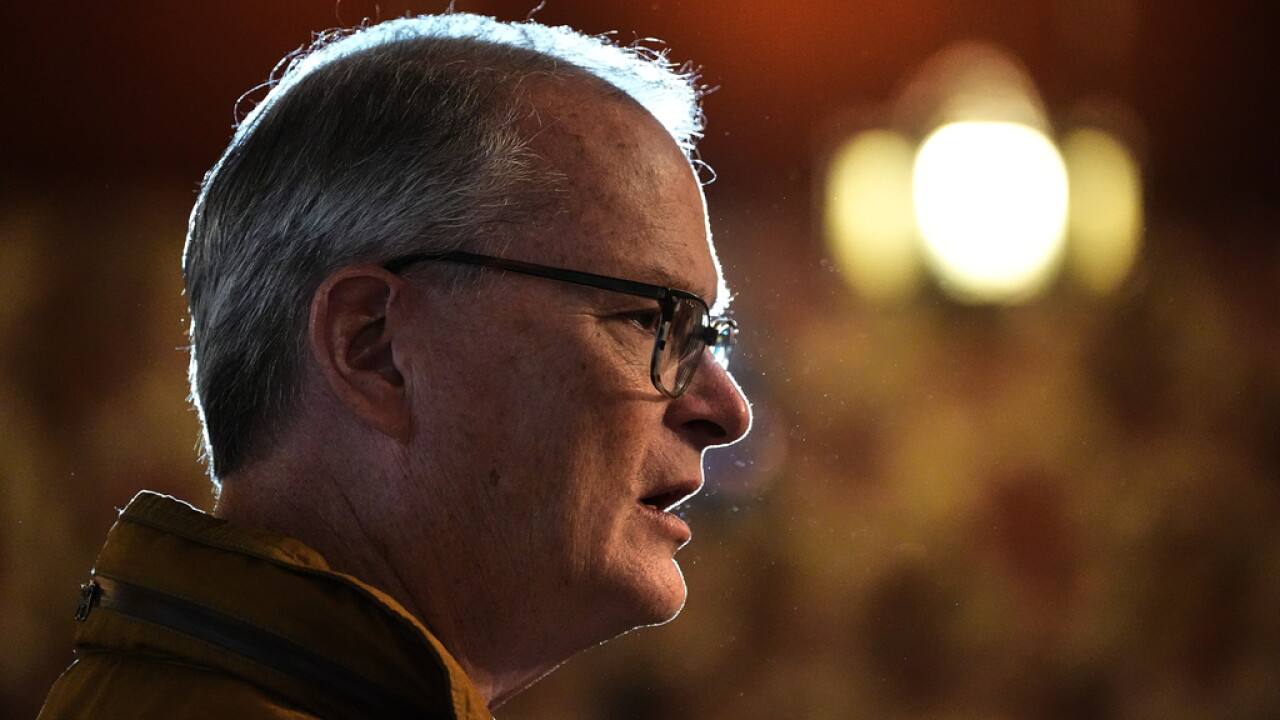
Kansas has done something it had not done since Franklin D. Roosevelt's first election: it has chosen a Democrat for the United States Senate. The Associated Press called the state's Senate race on Tuesday night, November 3, 2026, for Adam Hamilton — the founding pastor of one of the largest United Methodist churches in the country — over Republican Senator Roger Marshall, ending a nearly century-long streak of Republican wins in Kansas Senate elections. Hamilton becomes the first Democrat elected to the Senate from Kansas since 1932, in a state Donald Trump carried in all three of his presidential campaigns, most recently by about 16 points in 2024. All election-night figures are unofficial until Kansas certifies the result.
Two independent counts told the same story. The AP tally, at 93.8 per cent of precincts reporting, put Hamilton at 553,023 votes — about 51.3 per cent — against Marshall's 491,822, about 45.7 per cent, with Libertarian David Graham at 32,197, about 3.0 per cent. Decision Desk HQ, which called the race at 10:48 p.m. Eastern, had Hamilton at 549,129 votes and 51.49 per cent to Marshall's 485,200 and 45.50 per cent in its 11:49 p.m. count. The margin was not a recount-in-waiting: Hamilton led by more than 61,000 votes in the AP count with over nine-tenths of the vote in.
The pastor who ran from the middle
Hamilton is not a career politician, and he ran hard against his own party's brand as well as Marshall's. A onetime Republican who had considered running for the Senate as an independent, he is the founding pastor of one of the nation's largest United Methodist congregations in the Kansas City area. He campaigned as a moderate focused on the cost of living, distanced himself from national Democrats — saying he would not support Senator Chuck Schumer for majority leader and that he did not want former Vice President Kamala Harris to campaign for him in Kansas — and promised to serve Kansas the way he serves his congregation, by 'leading from the middle.' Bob Beatty, a political scientist at Washburn University in Topeka, said Hamilton 'smartly hammered his moderate message and communicated it well,' adding: 'Not all pastors are great communicators, but many are, and [Hamilton] certainly is.'
The money gap was visible for months. Hamilton outraised Marshall and entered October with a 3-to-1 cash advantage. Marshall's third-quarter fundraising haul was $800,000, a figure David Kensinger, a lobbyist and veteran Kansas Republican operative, called an 'astonishing shortfall' for an incumbent under threat: 'I think everyone expected that an incumbent senator under threat, in the third quarter of his election year … was going to raise a significant amount of cash.' Kensinger called the Marshall campaign a 'failure to launch.' The polls, unusually, saw it coming: the final polling average put Hamilton ahead by 4.4 points, and the last survey in that average, completed November 1, had him up 50 to 43.
How 'Doc Marshall' lost a Republican state
Marshall, an OB-GYN who styled himself 'Doc Marshall,' was first elected in 2020, when he beat Democrat Barbara Bollier by about 11 points. This time his medical career became the weapon used against him: his past lawsuits against patients to recover medical debts — which in some cases led to patients being arrested — became a major campaign issue, amplified by attack advertising. 'Your local, friendly country doctor is charging you 18% interest on your new baby. And it's had legs,' Beatty said of the storyline. Marshall cut a late-campaign video responding to the medical-debt issue, reportedly against his advisers' wishes. He also faced criticism over how much time he spent at his second home in Florida and questions about whether official Senate staff were used as an extension of his campaign. By the final debate on October 21, Marshall was conceding the obvious: it was a competitive race, he pleaded for 'Trump voters to come out,' and he told the audience, 'Control of the Senate comes through Kansas.'
Trump tried to close the gap in person, visiting Kansas the weekend before Election Day to campaign for Marshall. But the president was also part of the weather Marshall had to run in. TMJ4's report of the AP call noted the result came 'amid growing frustration over the economy, with Republicans controlling both Congress and the White House,' and that Hamilton campaigned on the cost of living. The Washington Sun's account put concrete Kansas texture on that frustration: the Iran war had driven up diesel prices for farmers, immigration raids and the administration's move to open beef markets had hurt ranchers, and amid the trade war with Canada, Trump had threatened Bombardier, the Montreal-based aerospace company with a major presence in Wichita. Marshall did not distance himself, telling voters last month that 'this is one of the best economies I've ever seen in my lifetime.'
Republicans entered election night holding the Senate 53–47. Democrats needed a net gain of four seats to take control, and Kansas was not supposed to be one of the four — no Democrat had won a Senate election there in 94 years, and election analysts who had watched close Kansas polls resolve Republican in 2014 and 2020 expected the same pattern again. Instead Kansas became one of a string of Democratic pickups on the night, alongside Roy Cooper's flip in North Carolina and Annie Andrews' upset in South Carolina, in states Trump won comfortably in 2024.
What happens next
The call is a projection, not a certification: Kansas counties will finish their counts and the state will certify the result in the coming weeks, after which Hamilton is expected to take the seat for a full six-year term when the new Senate convenes in January. Marshall, who won the August Republican primary with 79.8 per cent of the vote, remains in office until the term ends. The result also rewrites Kansas' own political map: a state whose congressional delegation and statewide offices have been a Republican stronghold for a generation now sends a Democratic senator to Washington — one who won by running against Washington's tone as much as against his opponent.
For this site's readers, Kansas is working country for Punjabi America: the Kansas City metro, Wichita's aviation plants and the I-70 and I-35 freight corridors are run daily by Punjabi truckers and dotted with the warehouses, truck stops and gurdwaras of a settled Midwestern diaspora. The issues that decided this race are priced in that world every week — diesel costs pushed up by war, farm and ranch economics, medical bills and the interest charged on them, and the cost of living in the small cities where those corridors run. Hamilton promised affordability and a politics of the middle; the record he builds against those promises, starting in January, is the story this desk will follow.