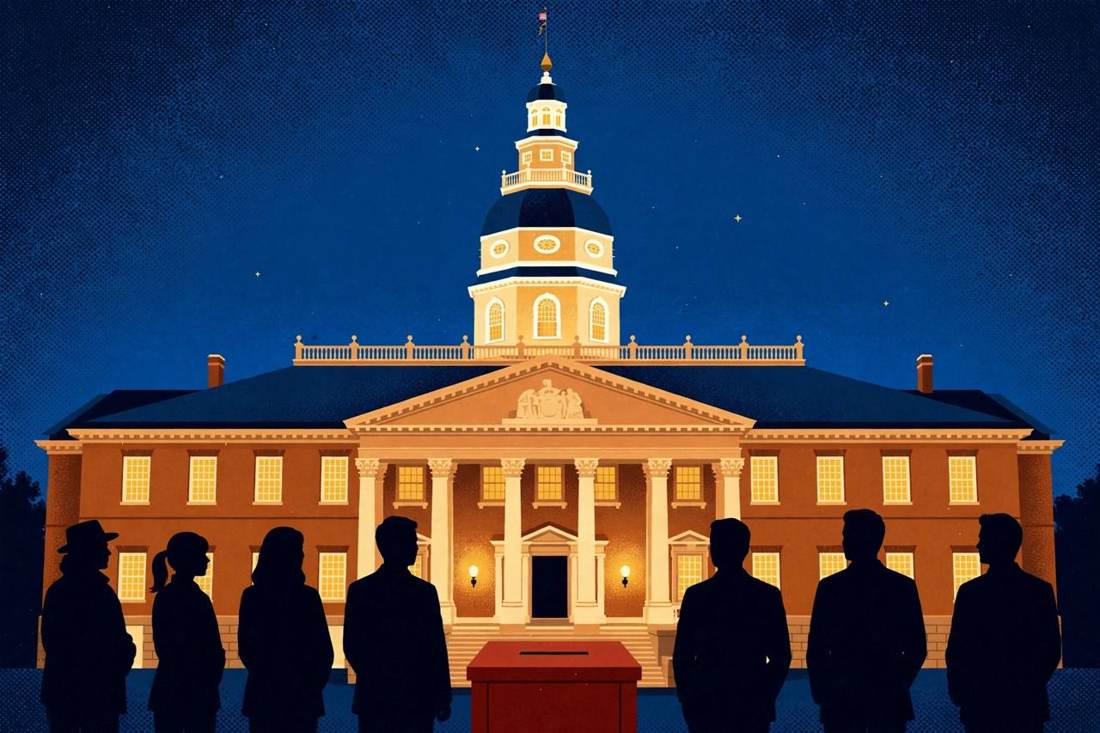
Maryland Governor Wes Moore won a second four-year term on Tuesday night, November 3, 2026, defeating Republican challenger Dan Cox in a rematch of the state's 2022 governor's race. The Associated Press called the race for the Democrat as soon as polls closed at 8 p.m. Eastern. Lieutenant Governor Aruna Miller, Moore's running mate, was also re-elected, so the full Democratic ticket returns to the State House in Annapolis for another four years. Counting of provisional and mail ballots continues, and all election-night results remain unofficial until the Maryland State Board of Elections completes its canvass and certification in the coming weeks.
Source: Associated Press election results, Maryland Governor (race called for Moore)
At Moore's victory party at the M&T Bank Exchange in downtown Baltimore, a roar went up from the standing-room-only crowd when the result was announced. Across town in Towson, at Cox's party, the Republican campaign declined to accept the call: spokesman Jimmy Mathis said the campaign does not recognize the AP call as official, adding, 'By no means are we reading too much into that.' Cox cast his own ballot on Tuesday morning at Sabillasville Environmental School in Frederick County; Moore had voted during early voting in Annapolis in October.
Source: The Baltimore Banner, Wes Moore wins second term as Maryland governor
A rematch that ended the same way
Moore made history when he took office in January 2023 as Maryland's first Black governor, and he has been the nation's only Black governor for the past four years — a profile that has made him a rising star in the Democratic Party. This summer he spent time campaigning for four other Black Democratic gubernatorial hopefuls around the country. None of that national exposure was needed at home: in a reliably Democratic state, the race was never rated competitive, and Moore spent part of the closing week campaigning in rural, largely Republican areas in hopes of running up the score and wooing voters to his party, rather than shoring up his base in Democratic central Maryland.
Source: The Baltimore Banner, Wes Moore wins second term (Moore profile and campaign)
Cox, a former state delegate, tried to score points on what his campaign presented as Moore's weaknesses: higher taxes and fees — 'Maryland should be the Free State, not the fee state,' he said during a stop in Baltimore on Friday — and slow progress on rebuilding the Francis Scott Key Bridge. But Cox was heavily outspent by Moore's campaign machine and, the Banner reported, was unable to escape his past alliances with President Donald Trump, including taking buses to Washington, D.C., on January 6, 2021, and fundraising at Mar-a-Lago during his last campaign. He spent Election Day making stops at polling sites, including one alongside Robert Ehrlich Jr., Maryland's Republican governor from 2003 to 2007.
Source: The Baltimore Banner, Wes Moore wins second term (Cox campaign)
The hard second term: a budget gap and the Key Bridge
Moore's second term opens with two problems that dominated the campaign's closing arguments. Maryland faces what the Banner described as a severe budget gap, and the rebuilding of Baltimore's Francis Scott Key Bridge — which collapsed after a cargo ship strike in 2024 — is already far behind schedule and billions of dollars above its initial projected cost. In an interview at his South Baltimore campaign office in October, Moore said he wants to continue the reduction in violent crime and push to transform the state's economy, which has long been reliant on federal jobs and federal spending. 'The thing that I'm excited about is we have more work to do, and we just have unfinished business,' he said.
Source: The Baltimore Banner, Wes Moore wins second term (second-term challenges, Moore interview)
Affordability was the word voters themselves kept returning to on Election Day. Campaigning Tuesday at the Laurel-Beltsville Activity Center, Moore said: 'I think people want to make sure that we're focusing on affordability and bringing prices down. We want to make life a little bit easier on the people of Maryland.' Charles Jones, 70, who cast his ballot in Brooklyn for Cox while calling himself not the biggest Cox supporter, said he was driven by affordability: 'I voted because they're handling the money wrong. It's not about you and me no more. Something's got to get better. It's unaffordable to live here.' Francisco Guzman, a 25-year-old voter from Baltimore's Old Town neighbourhood who backed Moore, said he wants the governor to focus on affordability and on rising inflation and utility costs for people at the lower end of the income ladder.
Source: The Baltimore Banner, Wes Moore wins second term (voter voices)
Question 3, third parties and the national question
The governor's race was not the only fight Moore waged this fall. In the final weeks he shifted campaign spending away from his own advertising and instead funded ads promoting Question 3, a ballot measure that, if it passes, would change redistricting rules in a way that could expand Democrats' ability to draw congressional districts; Cox criticised Moore's support for congressional redistricting, which several polls showed to be unpopular across the state. The governor's ballot also featured two third-party candidates: Andy Ellis of the Green Party and Cathy White of the Working Class Party. The final Question 3 result will be settled as the remaining ballots are counted.
Source: The Baltimore Banner, Wes Moore wins second term (Question 3 and ballot)
Moore will also steer the state while fielding questions about his national ambitions. At the only gubernatorial debate this fall he did not commit to serving a full four-year term, though he has said he is focused on being governor. 'Being the governor of Maryland has been the honor of a lifetime,' he said, 'and I would not be running for reelection if I was not committed to the people of Maryland.' Cox seized on the roundabout answer during the campaign: 'This governor will not look you in the eyes and commit to not running for president,' he said. What happens next is procedural before it is political: counties finish counting provisional and mail ballots, the State Board of Elections certifies the result, and Moore and Miller begin a second term in January facing the budget gap, the Key Bridge rebuild and the redistricting fight their own ballot measure has set up.
Source: The Baltimore Banner, Wes Moore wins second term (national ambitions)
For Awaaz Punjab's readers in Maryland — families in the Baltimore-Washington corridor and the truck drivers who run I-95, I-695 and I-70 through the state — the second Moore term keeps the same administration in charge of the two files that touch them most directly: the pace of the Key Bridge rebuild, which shapes freight movement around the Port of Baltimore, and a state budget fight in Annapolis in which taxes, fees and utility costs were the central arguments of the campaign that has just ended.
Source: Associated Press election results, Maryland Governor