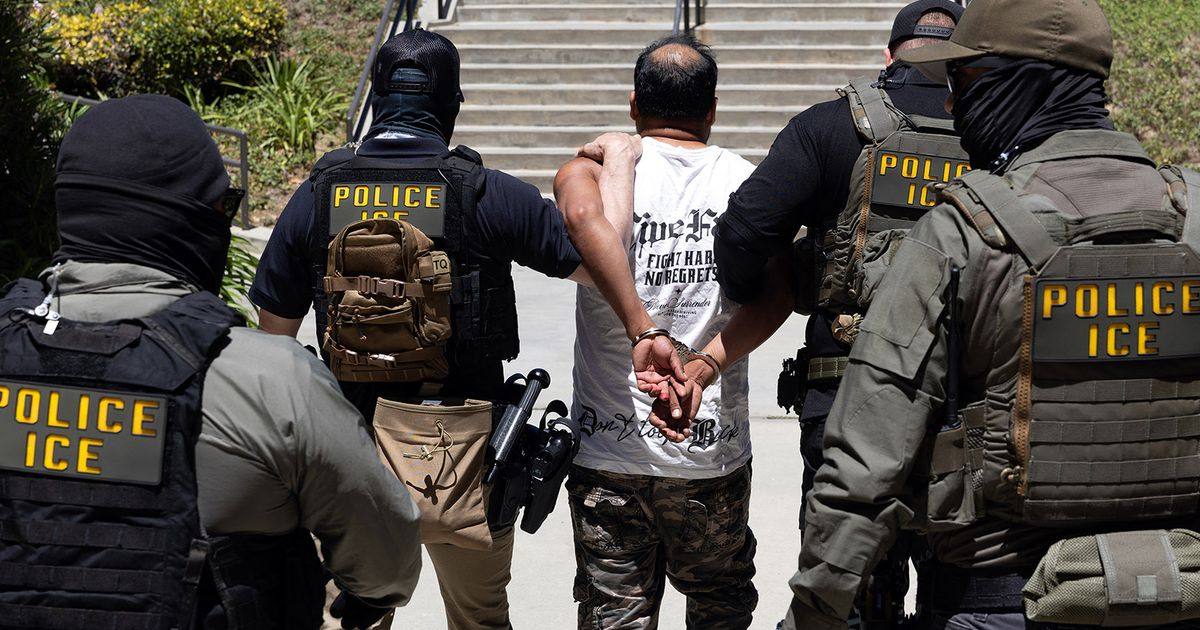
The Department of Homeland Security (DHS) announced on Friday, November 20, that U.S. Immigration and Customs Enforcement (ICE) arrested five people with serious criminal convictions on November 19, in Texas, North Carolina, Connecticut, Ohio and New Jersey. The arrests were publicised as the latest round of the department's 'Worst of the Worst' campaign, which highlights selected ICE cases involving people the department describes as public safety threats.
The five arrests
In Amarillo, Texas, DHS said ICE arrested Castulo Garay-Silva, a Mexican national convicted of aggravated sexual assault on a child. In Mecklenburg County, North Carolina, officers arrested Jose Rodas-Hernandez, a Salvadoran national convicted of second-degree exploitation of a minor. No further details of the underlying cases, including the dates of the convictions or the sentences imposed, were given in the announcement.
In Hartford, Connecticut, the department said ICE arrested Inpone Phothirath, a national of Laos convicted of first-degree assault, resisting arrest and possession of narcotics. In Chillicothe, Ohio, officers arrested Boos Corona-Aguilar, a Mexican national convicted of trafficking in heroin and trafficking in cocaine. In Newark, New Jersey, the fifth arrest was Franklin Javier Mejia, a Honduran national convicted of racketeering conspiracy.
What the announcement does not say
The announcement did not state whether any of the five people had already been deported, and it did not say whether any of them had a final order of removal. It gave no sentences for the underlying convictions, no immigration status for each person, no length of detention and no next court dates. An ICE arrest in a case like this is an immigration-enforcement action, not a new criminal prosecution for the offence listed by DHS: the convictions cited are the underlying criminal records the department used to explain why it highlighted these individuals.
The 'Worst of the Worst' campaign
DHS runs the 'Worst of the Worst' campaign as a public-information effort, directing the public to its WOW.DHS.Gov page for more cases. It has publicised similar batches of arrests through the autumn, including rounds in October and earlier in November, each naming a small number of people with convictions for violent, sexual or drug-related offences. The five arrests announced on November 20 are selected examples, not a statistical report: they do not show how many immigration arrests ICE made across the country on November 19.
The announcement comes against the record enforcement totals DHS reported for fiscal year 2026, which ended on September 30. ICE carried out 483,200 deportations and made more than 491,000 immigration arrests in the year, the highest totals in the agency's 23-year history, according to DHS. Homeland Security Secretary Markwayne Mullin said the department would continue enforcing immigration laws against people it identifies as serious public-safety threats.
What happens next
After an arrest, ICE's Enforcement and Removal Operations division can detain a person under immigration authority while the government determines whether the person can be removed from the United States. The government may pursue removal proceedings, carry out an existing final removal order, or take another action authorised under immigration law. The timing depends on custody decisions, court proceedings, appeals, travel-document issues and whether another agency has an active criminal matter involving the person. A detained person may still have immigration proceedings, appeals or other legal steps available under federal law.
Do not assume a public announcement means the person has already been deported. Families should verify the person's full name, date of birth, country of birth and any immigration identification number through ICE's official detainee-information tools, or contact an immigration attorney who can review the custody records and immigration court documents.
For the Punjabi diaspora and other immigrant communities, the campaign is a reminder of how the current enforcement drive works in practice: DHS is publicising arrests of people with serious criminal convictions, while the wider totals — nearly half a million arrests and more than 483,000 deportations in a single fiscal year — show the scale of enforcement behind the individual announcements. Anyone with questions about a specific case should rely on the official detainee locator or an immigration lawyer, not on a press release, because the announcement alone does not settle a person's legal position.
Sources: U.S. Department of Homeland Security announcement, November 20, 2026, as reported by Immigration News United States; DHS, 'ICE Breaks Records in Fiscal Year 2026,' November 12, 2026.
Source: Immigration News United States