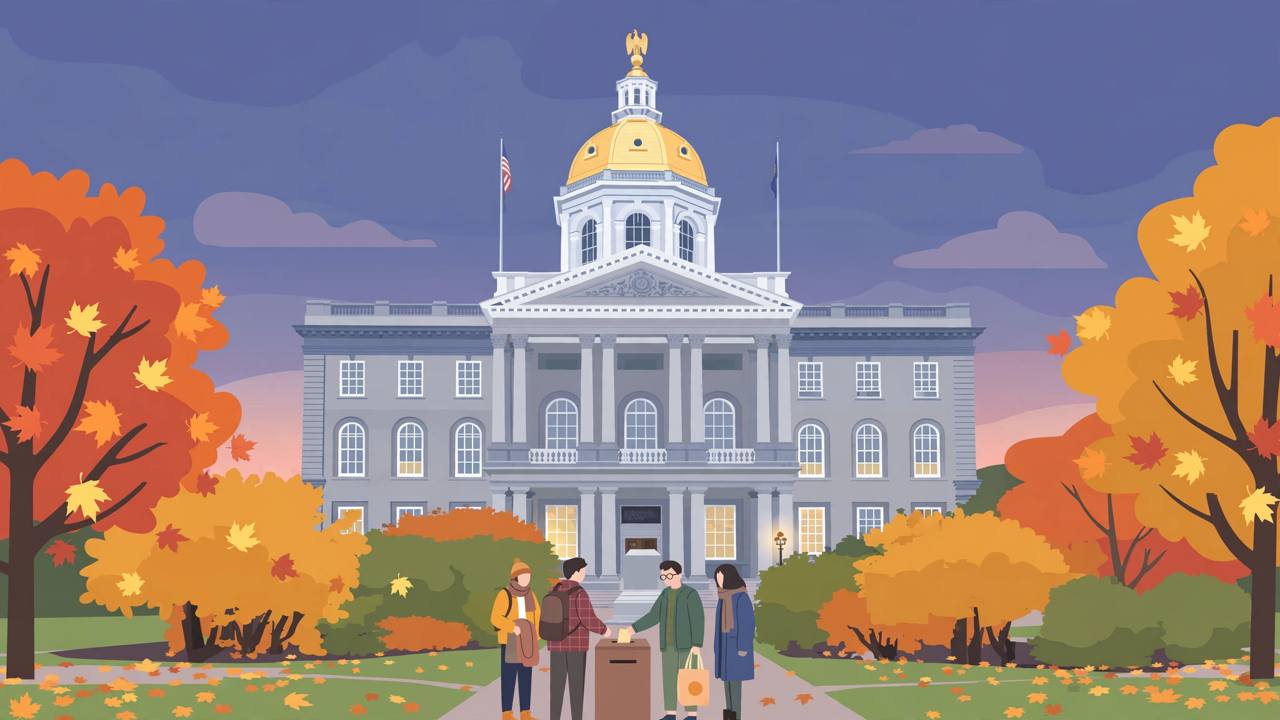
CONCORD, New Hampshire — Republican Governor Kelly Ayotte has won re-election in New Hampshire, defeating Democratic challenger Cinde Warmington in one of the closest governor's races in the country on Tuesday, November 3. The Associated Press called the race for Ayotte at 12:45 a.m. on Wednesday, with about 85 percent of the vote counted, making New Hampshire one of the clearest Republican holds on a night when Democrats won control of both chambers of Congress nationally.
Source: Associated Press
The numbers show how tight the contest stayed until the end. Decision Desk HQ's count, in a snapshot at 3:51 a.m. Eastern on November 4, put Ayotte at 300,370 votes, or 50.88 percent, against 281,070 votes, or 47.61 percent, for Warmington, with Libertarian Stephen Villee at 8,890 votes, or 1.51 percent — a total of 590,330 votes counted, with about 91 percent of the expected vote in. The margin between the two leading candidates was 19,300 votes. The AP's own running count listed Ayotte at 299,637 votes, with 276 of the state's 318 precincts reporting, or 86.79 percent, and an estimated 90.11 percent of the vote counted. These are unofficial counts; a race call is a projection by a news organisation's decision desk, and the official result comes only when the state certifies its totals in the coming weeks.
Source: Decision Desk HQ
A victory party that waited for the count
Ayotte spent election night with supporters at a victory party at Tuscan Village in Salem, New Hampshire, according to local reporting by the Ink Link. She took the stage before the race was called and, although she did not yet claim victory, told the crowd they were very optimistic — but that she wanted to wait until every vote was counted before declaring victory. Minutes after the AP call, New Hampshire Republican State Committee Chairman Scott Maltzie released a statement saying: “Governor Kelly Ayotte has secured a second term in the corner office, and we couldn't be more excited.”
Source: Nashua Ink Link
The Republican Governors Association also claimed the result as a verdict on Ayotte's first term. RGA Chair Governor Greg Gianforte said: “Congratulations to Governor Kelly Ayotte on her reelection victory. Granite Staters made the right choice to keep New Hampshire on the path of low taxes, safe communities, and greater opportunity.” He added: “Tonight's result is a vote of confidence in her leadership and the great work still ahead.”
Source: Republican Governors Association
Background: a senator and attorney general in the corner office
Ayotte, a former U.S. senator and former New Hampshire attorney general, first won the governorship in 2024 and took office in 2025. New Hampshire is one of only two states where governors serve two-year terms, so she faced the voters again after barely two years. In the September 8, 2026 primaries, she won the Republican nomination almost unopposed, with 100,920 votes, or 91.9 percent, while Warmington — a former member of the state's Executive Council who had lost a Democratic primary for governor in 2024 — won the Democratic nomination with 126,223 votes, or 96.4 percent. Forecasters had the race leaning Republican but competitive: the Cook Political Report rated it Likely R on October 29, and Decision Desk HQ rated it Lean R on November 2.
Source: 2026 New Hampshire gubernatorial election
The result fits a long New Hampshire pattern of split decisions. The state has voted Democratic in every presidential election since 2004, yet voters have repeatedly chosen Republican governors in recent cycles, and Tuesday was no exception: on the same ballot, Democrat Chris Pappas was elected to the U.S. Senate from New Hampshire and Democrat Maggie Goodlander won re-election in the state's 2nd Congressional District. In 2024, Ayotte had outperformed Donald Trump in the state, winning her race by 9 points while he lost New Hampshire by 3 — a personal vote that appears to have carried her through a much harder national night for her party.
Governor's races decide who runs state government for the next term — state taxes, state police and highways, and how federal programmes are carried out on the ground. New Hampshire's hold also shows the limits of the Democratic wave: in a small, closely watched state, a personally popular incumbent governor survived even as her party lost Congress, because voters separated the state race from the national one.
What happens next
Ayotte will be sworn in for a second two-year term, and attention now turns to her second-term agenda and to the state legislature she will work with. The vote totals remain unofficial until the state completes its canvass and certification, and the remaining uncounted ballots will settle the final published margin. For Warmington and the Democrats, the narrow 3.9-point loss — in a state their party wins at the presidential level — renews a familiar question: how to turn federal strength in New Hampshire into a win for the corner office, something Democrats have not managed in a governor's race since the Republican run began in 2016.