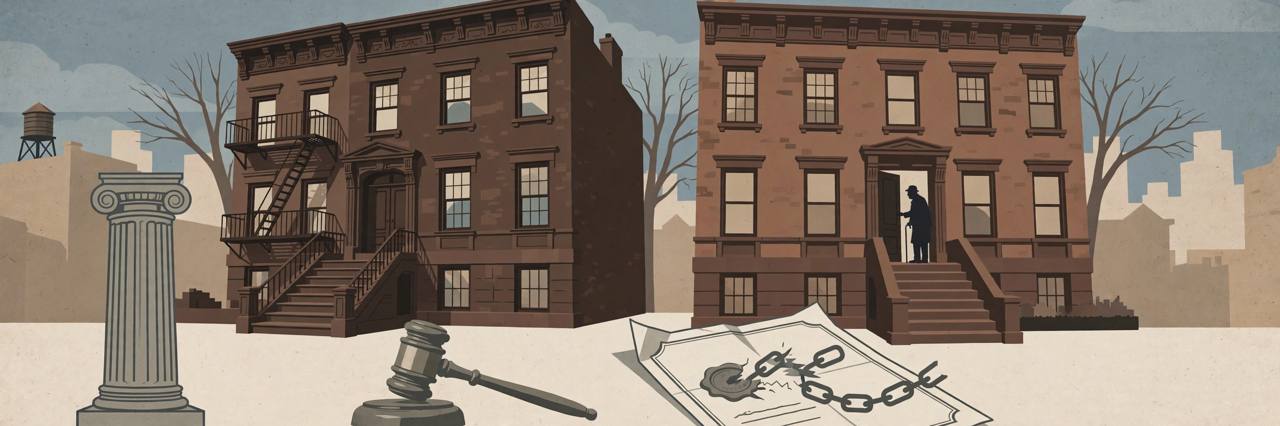
Joseph Makhani, 63, of Kings Point, Long Island, has been sentenced to seven to 21 years in prison for stealing two Harlem brownstones worth approximately $4.7 million, in a deed theft case the New York Attorney General's office prosecuted over several years. New York State Supreme Court Judge Michele Rodney imposed the sentence after a jury convicted Makhani earlier this year.
Source: The Real Deal
The sentence is made up of separate terms for each building. Judge Rodney sentenced Makhani to four to 12 years for the theft of 107 West 118th Street and three to nine years for the theft of 135 West 131st Street, with the two terms to run consecutively — one after the other. A further term of one and one-third to four years for scheme to defraud runs at the same time as the others, giving a combined total of seven to 21 years, according to the Attorney General's statement on the sentencing.
Source: New York Attorney General statement via EIN Presswire
How the West 118th Street theft worked
Beginning in 2012, Makhani used false documents and shell companies to steal the deed of the brownstone at 107 West 118th Street from an elderly homeowner, according to prosecutors. The Attorney General's office said the rightful owner was forced to live in a homeless shelter for years as a result of the theft, while Makhani took control of a home that was never his.
Prosecutors said Makhani falsely reported that he had paid $975,000 for the West 118th Street property. On the strength of that claim he received a $650,000 construction loan for renovations, and he later refinanced and received a $1.2 million long-term mortgage loan on the property, according to the Attorney General's office. Between 2016 and 2023 he also rented out four units in the building for between $3,000 and $3,400 per month, after receiving approval from the New York City Department of Housing Preservation and Development to convert the home into market-rate rentals.
The West 131st Street deed
Makhani also targeted 135 West 131st Street, where the last genuine deed on record dated from 1975, according to the Attorney General. He took advantage of a beneficiary's death in 2010 and approached one of the building's tenants around 2012, falsely claiming he had purchased the brownstone. Prosecutors said he secured the tenant's signature by pretending to offer him a job, then recreated that signature on a fraudulent deed that unlawfully transferred the property to One 35 West Corp., a company Makhani controlled.
Indictments, a seven-week trial and a 90-minute verdict
The Attorney General's office indicted Makhani in 2021 and again in July 2023 over the two Harlem properties. The case came to trial in July 2026 and lasted seven weeks. The jury found Makhani guilty of two counts of Criminal Possession of Stolen Property in the First Degree and one count of Scheme to Defraud in the First Degree — and it reached that verdict after just 90 minutes of deliberation. He was remanded into custody to await sentencing.
"Makhani's heartless deed theft operation caused years of chaos for tenants and left the rightful owner of a valuable Harlem brownstone homeless. This case sends a clear message to anyone who attempts to steal a home in New York: we will not rest until you are held accountable for your crimes."
A record stretching back decades
Reporting on the case noted that Makhani's schemes stretch back decades. In 1999, he and his brother Kamran Makhani pleaded guilty for their roles in a scheme involving foreclosed properties in Queens; they were fined and sentenced to three months in prison. Nine years later, companies in which Joseph Makhani was a principal pleaded guilty in State Supreme Court to filing false deeds as part of a housing scam in Queens and were fined $5,000 each. Neither episode stopped the conduct that led to the Harlem prosecution.
What happens next
Makhani must pay $500,000 in restitution to Flushing Bank by May 7, 2027. The court will also hold a later hearing to determine whether to vacate the deeds and mortgage that were recorded against the 107 West 118th Street property — the step that decides how the building's paperwork is finally unwound. After his conviction, Makhani's lawyer said he was innocent of the charges and that the defence expected to win on appeal.
Deed theft works on paper, not by force: a forged or fraudulently obtained deed is filed with the city, and the true owner may not learn what has happened until a loan is taken against the home, tenants are told to pay a new landlord, or eviction papers arrive. The Attorney General's office urges New Yorkers who believe they may be a victim of deed theft to call 1 (800) 771-7755 or file a confidential complaint with the office. For immigrant and diaspora families in New York — including Punjabi families in Queens and the wider city who hold homes bought over decades of work — officials say the practical defences are unglamorous but effective: watch for missing mail about your property, check your deed record if a stranger claims an interest in your home, and treat any request to sign property papers for an unrelated favour, such as a job offer, as a warning sign. That is exactly the approach prosecutors said was used on a tenant at West 131st Street.