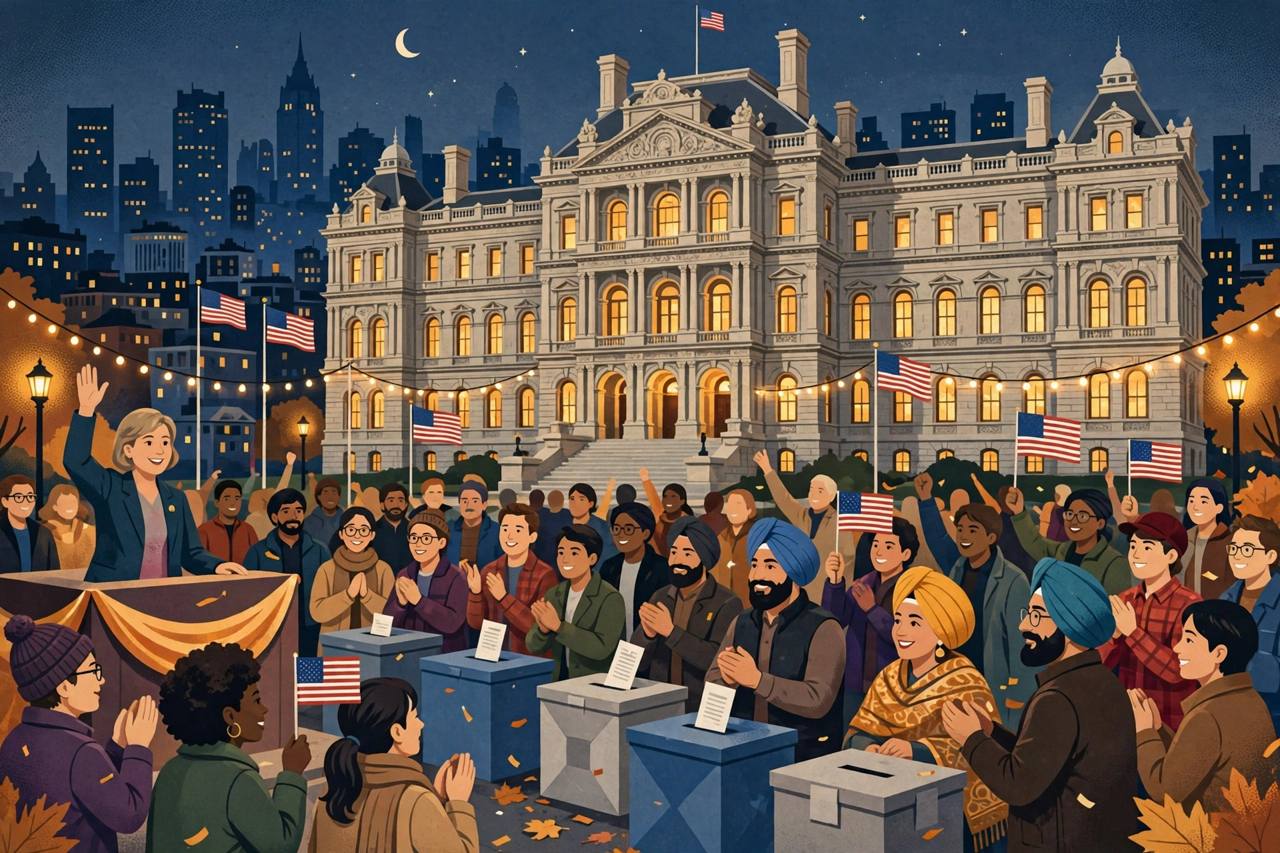
Democratic Governor Kathy Hochul won re-election in New York on Tuesday night, November 3, 2026, defeating Republican Bruce Blakeman, the Nassau County executive, to secure a second full four-year term as governor of the state. The Associated Press called the race on election night, and NBC News also projected Hochul the winner, as returns from across the state made the outcome clear well before counting finished.
Source: Associated Press
The numbers behind the call were decisive. In the Associated Press tally at the time of the call, Hochul had 1,548,187 votes to Blakeman's 637,837 — a lead of more than 910,000 votes, roughly 71 per cent to 29 per cent of the votes counted at that stage — with 4,270 of the state's 13,268 precincts reporting, about 32 per cent of the total. A margin that large, that early, left the decision desks no doubt about where the remaining votes would land.
Source: Associated Press
From Cuomo's successor to a two-term governor
Hochul's path to this night began in crisis. She first took office on August 24, 2021, stepping up from lieutenant governor after Andrew Cuomo resigned, and then won her first full term in the 2022 election. Tuesday's result makes her a two-full-term governor in her own right — no longer governing in anyone's shadow, and now holding a fresh four-year mandate that begins in January and runs through the end of 2030.
Source: The Real Deal
Blakeman ran as the Republican and Conservative nominee, with Todd Hood as his running mate, on a campaign built around crime and lower taxes, and carrying the endorsement of President Donald Trump. Hochul, for her part, framed the election as a referendum on Blakeman's ties to Trump and on the impact of federal policy on New York, and campaigned alongside New York City Mayor Zohran Mamdani on tenant-friendly positions. The final Siena College poll, released October 28, had put Hochul ahead 54 per cent to 40 per cent among likely voters, and for the first time a majority of voters — 51 to 45 per cent — viewed her favourably; a separate Marist poll had her ahead 53 to 42.
Source: Siena Research Institute
The geography of the win — and the issues underneath it
New York races are won and lost in three different states at once: New York City, the suburbs, and upstate. Pre-election polling showed the map clearly — the city breaking heavily for Hochul, upstate leaning toward Blakeman, and suburban voters closely divided, with independents the softest spot in the governor's coalition. What voters said mattered most was not ideology but the cost of staying alive in New York: Quinnipiac polling put the cost of living first at 28 per cent, followed by the economy at 21 per cent and health care at 11 per cent. Polls were open from 6 a.m. to 9 p.m. on Tuesday, and Hochul herself had cast an early ballot in Buffalo before campaigning in Rochester and Syracuse.
Source: Associated Press
Hochul is expected to sustain or expand her 'build, baby, build' housing strategy in the new term, after reforms in her first full term aimed at New York's long-running housing shortage. The size of her final margin will shape how hard she can push that agenda in Albany.
What it means for Punjabi and Indian-American readers
New York is one of the great diaspora states — home to large Punjabi and Indian-American communities in New York City, Long Island, the Hudson Valley and upstate cities, and to thousands of Punjabi truckers who run the state's freight corridors, including Interstate 90 across upstate, I-87 between the city and Albany, and I-95 through the city. A governor decides state taxes, road and bridge spending, commercial-driver policy enforcement at state level, and how Albany deals with Washington on immigration and trade — all questions that land directly on those families and businesses. Hochul also governs a state currently managing a measles emergency she declared in October, a reminder that Albany's public-health decisions reach every county, including rural ones far from the city.
What happens next
Counting continues in all 62 counties, including mail and early ballots, and the results will be certified through New York's normal county and state canvass in the coming weeks; a lead above 900,000 votes leaves the outcome itself in no doubt. Hochul's second full term begins in January. The questions that follow are Albany questions: the state budget, the housing push, and how a re-elected Democratic governor negotiates with a Trump White House whose policies she made the centrepiece of her campaign.